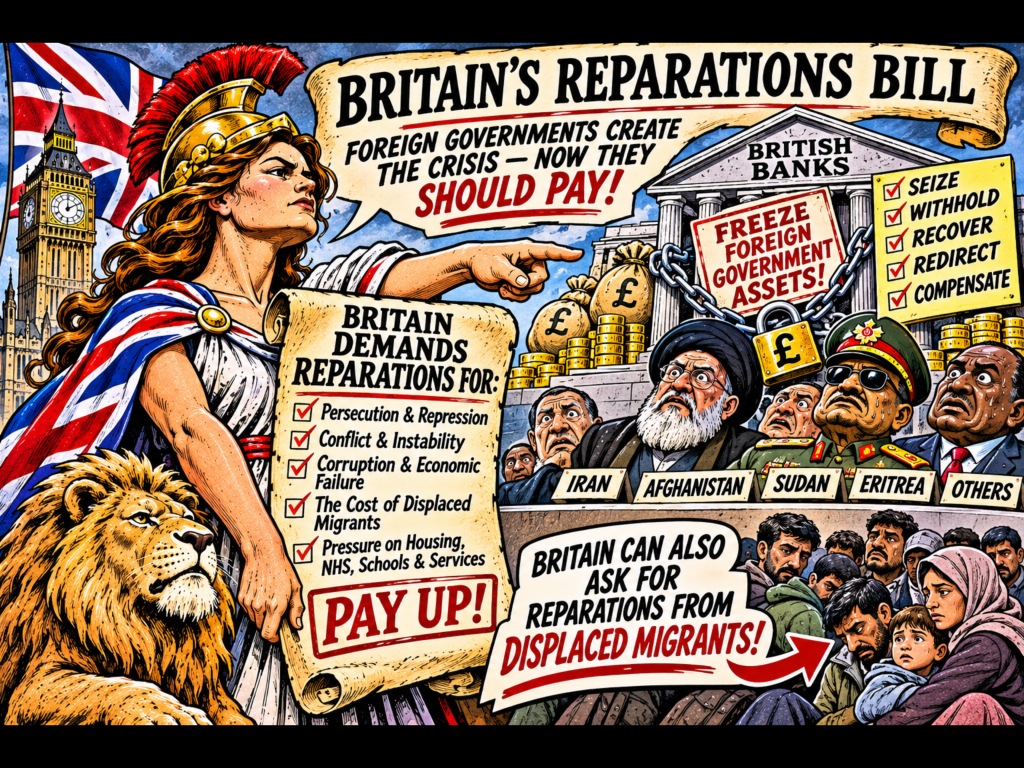
When governments persecute their citizens, tolerate corruption, wreck their economies or contribute to mass displacement, the consequences frequently extend far beyond their borders.
Britain receives people fleeing these conditions and bears substantial asylum and accommodation costs.
But why should governments responsible for creating displacement escape financial accountability while receiving countries deal with the consequences? ⚖️
💷 Dear Foreign Governments, Britain Wants the Accounts Opened!
From authoritarian repression in Iran and Eritrea to conflict and political instability in Afghanistan and Sudan, people leave countries where governance, security and human rights have broken down.
Responsibility differs between countries and individual authorities. But where state wrongdoing can be established, financial accountability should be examined.
If political leaders have assets in British financial institutions, should those assets be investigated and, where legally justified, frozen?
🏦 Billions in British Banks — Could the Money Be Withheld?
Britain already operates financial sanctions allowing assets belonging to designated individuals and organisations to be frozen.
In October 2026, the UK Government confirmed that £37 billion in frozen assets had been reported in the latest published annual review. That figure covers multiple sanctions regimes, not simply countries associated with migration.
The crucial distinction is that freezing assets prevents their use; it does not automatically transfer ownership or permit the Treasury to spend them.
Could Parliament establish additional lawful routes for confiscating proven criminal proceeds or using assets linked to established wrongdoing to fund compensation?
⚖️ Government Responsibility Should Have Financial Consequences
Where rulers or state institutions are responsible for persecution, serious human rights violations or unlawful displacement, financial consequences could include targeted sanctions, asset recovery, international compensation agreements and court-ordered remedies.
But payments must follow evidence and legal process, rather than simply freezing the property of anyone from a particular country.
The focus should be the governments and officials responsible for wrongdoing — not the people escaping it.
🧾 Britain’s Reparations Demand: Follow the Money!
An independent international accountability proposal could examine:
- Freeze eligible assets belonging to sanctioned officials and state-linked entities responsible for established wrongdoing.
- Investigate foreign-held wealth and recover corruption proceeds through lawful proceedings.
- Withhold appropriate state-level funding or financial benefits where permitted by sanctions and international obligations.
- Create a compensation mechanism allowing legally recovered funds to support victims and demonstrable costs borne by receiving countries.
- Demand international accountability, including transparent assessments of responsibility, financial loss and enforcement.
Any scheme would need to protect humanitarian assistance, legitimate property rights and the interests of innocent civilians.
There is currently no automatic legal entitlement for Britain to charge foreign governments for every citizen who emigrates or claims asylum.
But that does not prevent a debate about stronger international financial remedies when governments are proven responsible for forced displacement.
⚖️ If Governments Create the Crisis, Should Their Assets Help Meet the Costs?
The central question is whether international law should provide stronger mechanisms for holding governments financially accountable for serious wrongdoing that drives people from their homes.
Britain’s financial institutions should not be a safe haven for proven proceeds of corruption or assets connected to sanctioned officials.
And where legally recoverable funds exist, their use for compensation and humanitarian recovery deserves serious consideration.
Financial accountability should reach those responsible for wrongdoing — not stop at the borders of the countries dealing with its consequences.
🔥 Challenges: Should Britain Freeze Foreign Government Assets?
Should Britain seek stronger powers to freeze, recover and redirect assets connected to governments and officials found responsible for serious abuses?
Should legally recovered money compensate affected British communities, support refugees, rebuild countries of origin — or be shared between those purposes?
💬 COMMENT on the Chameleon News blog. 👍 LIKE and 🔄 SHARE to join the debate.
🏆 The best comments will feature in the next issue of Chameleon News Magazine!
🇬🇧 If governments are financially accountable for their actions, who should receive the compensation?


Leave a Reply