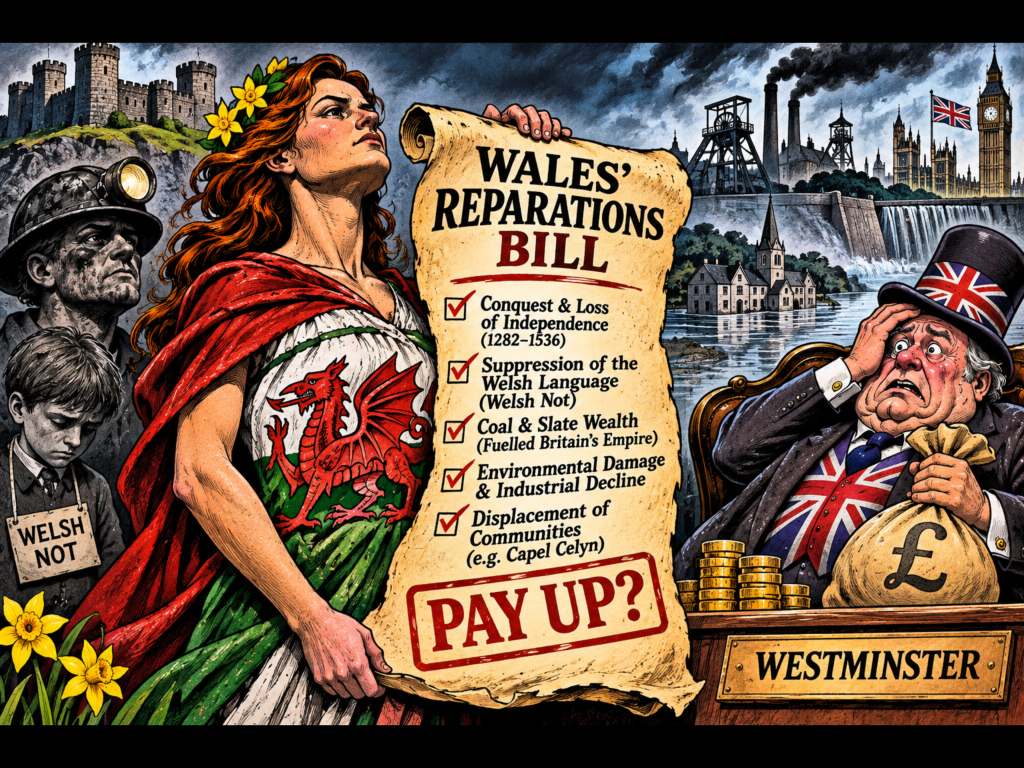
For centuries, Wales endured military conquest, loss of political independence, cultural suppression and economic upheaval under English and later British rule.
From Edward I’s invasion to the punishment of Welsh-speaking children and the industrial exploitation of coal and slate, Wales contributed enormously to Britain’s wealth.
If historical injustices justify reparations elsewhere, should Wales demand the same consideration? ⚖️
💷 Westminster, Wales Wants the Accounts Opened!
In 1282, Edward I conquered the principal Welsh territories, and the Statute of Rhuddlan in 1284 imposed English royal authority. The Laws in Wales Acts of the sixteenth century subsequently integrated Wales into England’s legal and administrative system.
Wales lost its independent political institutions. Should that historical loss form part of a national reckoning?
🗣️ The Welsh Language: Punished for Speaking Your Own Tongue
During the nineteenth century, some Welsh schoolchildren were punished for speaking Welsh, sometimes through the humiliating Welsh Not.
English-language dominance in education contributed to cultural pressures, although historians debate the extent to which individual practices caused the language’s decline.
Can financial compensation restore generations of cultural damage, or should reparations fund Welsh-language education and revival?
⛏️ Coal, Slate and the Wealth of Britain
Welsh coal powered industry and transport, while Welsh slate roofed buildings across Britain and beyond.
Industrial development brought employment and infrastructure, but also dangerous working conditions, environmental damage and wealth distributed unevenly between workers, landowners and investors.
When industries declined, many communities faced lasting economic hardship.
If Welsh resources helped build Britain’s prosperity, should the financial benefits and long-term costs be independently examined?
💧 The Drowned Village: Capel Celyn
In 1965, the village of Capel Celyn in the Tryweryn valley was flooded to create a reservoir supplying Liverpool.
Despite substantial Welsh opposition, the project proceeded under legislation passed at Westminster.
The destruction became a powerful symbol of Welsh communities having limited control over decisions affecting their land.
Should communities displaced by major public projects receive lasting recognition and appropriate redress?
🧾 Wales’s Reparations Demand: What’s Owed?
An independent inquiry could examine:
- Historical conquest and the loss of Welsh political institutions.
- Language suppression and investment in cultural restoration.
- Coal and slate wealth and the distribution of industrial profits.
- Environmental damage and regeneration of former industrial communities.
- Displacement and constitutional accountability, including cases such as Capel Celyn.
Reparations could mean investment, restitution, cultural funding, formal acknowledgement or compensation for demonstrable harm.
There is no automatic legal entitlement to a national payment for centuries of history. Any claim would need evidence of loss, legal responsibility and realistic remedies.
Nor should modern English citizens be personally blamed for historical decisions.
⚖️ Seven Centuries Later — Should Britain Settle the Bill?
Wales has its own devolved Parliament today, but many constitutional and financial powers remain at Westminster.
Wales also benefited from aspects of industrialisation and shared British institutions, making a fair historical accounting more complicated than simply adding up the value of exported coal.
The question is what wealth was created, who benefited, what damage remains and whether meaningful redress is justified.
If Britain believes historical injustice deserves examination, should Wales’s experience be judged by the same standards?
🔥 Challenges: Does Britain Owe Wales Reparations?
Should Wales seek financial compensation, industrial regeneration, greater control over natural resources, Welsh-language investment or a formal acknowledgement of historical injustice?


Leave a Reply