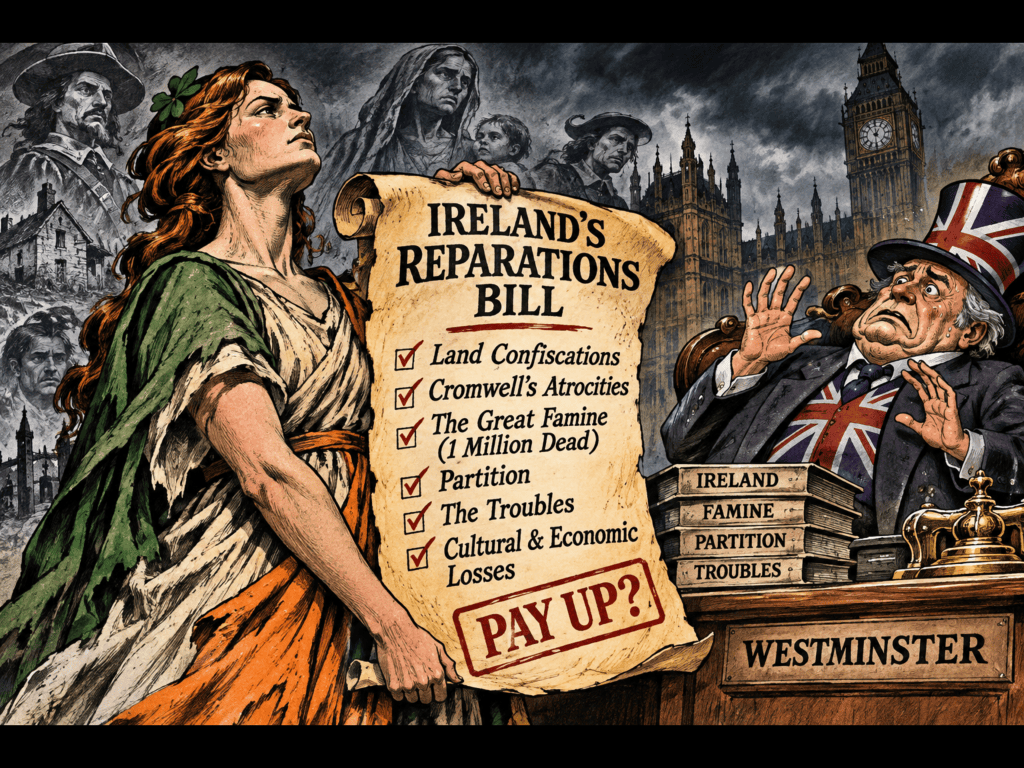
For centuries, Ireland endured conquest, land confiscation, religious persecution, economic exploitation and British political control.
From Cromwell’s massacres to the Great Famine, partition and the Troubles, the human and economic consequences were immense.
If historical injustices justify reparations elsewhere, should Ireland demand the same consideration? ⚖️
💷 Westminster, Ireland Wants the Accounts Opened!
English intervention began in 1169, followed by centuries of conquest and resistance. Plantations transferred Irish land to settlers, while Cromwell’s seventeenth-century campaigns brought massacres, confiscations and widespread suffering.
🥀 The Great Famine: A Million Dead
Between 1845 and 1852, approximately one million people died and mass emigration transformed Ireland. Potato blight caused the crop failure, but inadequate British relief policies and continuing evictions compounded the disaster.
Should those government decisions carry historical responsibility?
⛓️ Partition and the Troubles
In 1922, most of Ireland gained independence, while Northern Ireland remained within the UK. Partition created divisions that remain politically contested.
The Troubles subsequently claimed thousands of lives. Bloody Sunday in 1972 exposed serious wrongdoing by British soldiers, for which Prime Minister David Cameron apologised in 2010.
For victims and families, apologies cannot replace truth, justice or appropriate compensation.
🧾 Ireland’s Reparations Demand: What’s Owed?
An independent inquiry could investigate:
- Land confiscations and possible restitution.
- Famine policies and historical accountability.
- Economic losses from colonial rule.
- Troubles victims and compensation for proven wrongdoing.
- Cultural restoration, including Irish-language and community investment.
Reparations could involve money, acknowledgement, restitution or targeted investment. However, historical suffering does not automatically establish a legally enforceable financial claim.
This isn’t about blaming ordinary British people. It’s about examining the responsibility of historical governments and institutions.
⚖️ Eight Centuries Later — Should Britain Settle the Bill?
Ireland cannot recover the lives lost, communities destroyed or generations displaced.
But an honest accounting could establish what was taken, what losses can be demonstrated and whether meaningful redress is justified.
If Britain believes in historical accountability, should Ireland’s experience be examined by the same standards?
🔥 Challenges: Does Britain Owe Ireland Reparations?
Should Ireland seek financial compensation, land restitution, cultural investment or a formal apology? Or should historical reconciliation take another form?


Leave a Reply