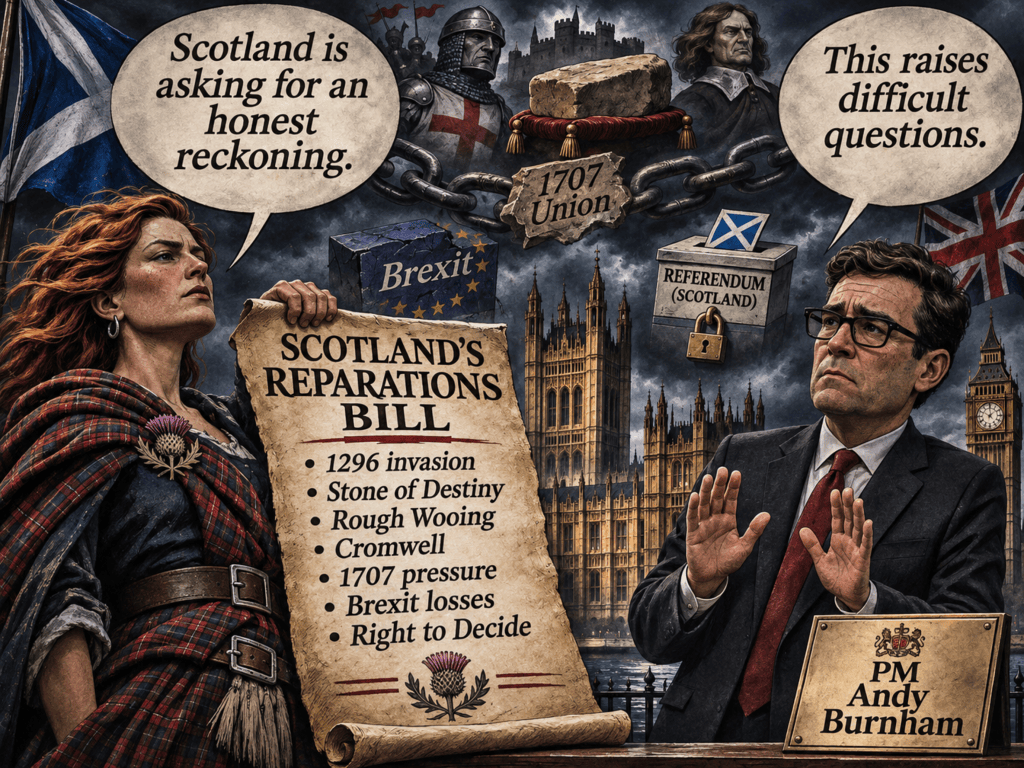
For centuries, Scotland has faced English invasions, military occupation, economic pressure and political control. From Edward I stealing the Stone of Destiny in 1296 to Westminster retaining the power to block another independence referendum, one uncomfortable question remains: if Scotland is an equal partner in the United Kingdom, why can’t it independently decide whether to leave?
And here’s another: after centuries of historical injustice, should Scotland demand reparations? ⚖️
💷 Dear Westminster, Scotland Would Like an Itemised Bill!
Edward I invaded Scotland, removed its king and seized the Stone of Destiny. Scotland fought back through Wallace, Bruce and generations determined to defend their sovereignty.
Henry VIII followed with the devastating Rough Wooing, while Cromwell’s armies conquered Scotland in the seventeenth century and imposed political incorporation backed by military power.
Then came the Union of 1707. Scotland’s failed Darien scheme had damaged its economy, England threatened trade restrictions, and financial incentives helped secure parliamentary agreement. Scotland’s Parliament voted for Union, but ordinary Scots had no referendum.
Scotland also participated in and profited from the British Empire, including its exploitation and slavery. Scottish landlords were deeply involved in the Highland Clearances, which displaced communities and devastated Highland culture. Any honest examination of reparations must acknowledge those responsibilities too.
But acknowledging Scotland’s own historical wrongdoing doesn’t erase injustices committed against Scotland.
The question is simple: who suffered, who benefited, what losses can be demonstrated, and should any of those losses now be addressed?
🇪🇺 Brexit: Scotland Voted Remain — And Left Anyway
In 2014, Scotland voted 55.3% to remain in the UK, partly amid warnings that independence could threaten EU membership.
Two years later, Scotland voted 62% to remain in Europe, with majorities in all 32 council areas. Yet Brexit removed Scotland from the EU in January 2020 because the UK-wide electorate voted Leave.
The decision was lawful, but Scotland’s democratic preference was overridden by the UK-wide result.
Should Scotland now demand an independent assessment of Brexit’s economic consequences and whether any financial or constitutional redress is justified?
⚖️ An Equal Partnership — With Westminster Holding the Exit Key?
In 2022, the Supreme Court ruled that Scotland’s Parliament could not independently legislate for an independence referendum, even an advisory one, because the matter falls outside its devolved powers.
So Scotland can elect representatives supporting another referendum, but Westminster retains the authority needed to make it happen.
Union supporters argue that constitutional decisions belong to the UK as a whole. Independence supporters argue that a nation should have the democratic right to reconsider its future.
But what kind of voluntary partnership has no guaranteed democratic process for one partner to reconsider membership?
🧾 Scotland’s Reparations Demand: Open the Books!
Scotland should consider formally requesting an independent historical, legal and economic inquiry into the consequences of conquest, coercive political arrangements, dispossession, Westminster decision-making and Brexit.
That investigation should consider five demands:
- Historical accountability for identifiable injustices, confiscation, displacement and economic harm.
- An independent financial audit examining demonstrable losses, shared benefits and the consequences of UK government decisions.
- A legal assessment of reparations, separating enforceable claims from moral and political arguments.
- Targeted compensation or investment, where justified, for communities affected by historical dispossession and cultural damage.
- A clear constitutional right to seek another referendum, through an agreed, lawful and democratic process.
This isn’t about demanding an imaginary trillion-pound cheque or blaming ordinary English people. The modern constitutional claim would be addressed to the UK Government, while historical responsibility must be established according to the evidence.
Nor is Scotland automatically legally entitled to compensation simply because historical wrongs occurred. A credible reparations claim would need evidence, proper attribution of responsibility and realistic remedies.
But reparations aren’t necessarily just about money. They can mean recognition, restitution, rebuilding communities and correcting unequal arrangements.
Perhaps the greatest compensation would be a guaranteed democratic mechanism allowing Scotland to determine its constitutional future.
Because after centuries of being told how much Scotland benefits from the Union, surely asking to inspect the complete accounts isn’t unreasonable.
Although Westminster might suddenly discover that 700 years of paperwork has been misplaced behind a filing cabinet marked Nothing to See Here. 📂💸
🔥 Challenges: Should Scotland Finally Send Westminster the Bill?
If Scotland can demonstrate historical injustices, measurable economic losses or continuing constitutional disadvantages, should the UK Government negotiate reparations?
Should that mean financial compensation, investment in Highland communities, greater economic autonomy, democratic reform — or all four?
And how should Scotland account for its own role in the British Empire and the benefits it received from the Union?
👇 Have your say in the Chameleon News blog comments!
💬 COMMENT — Should Scotland formally request reparations?
👍 LIKE if you believe Scotland deserves a full historical and financial accounting.
🔄 SHARE and challenge others to explain what a fair settlement should look like.
🏆 The best comments and sharpest arguments will feature in the next issue of Chameleon News Magazine!
🏴 Scotland isn’t asking history to be rewritten. It’s asking whether the accounts should finally be settled.


Leave a Reply