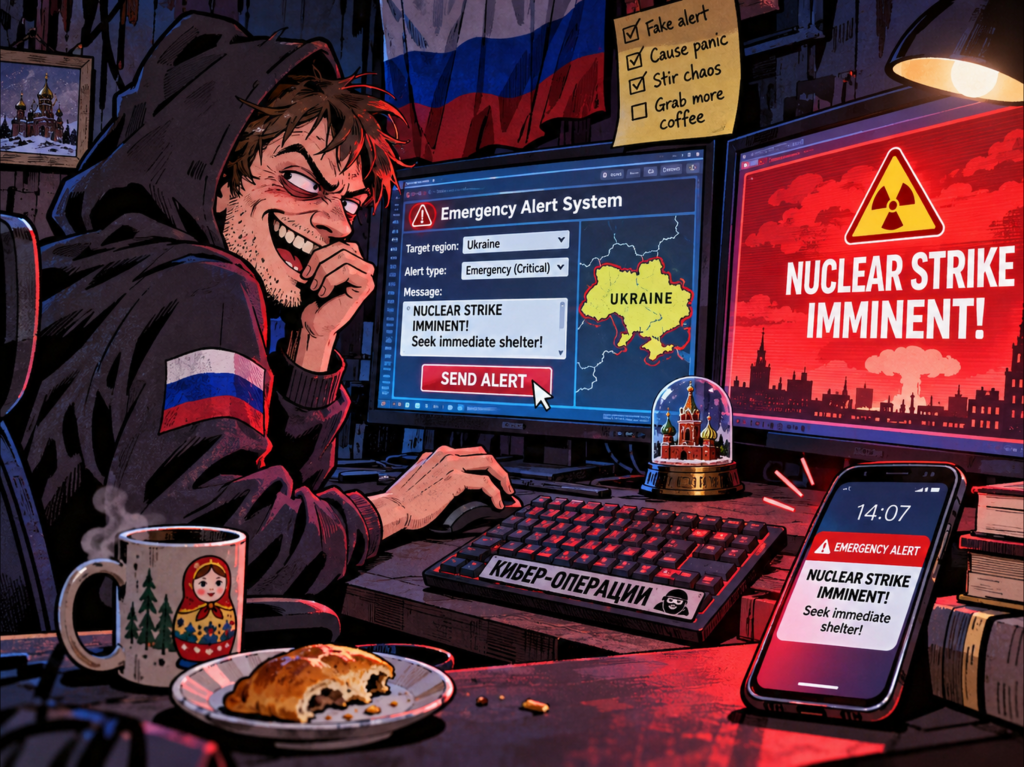
Imagine living in a country already battered by years of war, where every air-raid siren could mean the difference between life and death. Then, at 10.48pm, your phone announces that a Russian nuclear missile is on its way. Welcome to 21st-century psychological warfare, where apparently even the apocalypse comes with push notifications.
On Sunday, 1 November 2026, Ukraine’s Air Alert app was compromised, sending millions of users false warnings about radiation, a nuclear strike, chemical weapons and street fighting in Kyiv. Ukrainian authorities confirmed there was no radiation threat. Russia was blamed by Ukrainian officials, although responsibility for the breach has not been independently established.
🚨 Congratulations! You’ve Been Selected for the Nuclear Apocalypse — Please Rate Your Experience! ⭐
Once upon a time, starting a nuclear war required missiles, military commanders and a terrifying amount of political brinkmanship.
Now, apparently, all you need is a compromised app and someone with the digital maturity of a teenager changing the school computer wallpaper.
Four alarming messages appeared within minutes. Radiation! Nuclear missiles! Chemical weapons! Street fighting!
Good grief. That’s not an emergency notification system. That’s the entire disaster section of Netflix arriving before bedtime. 🍿
One particularly bizarre warning referenced Russia’s Oreshnik missile while casually telling people not to worry.
Don’t worry? DON’T WORRY?!
That’s like receiving a message from your airline saying: “Good evening, passengers. Both engines have fallen off. Please enjoy the complimentary peanuts.” ✈️🥜
And this is where the joke stops being funny.
For Ukrainians who have spent years dealing with genuine missile strikes, destroyed homes and nights in shelters, these weren’t harmless little digital tricks. They were messages arriving through a system people depend upon to survive.
Imagine being a parent, grabbing your children, searching for medication, wondering whether you have minutes left to live, only to discover somebody has apparently turned a national safety system into a grotesque practical joke.
Whoever carried out the attack wasn’t merely spreading misinformation. They were interfering with the very mechanism people use to distinguish genuine danger from fabricated terror.
And the consequences could extend far beyond one frightening evening.
Because what happens when tomorrow’s warning is genuine?
Will people react immediately? Or will some hesitate, wondering whether another keyboard warrior has decided to play Nuclear Bingo? 🎰☢️
That’s the particularly poisonous achievement of attacking an emergency warning system: even after the fake messages disappear, the doubt can remain.
In an almost surreal twist, Russian authorities also reported that their own emergency notification app had been compromised, producing further false warnings. It remains unclear whether the incidents were connected.
Apparently, the digital battlefield now has enough fake nuclear alerts to make the Cold War look like an era of reassuringly straightforward communication.
We have smartphones capable of identifying our faces, tracking our footsteps and recommending seventeen brands of yoghurt based on our shopping habits.
Yet protecting an emergency alert from malicious interference remains a matter of life-or-death cybersecurity.
Humanity has developed artificial intelligence, reusable rockets and self-driving cars, but we’re still capable of turning the end of civilisation into a notification with a cheerful greeting. 🤖💀
The real scandal isn’t just the false alarm. It’s the vulnerability of systems that millions of frightened people have no choice but to trust.
And if whoever did this thinks terrifying civilians is clever, perhaps their next technical achievement could involve developing something genuinely useful.
Like an app that alerts the world whenever someone is about to confuse cruelty with comedy. 📱


Leave a Reply