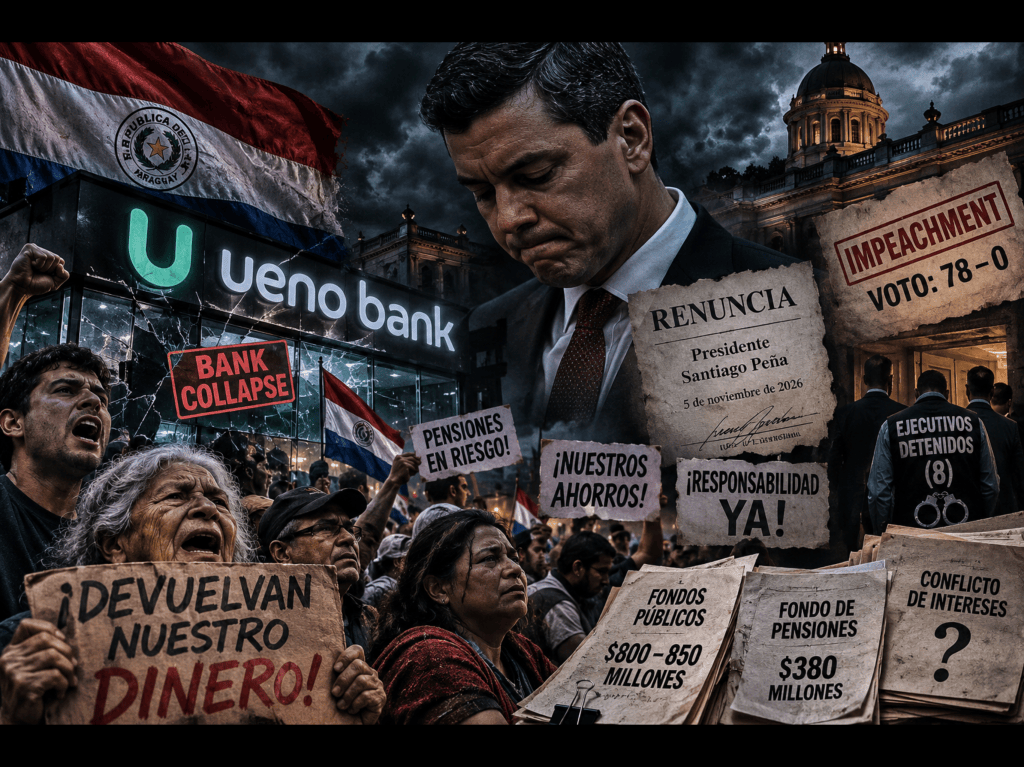
Before anyone in Britain, Europe or America starts watching Paraguay’s banking catastrophe with the comfortable smugness of someone observing a house fire three streets away, there’s an uncomfortable truth worth remembering.
We are all far closer to this nightmare than most people would like to believe. 😳💸
Think about it.
Your wages arrive electronically. Your pension exists largely as numbers on a screen. Your savings sit inside institutions you probably couldn’t explain, supervised by regulators whose names you may never have heard.
And your entire financial life depends on one rather optimistic assumption:
That when you press the button marked “Transfer”, the money will actually move.
We call that financial security.
But sometimes it’s really just confidence wearing a very expensive suit. 👔🏦
Modern banking operates on trust, liquidity, regulation and the expectation that everyone won’t demand their money simultaneously.
Banks don’t keep every pound, dollar or euro deposited with them sitting in a giant vault waiting for its owner. They lend, invest and manage those funds within rules designed to keep the system functioning.
That’s normal banking.
But when confidence disappears, even sophisticated financial arrangements can suddenly become frighteningly fragile.
Remember Northern Rock in 2007? Remember the financial crash of 2008? Remember Silicon Valley Bank in 2023?
Different institutions. Different circumstances. Different regulatory failures.
But the same chilling reminder:
A bank can look perfectly respectable right up until the moment everyone starts asking where the money is. 💥
And while deposit protection schemes in countries such as Britain provide important safeguards, they are not magical emergency cash machines. Protection limits, eligibility rules and the time required to return money still matter.
A protected deposit is reassuring.
A protected deposit you cannot immediately access when the mortgage is due is considerably less comforting.
🏦 The Cashless Trap: Convenience Until Someone Pulls the Plug
We’ve spent years being encouraged to abandon cash, embrace digital banking, automate our bills and trust increasingly interconnected financial systems.
Wonderful!
Until an app stops working, an account gets frozen or a bank enters resolution.
Suddenly, the society that told you cash was outdated expects you to survive on an apologetic notification and a customer service chatbot called Oliver.
“Your money is important to us.”
Fantastic, Oliver.
Unfortunately, Tesco doesn’t accept reassurance as payment. 🛒🤖
None of this means every bank is about to collapse, or that Paraguay’s crisis will spread around the world. Most banks operate under substantial capital, liquidity and supervisory requirements.
But it does mean that access to money is just as important as the numbers appearing on a balance sheet.
And perhaps we should be asking some rather awkward questions.
How concentrated are our savings? How independent are our regulators? How quickly could deposit protection actually help? And what happens when the digital systems we rely on suddenly stop cooperating?
Because the frightening thing about financial disaster isn’t always that your money has vanished forever.
Sometimes it’s that your money is still technically yours — but you can’t use a penny of it.


Leave a Reply