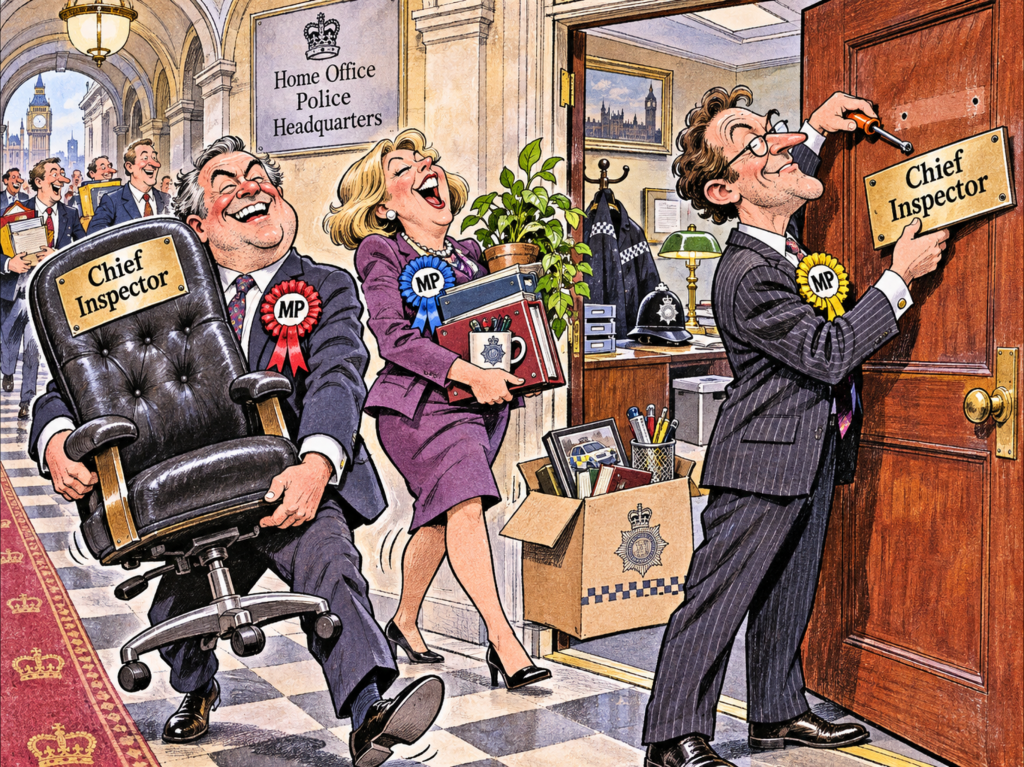
Britain has 43 territorial police forces across England and Wales, each with its own leadership structure, headquarters and administrative machinery. Meanwhile, the public wants something considerably less complicated: police officers who turn up, criminals who get caught, and streets that feel safe.
In January 2026, the Government published proposals to dramatically reduce the number of forces, arguing that duplicated management, procurement, technology and support functions waste money that could be invested in policing.
Greater Manchester’s Chief Constable, Sir Stephen Watson, backed the idea of reducing 43 forces to nine in October, calling substantial reform essential to tackling increasingly sophisticated crime. But opponents fear enormous regional forces could weaken local policing and accountability.
So here’s the million-pound question — possibly several million once consultants have finished billing us: are we maintaining 43 police forces because the public needs them, or because too many senior people have become comfortable running them? 🤔
🏰 The Thin Blue Empire: Too Many Chiefs, Not Enough Boots on the Beat?
Imagine running a national supermarket chain with 43 separate head offices, 43 executive structures, 43 purchasing arrangements and a small army of managers explaining why their particular brand of paperclips is operationally essential.
You’d be laughed out of the boardroom.
But in policing, apparently, that’s called tradition. 👑
Every time someone suggests consolidation, the alarm bells ring. Local identity! Community accountability! Operational independence!
All perfectly reasonable concerns.
But here’s another concern: how many taxpayers are funding overlapping management structures while wondering when they last saw a police officer walking down their street?
And let’s not pretend every person working behind a desk is a bureaucratic ornament. Intelligence analysts, investigators, safeguarding specialists and evidence-processing staff are vital. The police cannot solve crimes using flashing blue lights and enthusiasm alone.
The question is whether we genuinely need 43 separate organisational pyramids to support them.
Sir Stephen Watson appears willing to challenge the existing structure. Others are understandably nervous about creating regional policing giants.
Perhaps some genuinely fear losing local accountability.
Perhaps others fear losing local authority.
And perhaps a few are looking at the proposed restructuring and wondering whether the executive parking space, impressive title and corner office might be heading for the same fate as the fax machine. 📠
The public deserves to know where legitimate operational concerns end and institutional self-preservation begins.
Then there’s Scotland.
In 2013, eight territorial forces were combined into Police Scotland. The merger offered opportunities to consolidate specialist services and management, although centralisation also raised concerns about local accountability.
So the answer isn’t automatically to replace 43 bureaucracies with nine enormous ones, each equipped with an executive board, a communications empire and a consultant hired to explain why the printer still doesn’t work.
That would be less police reform and more bureaucratic Russian dolls. Open one management structure and discover another six inside. 🪆
And spare us the grand announcements about efficiency savings unless somebody can show exactly where the savings will go.
Will they deliver more neighbourhood officers? Faster emergency responses? Better investigations? Higher crime detection rates?
Or simply fund another restructuring programme with a glossy logo and an expensive PowerPoint presentation?
Here’s a radical suggestion: judge police reform by the policing the public receives, not the number of senior executives attending meetings about delivering it.
Because criminals don’t care whether there are 43 chief constables or nine.
They care whether there’s a reasonable chance of getting caught.
And so, rather more importantly, do their victims.


Leave a Reply