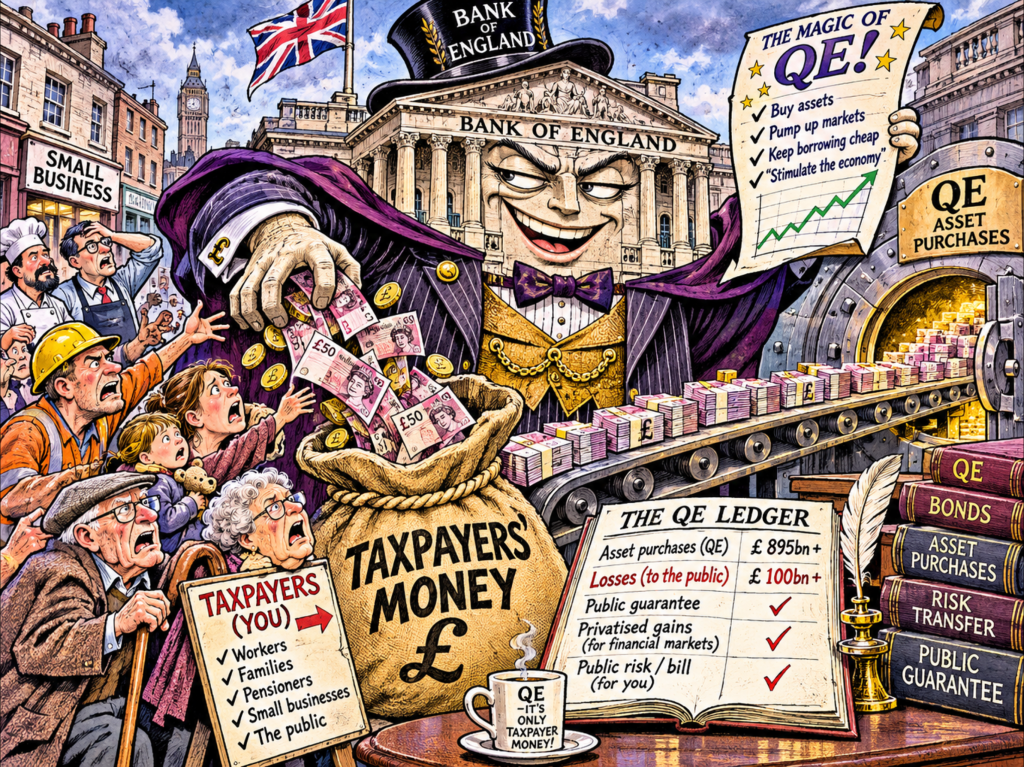
Imagine going into a casino with £100 billion that isn’t yours.
If you win, the Government takes the winnings. If you lose, the taxpayer picks up the bill.
Sounds ridiculous, doesn’t it?
Well, that’s not a bad way of describing some of the financial risks behind the Bank of England’s money-printing programme, known as Quantitative Easing (QE).
💰 So what actually happened?
When Britain was facing financial trouble, the Bank of England created money electronically and used it to buy hundreds of billions of pounds’ worth of government debt.
The idea was to keep borrowing costs down, support businesses and stop the economy collapsing.
Fair enough. Something had to be done.
But there was a catch.
When interest rates went up, the Bank started paying out far more interest on the money it had created. It also faced losses when selling some of the government bonds it had bought.
And guess who guarantees those losses?
That’s right. The Treasury — which means Britain’s public finances.
💸 How much money are we talking about?
According to figures given to Parliament in September 2026:
- 💷 £123.85 billion had previously been paid to the Treasury from the programme.
- 💸 £110.72 billion had since been paid back to cover losses.
- ✅ That left the Treasury £13.13 billion ahead on those payments at that point.
But here’s the problem.
More losses are coming.
The Institute for Fiscal Studies estimated that the Treasury would need to pay around £19 billion in 2026–27 alone to cover further losses.
That is money the Government must find while telling the rest of us that public finances are under pressure.
🏦 So who’s responsible?
The Bank of England makes its own decisions about interest rates and monetary policy.
The Treasury stands behind the financial risks.
And ordinary people are left wondering how hundreds of billions of pounds can be moved around without anyone clearly explaining what the final bill might be.
Now, to be fair, QE was introduced to help prevent serious economic damage. It may have saved jobs, businesses and livelihoods.
But that doesn’t mean we shouldn’t question how it was managed or what it will ultimately cost.
🔥 Here’s what I want to know!
Why weren’t the long-term financial risks explained more clearly?
Why does Parliament not subject these enormous financial commitments to more public scrutiny?
Could the Bank of England have reduced the losses by managing the programme differently?
And if the Government can find billions to cover these losses, why is it constantly telling pensioners, workers and struggling families that money is tight?
Nobody is suggesting we should have allowed the economy to collapse.
But protecting the economy shouldn’t mean handing the taxpayer a bill that nobody fully understands.
🦎 The Chameleon News Verdict
When you or I make a bad financial decision, we pay for it.
When the Bank of England makes decisions involving hundreds of billions, the Treasury guarantees the financial outcome.
The Bank may have had good reasons for what it did. But the British public deserves to know whether those decisions were worth the cost.
Because £17 billion isn’t just a number on a spreadsheet. It’s an enormous sum of public money.
And taxpayers have every right to ask where their money is going.
💬 What do you think?
Should Parliament investigate the Bank of England’s QE programme and publish a clear account of what it has cost — and what benefits it delivered?
Or is this simply the price Britain had to pay to protect its economy?
👇 COMMENT on Chameleon News and have your say!
👍 LIKE if you believe taxpayers deserve answers.
🔁 SHARE if you think Parliament should be asking tougher questions.
🏆 The best comments will feature in the next issue of Chameleon News magazine! 🦎📰


Leave a Reply