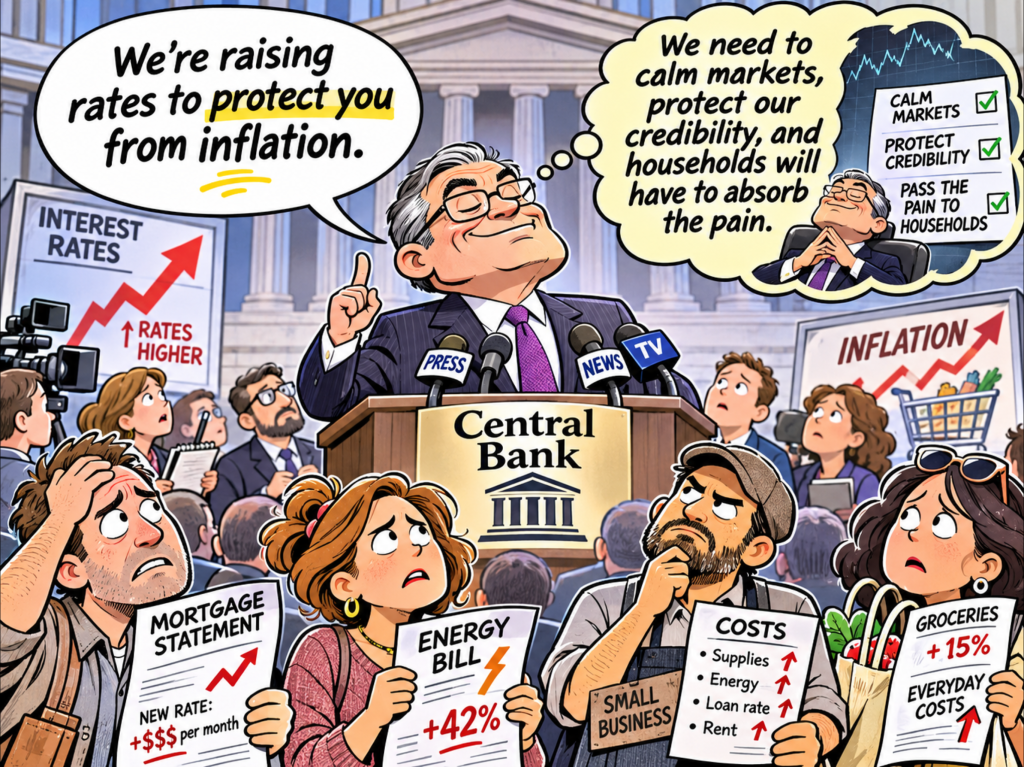
Welcome to the wonderful world of British economics, where the solution to expensive petrol is apparently an expensive mortgage.
Oil prices rising because of international conflict? Raise interest rates.
Gas prices going through the roof? Raise interest rates.
Businesses struggling with energy bills? Raise interest rates.
Families unable to afford the weekly shop? Congratulations! Your borrowing costs may be going up too.
It’s like calling a plumber because your kitchen is flooding, only for him to arrive, turn off your electricity and announce that he’s successfully reduced demand for water. 🚰💥
Of course, the Bank has a legitimate argument. Higher interest rates can reduce spending and borrowing, helping prevent an energy shock from turning into persistent inflation.
But that doesn’t make the consequences painless, or guarantee that monetary policy is the right answer to every inflationary problem.
And this economic circus has several acts.
💰 Act One: The Great Quantitative Easing Vanishing Trick
Remember quantitative easing? The programme where the Bank bought enormous quantities of government bonds to support the economy?
Well, now comes quantitative tightening, where those holdings are gradually reduced.
The Bank is effectively reversing part of its earlier intervention, returning more government debt to private ownership through sales and maturing bonds.
That matters because private investors must absorb the supply, while also deciding what interest rates they require to lend to the Government.
But here’s the twist: the Government is already spending substantial sums servicing its debt.
And while quantitative tightening and rising interest rates operate through different mechanisms, both can contribute to tighter financial conditions.
It’s rather like selling the family silver to help pay the electricity bill, only to discover that the buyer wants to charge you interest for borrowing the cutlery back. 🍴
🔮 Act Two: The Crystal Ball That Keeps Sending the Bill to Everyone Else
Central banking involves forecasting.
Unfortunately, predicting inflation has recently demonstrated all the reliability of a British summer barbecue forecast.
The Bank has faced criticism over previous inflation forecasts. Now it is particularly concerned about what might happen next.
It is acting partly because it fears that higher energy prices could become embedded in wages and other prices.
In other words, the Bank is increasing borrowing costs partly to prevent inflation that hasn’t fully materialised.
Imagine your insurance company increasing your premium because it suspects you might crash your car next year.
You haven’t crashed.
You haven’t even started the engine.
But apparently your financial punishment is already due. 🚗💸
📈 Act Three: The Economy Is Stronger Than Expected — Quick, Punish It!
Here’s another delicious contradiction.
Britain’s economy has performed better than the Bank anticipated.
Normally, that sounds encouraging.
But in the upside-down kingdom of monetary policy, economic resilience can provide another reason to increase interest rates.
The Bank worries that stronger demand could allow inflationary pressures to persist.
So businesses managing to survive difficult conditions may now face higher financing costs.
It’s the economic equivalent of watching a patient recover, then increasing the medication because they’re looking suspiciously healthy.
⛽ Act Four: Fighting International Oil Prices With a British Mortgage
And here we arrive at the centrepiece of this financial pantomime.
Global energy prices have surged.
Oil and gas markets can be affected by international conflict, supply disruptions and geopolitical uncertainty.
But here’s something worth remembering:
The Bank of England cannot print oil, manufacture natural gas or end an international conflict by changing its interest rate.
What it can do is make borrowing more expensive, cool domestic spending and reduce the risk that higher energy costs spread throughout the economy.
That is the economic rationale.
But it also means asking households and businesses to absorb another financial squeeze while the original energy shock remains beyond their control.
Your gas bill goes up because international energy supplies are disrupted.
Your mortgage becomes more expensive because the Bank fears your gas bill might push up inflation.
And your wages?
Well, we’d better not let those rise too quickly, because apparently that could make matters worse.
Welcome to Britain, where your disposable income is treated like a suspicious luxury. 🥶
🏛️ Act Five: Westminster Meets the Interest Bill From Hell
Higher interest rates also have implications for the public finances, although the precise effect depends on debt maturities, inflation-linked borrowing and wider financial conditions.
The Government must balance public spending, taxation and the cost of financing its debts.
Meanwhile, businesses must finance investment, homeowners face refinancing pressures and renters can feel the consequences when landlords’ costs rise.
And hovering over everything is the risk of stagflation: weak economic growth combined with stubbornly high inflation.
That’s the economic equivalent of ordering a meal, discovering it’s cold, being charged extra to reheat it and then being told the restaurant has run out of electricity. 🍽️⚡
The Bank’s defenders will rightly point out that failing to contain inflation could ultimately be even more damaging, especially for lower-income households.
But critics have an equally important question:
How much economic pain is justified to prevent inflation driven substantially by overseas energy prices?
That is a debate worth having.
Because while the Bank’s inflation target is 2%, the people experiencing its decisions are not percentages on a spreadsheet.
They’re households, pensioners, employees, small businesses and people already calculating whether they can afford to turn the heating on.
And no beautifully presented monetary policy report can make that reality disappear.
🔥 Challenges: Is This Inflation Control — or an Economic Squeeze Disguised as Stability? 🔥
Here’s the question Westminster, the Bank of England and the British public should be debating.
If inflation is being driven substantially by global energy shocks, how much can higher domestic interest rates realistically achieve?
And if the Bank gets its judgement wrong, who carries the consequences?


Leave a Reply