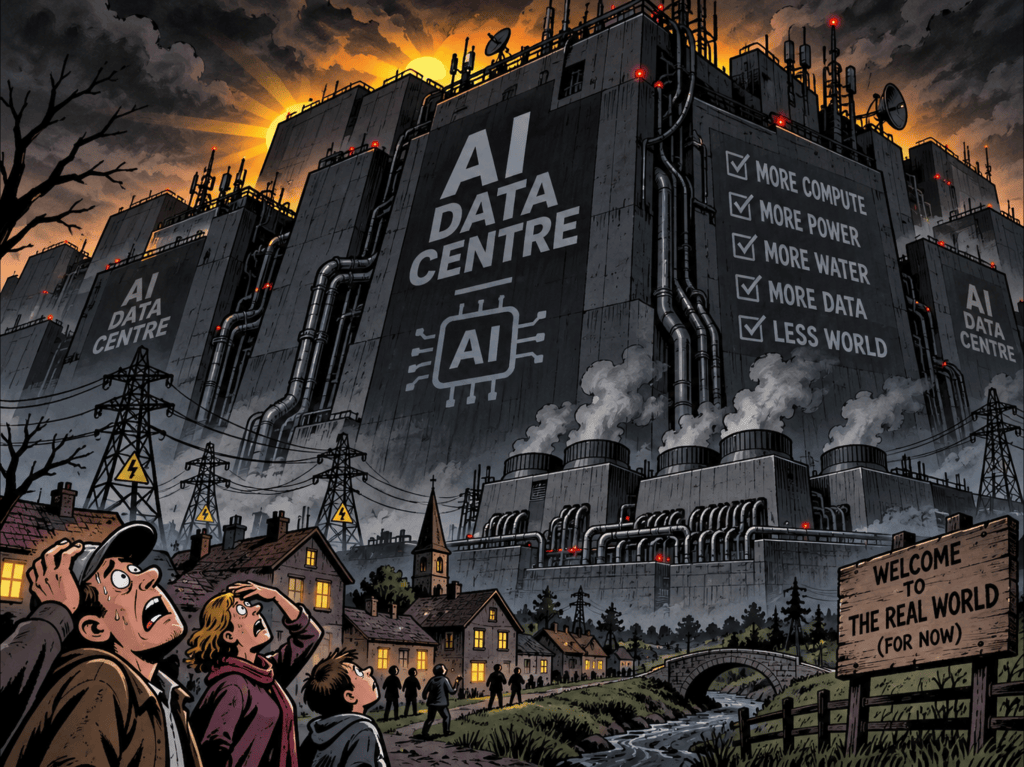
The FTSE 100 has been caught in the global AI sell-off, Wall Street’s technology darlings are suddenly looking rather less golden, and investors are discovering something extraordinary: apparently, promising to revolutionise the entire planet doesn’t automatically guarantee a profitable business.
But there’s another storm gathering, and this one isn’t confined to the stock markets. Public anger over gigantic, electricity-guzzling, water-hungry data centres is growing, raising an uncomfortable question: is the supposedly clean, intelligent future turning into an environmental nightmare?
Well, we always knew that when the trumpets stop blowing, the money stops flowing. And now the people paying the environmental price are starting to ask who invited the orchestra in the first place. 🎺💰
🤡 Artificial Intelligence, Artificial Valuations and an Environmental Hangover! 🌍🔥
For years, Silicon Valley’s technology evangelists have been preaching the gospel of artificial intelligence as though they’d personally discovered electricity, gravity and the meaning of life.
Mention AI in a boardroom and investors practically threw money at you.
Profits? Don’t be vulgar.
Environmental consequences? We’ll discuss those in 2050.
Electricity bills? Someone else’s problem.
Water consumption? Plenty of that on the planet, apparently!
And now, with stock markets wobbling and valuations under pressure, the trillion-dollar question is becoming harder to avoid.
What happens when the hype becomes more expensive than the benefits?
Because behind those wonderfully clever chatbots and futuristic promises sits an industrial operation of astonishing proportions.
Not magic. Not digital fairy dust.
Concrete. Steel. Cooling systems. Vast electricity supplies. Water. And an increasingly uncomfortable relationship with fossil fuels.
🏭 Data Centres: The New Oil Rigs Wearing Environmentally Friendly Hats! 🛢️💻
Here’s where the comedy becomes particularly dark.
For decades, we’ve been told to worry about oil rigs, fossil fuels and their environmental consequences.
And quite rightly.
But now we’re constructing enormous data centres that can require tremendous amounts of electricity, substantial cooling infrastructure and, depending on their design, vast quantities of water.
The International Energy Agency projects that worldwide data-centre electricity consumption could almost double from 485 terawatt-hours in 2025 to 950 terawatt-hours by 2030.
That’s quite an appetite for an industry that keeps promising to make everything more efficient! ⚡
And when those facilities depend on electricity generated using gas or coal, the environmental costs don’t disappear simply because somebody sticks the words Artificial Intelligence above the entrance.
Let’s be clear: data centres aren’t demonstrably worse for the environment than drilling for oil across the board. Oil extraction and burning fossil fuels have enormous climate consequences of their own.
But the comparison exposes an uncomfortable irony.
We’ve spent years condemning dirty industrial expansion, only to embrace another resource-intensive building boom because this time the machinery can write poetry and generate pictures of cats wearing spacesuits. 🐱🚀
And the public is beginning to notice.
Environmental campaigners and local communities are raising concerns about electricity use, water supplies, infrastructure demands and the pace of data-centre development.
Apparently, local communities aren’t universally delighted by the prospect of enormous industrial computing facilities appearing nearby while technology companies promise that everything will be wonderful.
Who knew?
The AI revolution promised to save humanity from inefficiency. Nobody mentioned it might need its own power station and a rather generous water supply to do it! 💧⚡
And consider the financial absurdity.
Technology companies are spending extraordinary sums building infrastructure for AI, while investors are starting to question whether the returns will justify the expense.
Billions upon billions are being poured into a technological arms race, yet the public is expected to applaud politely and refrain from asking awkward questions.
Questions like:
Who pays for upgrading the electricity grid?
Who gets priority when water supplies are under pressure?
Who benefits financially?
And who deals with the environmental consequences if the investment bubble bursts?
Because a failed AI investment can be written off in an accountant’s spreadsheet.
A damaged environment isn’t quite so easy to delete with the press of a button.
💰 Wall Street Gets the Champagne, Everyone Else Gets the Electricity Bill! 🥂
And there’s the real punchline.
Ordinary households are told to conserve energy, reduce waste, watch their consumption and make sacrifices for the planet.
Meanwhile, the technology industry is racing to build enormous computing complexes to power increasingly sophisticated artificial intelligence.
Yes, AI offers genuine benefits in medicine, scientific research, energy management and countless other fields.
But technological progress doesn’t automatically give corporations a free pass on environmental responsibility.
And neither does it mean every data centre is a sensible investment.
The same financial establishment that sold investors the AI dream is now discovering that even revolutionary technology has to obey the rather old-fashioned laws of economics.
You cannot sustain an investment boom indefinitely on enthusiasm, expensive computer chips and PowerPoint presentations featuring the word “transformational.”
Eventually, somebody wants to see a return.
And somebody else wants to know why the local electricity grid needs upgrading.
It’s almost as though artificial intelligence has encountered something its promoters temporarily forgot existed.
The real world. 🌎
🔥 Challenges: Is AI Progress, or the Biggest Greenwashing Opportunity in History? 🔥
Here’s the question that deserves to be debated long after the stock markets have finished their latest nervous breakdown.
Are we witnessing a genuine technological revolution, or another speculative gold rush that risks leaving communities with the environmental bill?
And why should ordinary people be expected to reduce their environmental footprints while some of the world’s richest corporations rapidly expand resource-intensive infrastructure?
Is the growing backlash against data centres justified? Should companies have to prove their environmental sustainability and economic benefits before receiving approval to build?
Or will AI eventually deliver enough scientific, economic and environmental benefits to justify the resources it consumes?
💬 We want your verdict in the blog comments — not just on Facebook! Tell us whether the AI revolution is worth its environmental costs or whether we’ve simply swapped the oil derrick for a server rack and called it progress.
👇 COMMENT, LIKE and SHARE! 🎺🔥🌍
Because when the trumpets stop blowing, the money stops flowing — but the electricity meters keep spinning, the cooling systems keep running, and somebody still has to pay the bill.
🏆 The best comments, sharpest observations and most entertaining responses will be featured in the next issue of the magazine! 🦎📰


Leave a Reply