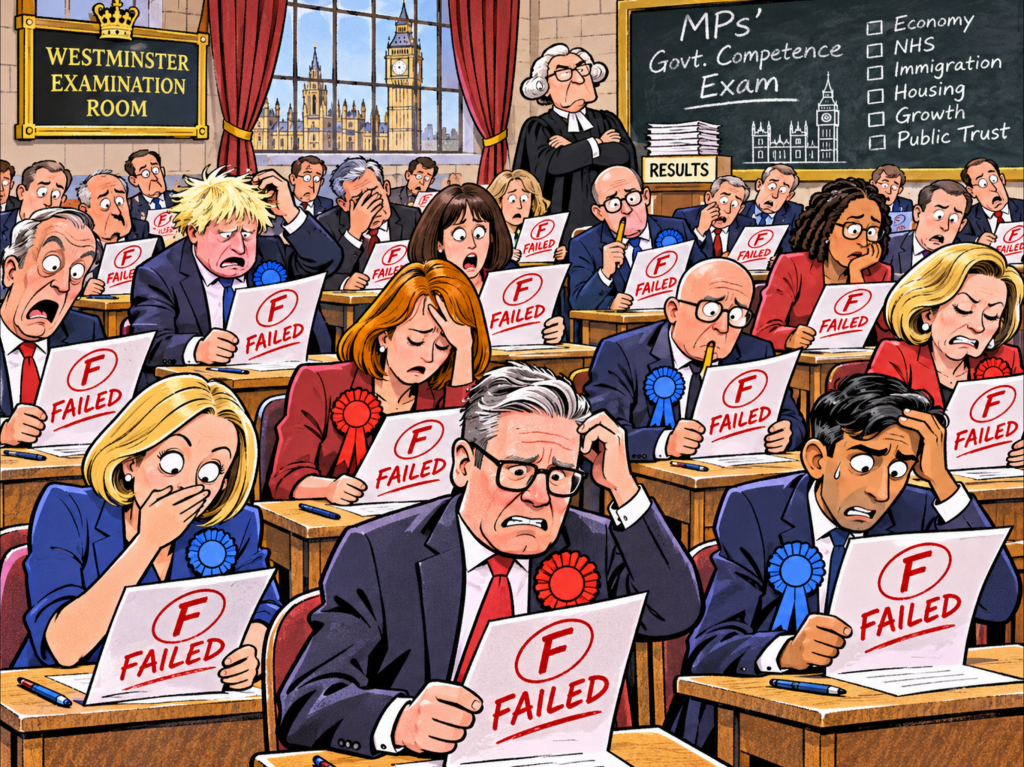
Imagine applying for a job where you help decide how billions of pounds are spent, influence the future of the NHS, shape education, oversee national defence and make decisions affecting millions of lives.
Now imagine being told: “Don’t worry about proving you understand any of it. Just win enough votes and we’ll give you a seat in Parliament!”
Welcome to British politics, where you might need qualifications to become a plumber, years of training to become a doctor and a driving test to operate a Ford Fiesta — but no formal competence test to become a Member of Parliament.
And here’s the truly astonishing bit: UK public spending runs into well over a trillion pounds annually. That’s an enormous amount of public money flowing through a system MPs are expected to scrutinise and help hold accountable.
Meanwhile, candidates must meet legal eligibility requirements to stand for Parliament, but they don’t have to demonstrate financial literacy, economic understanding or even the ability to explain what a government deficit is.
Is this democracy at its finest, or the world’s most expensive amateur dramatics society? 🎭
🎪 Westminster’s Got Talent — Unfortunately, Nobody Checked What the Talent Was!
Picture the interview.
Interviewer: “Do you understand public finances?”
Candidate: “I understand the public are furious.”
Interviewer: “Can you explain the difference between national debt and the budget deficit?”
Candidate: “Absolutely. One’s bad, and the other’s the previous government’s fault.”
Interviewer: “What experience do you have managing large budgets?”
Candidate: “I once organised a charity raffle. We raised £240, although £180 went missing in administrative expenses.”
Interviewer: “Excellent! Have you considered becoming Chancellor?” 💼💸
It’s absurd, isn’t it?
A hairdresser needs to demonstrate practical skills. An electrician needs technical knowledge. A surgeon needs years of training before being trusted with a scalpel.
But someone helping scrutinise enormous government budgets?
Apparently, a convincing handshake, an enthusiastic leaflet campaign and the ability to say “hard-working families” seventeen times without blinking will do nicely.
Of course, MPs don’t personally control the entire national budget. Government departments propose and manage spending, while Parliament authorises and scrutinises it. There are expert civil servants, parliamentary committees and independent watchdogs involved.
But surely that makes understanding the figures more important, not less?
How can you challenge a financial decision if you don’t understand the financial explanation?
How can you identify waste if the numbers might as well be written in ancient Egyptian hieroglyphics?
And how can you hold ministers accountable when your most devastating follow-up question is, “Could you put that in simpler terms, perhaps with pictures?” 📊🙈
💷 The Great Westminster Competence Challenge
Here’s a revolutionary suggestion that might send nervous tremors through the parliamentary tea room.
Before MPs get involved in decisions affecting billions of pounds, why not make sure they understand the basics?
Nothing ridiculous. Nobody needs to solve quantum physics while balancing the national debt on an abacus.
Just demonstrate a reasonable grasp of public spending, taxation, economic consequences, ethical responsibilities and how to examine evidence.
Perhaps a compulsory training programme with a publicly reported assessment?
After all, if you can’t explain the difference between borrowing and revenue, perhaps you shouldn’t be confidently announcing that you’ve discovered £40 billion behind the Treasury sofa.
And while we’re at it, let’s introduce a few practical exercises.
Exercise One: The Household Budget.
You’re given £2,000 to last a month. You must pay the rent, feed the family, cover energy bills and travel to work. No emergency taxpayer-funded bailout when you’ve blown half of it on consultants.
Exercise Two: Spot the Waste.
You’re presented with a £500 million project that’s running late, massively over budget and achieving approximately nothing.
Do you investigate, demand accountability or rename it the National Strategic Delivery Transformation Initiative and announce another £200 million?
Exercise Three: Answer the Question.
A journalist asks, “Where has the money gone?”
You have sixty seconds to answer without saying “moving forward”, “difficult decisions” or “the previous administration”.
Failure means another week of training. Not a promotion. 🎓
But there’s a serious problem with making an exam compulsory before someone can stand for election.
Who writes the test? Who decides what counts as competence? And could the political establishment use it to exclude ordinary people who might actually be brilliant representatives?
A university degree doesn’t guarantee wisdom. A successful business career doesn’t guarantee integrity.
And some of the most valuable voices in Parliament come from people who’ve experienced the real-world consequences of government decisions.
The last thing Britain needs is democracy turning into an exclusive members’ club for people who can recite economic theory but have never worried about the electricity bill.
So perhaps the answer isn’t banning people from standing.
Perhaps it’s demanding that every elected MP receives meaningful training, demonstrates an understanding of their responsibilities and faces greater scrutiny over the decisions they make.
Because democracy should mean anyone can represent the people — not that nobody has to learn how to do the job.
And there’s one final question.
If an ordinary employee repeatedly makes disastrous financial decisions, they might lose their job.
If politicians help make disastrous decisions, they can sometimes end up explaining why the public needs to make sacrifices.
Funny how accountability always seems to travel economy class while political responsibility gets the executive lounge. ✈️🥂
🔥 Challenges: Would Your MP Pass the Test — or Eat the Exam Paper? 🔥
Here’s the question Westminster might prefer we didn’t ask:
If politicians expect teachers to be qualified, doctors to be trained and ordinary workers to demonstrate competence, why shouldn’t MPs be expected to prove they understand the responsibilities of public office?


Leave a Reply