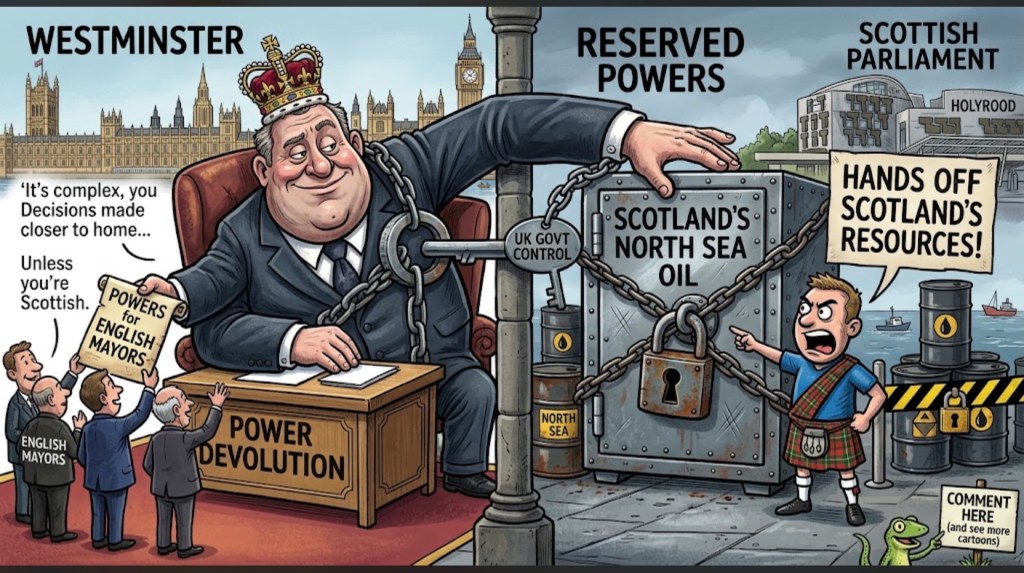
Apparently, Westminster believes power should belong to local people. Unless those people happen to be Scottish and the power involves billions of pounds’ worth of natural resources!
Welcome to the latest chapter of Britain’s constitutional comedy show.
The UK Government has been busy celebrating devolution in England, introducing new powers for mayors and local authorities because, apparently, people closer to the action should have a say in decisions affecting their communities.
What a magnificent principle! Democracy! Local accountability! Decisions made closer to home!
But turn north towards Scotland, mention the enormous oil and gas resources beneath the North Sea, and suddenly the enthusiasm for local decision-making appears to suffer a catastrophic mechanical failure.
Westminster’s message seems to be: “Trust English mayors with more decisions, but Scotland’s offshore resources? We’ll decide what happens to those, thank you very much!”
You couldn’t invent a more convenient version of devolution if you tried. 🎪
🛢️ The North Sea: Scotland Has the Coastline, Westminster Holds the Licensing Pen!
On 4 November 2026, the UK Government introduced its Energy Independence Bill, designed in part to end new licences for exploring new North Sea oil and gas fields. Existing licensed developments would be allowed to continue, with limited provisions for further production associated with existing fields.
But the central point remains: An elected Parliament in London can determine the future licensing framework for offshore resources associated with Scotland, while Scotland’s own Parliament cannot make that final decision.
The Scottish Government has expressly opposed these particular oil and gas measures, although it supports other elements of the legislation.
Think about that.
Scotland has a Parliament. Scotland has elected representatives. Scotland has communities whose livelihoods are connected to the North Sea energy industry. Yet when it comes to deciding whether new offshore exploration licences should be available, the final legislative authority remains at Westminster.
And while ministers in London are talking enthusiastically about shifting powers away from the centre in England, they’re also proposing legislation that would further restrict which new oil and gas developments can be licensed in the North Sea.
If devolution means trusting people to shape their economic futures, why does that principle stop short of Scotland’s offshore resources?
That is the question Westminster should have to answer, without disappearing behind a mountain of constitutional paperwork.
💷 It’s Not Just Oil — It’s About Who Gets to Decide!
The most important issue here isn’t whether somebody supports or opposes drilling.
Bullet You could believe that every remaining barrel should stay beneath the seabed and still question who ought to have the authority to make that decision.
Bullet You could support a rapid transition away from fossil fuels and still believe Scotland deserves a greater say over offshore energy policy.
Bullet You could also argue that North Sea resources should remain a UK-wide responsibility because energy security, taxation, and climate obligations affect everyone in the United Kingdom.
Those are legitimate competing positions. But they are arguments about where power should lie — not excuses to pretend the question doesn’t exist.
Because there’s a difference between a government explaining why a power should remain reserved and simply assuming Westminster should continue to hold it. And when the same government champions local empowerment elsewhere, the contrast becomes impossible to ignore.
🤖🌬️ Apparently, Every Resource Has Its Own Westminster Rulebook!
Then we arrive at the environmental argument.
Oil and gas developments face restrictions because of climate concerns. Meanwhile, governments are encouraging massive investment in AI data centres, renewable energy, and other major infrastructure.
Now, let’s be clear: wind power and fossil fuels do not have identical environmental impacts. Burning fossil fuels releases substantial greenhouse gases, while wind turbines generate electricity without combustion.
But large wind farms still have land-use, habitat, and construction impacts. AI data centres can require huge amounts of electricity and significant cooling infrastructure.
So there’s a perfectly reasonable question: Who decides which environmental impacts are acceptable, which economic benefits justify them, and which Scottish communities get a meaningful voice?
Because protecting the environment and debating Scotland’s democratic authority are not mutually exclusive.
🏴 The Question Westminster Cannot Solve With Another Devolution Press Release
Here’s the irony.
The English Devolution and Community Empowerment Act 2026 expands the powers and responsibilities available to strategic authorities and mayors across England. The Government argues that decisions closer to communities produce better outcomes.
But offshore oil and gas licensing in Scotland remains reserved.
English mayors aren’t being given the same powers as an independent national government, of course. And Scotland’s Parliament already exercises far wider powers than an English mayor.
Yet the contrast remains politically significant. Westminster is willing to redistribute some powers within England while defending its continued authority over a major resource affecting Scotland’s economic future.
That deserves a serious explanation:
Bullet What makes offshore resource licensing an essential UK-wide responsibility?
Bullet Could Scotland exercise greater authority while maintaining shared climate and energy obligations?
Bullet And if the answer is that Westminster must retain control, what does that say about the limits of devolution?
Because real constitutional accountability involves more than giving impressive speeches about empowering communities. It involves explaining exactly where that empowerment ends — and why.


Leave a Reply