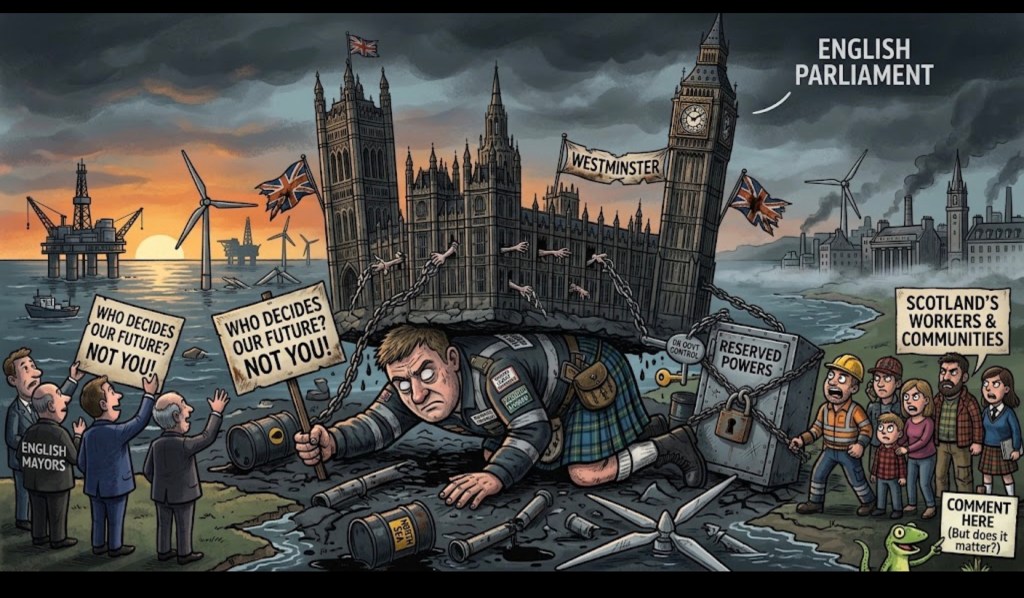
For decades, Aberdeen and the North East of Scotland have been at the heart of the North Sea oil and gas industry.
Generations of workers, engineers, local businesses, and families have built an industry that has generated immense economic value and hundreds of billions in tax revenue.
Now, as Britain faces the critical challenge of shifting toward new energy sources, a fundamental question arises: If Aberdeen helped build the oil economy, how much say should Aberdeen have in building the economy that replaces it?
And there is an even bigger question. Could the remaining economically recoverable oil and gas reserves directly help finance Scotland’s transition into new industries, rather than relying entirely on government grants and central promises?
💷 Imagine a Different Approach: A Dedicated Energy Transition Fund
What if we took a different path?
Instead of top-down decisions from London, picture a transition strategy directly shaped by Aberdeen, Aberdeenshire, Scotland’s energy workforce, industry specialists, and the Scottish Parliament.
Under this model:
Bullet A dedicated Scottish Energy Transition Fund would receive a defined share of future North Sea revenues.
Bullet Transparent accounting and local governance would ensure investment decisions directly involve the communities most affected.
Bullet Targeted reinvestment would drive engineering, renewable energy technology, port infrastructure, manufacturing, retraining, and the development of next-generation industries across Scotland.
Granted, declining production, volatile commodity prices, extraction costs, and strict climate commitments would all influence the capital realistically raised. Implementing this vision would also require structural changes to existing UK taxation and legislative frameworks.
But it highlights a critical flaw in current devolution logic.
🏴 A Test of Real Devolution
If Westminster genuinely believes English mayors and regional councils should have expanded powers to shape their local economic futures, why shouldn’t Aberdeen and Scotland have a substantial role in deciding how the North Sea’s remaining value supports their future?
After all, a just transition is not merely a government press release declaring that one industry is ending and another will magically appear.
It is about real people:
Bullet What happens to skilled offshore workers?
Bullet What happens to local supply chains and small businesses?
Bullet What happens to regional communities as legacy infrastructure winds down?
Surely those communities deserve more than an invitation to a advisory consultation after the major policy decisions have already been locked in.
⚡ The Ultimate Question
The challenge facing the North East is not simply deciding when the oil era ends.
It is deciding who controls the resources, the revenues, and the investment strategies required to build what comes next.
💬 WE WANT YOUR VERDICT!
Should North Sea revenues be directly ring-fenced into a locally managed Scottish Energy Transition Fund, or should offshore energy strategy and taxation remain strictly under UK-wide Treasury control?
COMMENT below on the Chameleon News blog, LIKE this piece, and SHARE it with anyone interested in the future of Scotland’s energy economy! 🔥
🏆 The sharpest comments will be featured in the next edition of Chameleon News Magazine! 🦎📰


Leave a Reply