(Where every resource is reserved, and every complaint is safely filed under “Lost in Transit”)
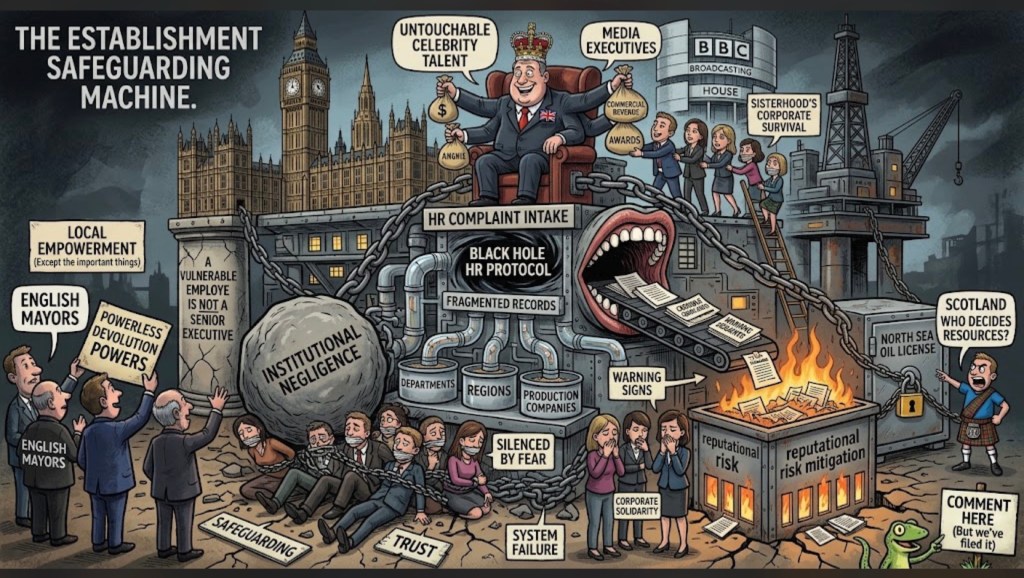
🎪 ACT I: The Great British Devolution Paradox
Apparently, Westminster believes power should belong to local people. Unless those people happen to be Scottish, or junior members of staff trying to report a prime-time national treasure.
Welcome to the latest chapter of the UK’s grand constitutional comedy show.
In England, ministers celebrate regional empowerment with overwhelming enthusiasm. English mayors are handed control over transport, local growth, and regional planning because—as the government proudly declares—decisions made closer to home produce better outcomes!
What a magnificent principle! Democracy! Local accountability!
But turn your eyes north toward Scotland’s vast offshore energy reserves, or look inside the glass towers of broadcasting headquarters, and suddenly the appetite for local decision-making suffers a catastrophic mechanical failure.
When it comes to billions of pounds in North Sea oil and gas, the rulebook instantly changes: “Trust local communities with minor decisions, but the big stuff? We’ll keep the key to that vault locked safely in London, thank you very much.”
And as it turns out, broadcasting executives learned their management style from the exact same playbook.
🛢️ ACT II: Reserved Powers & Untouchable Talent
Whether it’s offshore oil or prime-time television talent, the central governing rule remains unchanged: The people closest to the action hold zero regulatory authority.
For decades, the standard response to regional economic control and workplace safeguarding has been an elaborate exercise in administrative hand-washing:
Bullet The Resource Paradox: Scotland hosts the coastline, the infrastructure, and the energy workforce, yet an elected Parliament in London retains the exclusive right to decide licensing.
Bullet The Talent Paradox: A production floor hosts the crew, the junior runners, and the witnesses, yet an untouchable presenter holds the complete authority to operate without interference.
When questioned, the institutions retreat behind a mountain of constitutional and administrative jargon.
How can an organisation claim to take safeguarding or local empowerment seriously when its system is deliberately designed not to keep track of what’s happening?
As highlighted in official reviews, historical complaint handling suffered from a complete absence of centralised record-keeping. Allegations were scattered across sub-departments, regional offices, and independent production companies—ensuring that pattern recognition remained practically impossible.
It wasn’t a glitch in the system; the system was the glitch.
👩💼 ACT III: Sisterhood in the Green Room — The Myth of “Women for Women”
While executive suites were busy perfecting the art of turning a blind eye, another intriguing phenomenon was unfolding on the studio floor: the myth of female solidarity in corporate media.
For years, glossy industry panels and corporate press releases have championed the idea of women uplifting women in the workplace. Yet when dynamic power structures met actual risk, that solidarity frequently evaporated into corporate self-preservation.
The reality inside high-stakes broadcasting environments exposed a uncomfortable double standard:
1. The Ladder-Pulling Strategy: Rising through the ranks often meant adopting the rules of the boys’ club, not dismantling them. Senior female figures who secured positions of influence routinely proved just as adept at ignoring warning signs as their male counterparts, protecting the “brand” (and their own executive bonuses) over vulnerable junior staff.
2. The Whispering Campaign vs. Actual Action: Warning a select friend over a prosecco in the green room was quietly substituted for filing formal complaints. Passing along subtle hints while leaving the next generation of young women to walk blindly into the same predatory traps became standard operating procedure.
3. Complicity Masquerading as Survival: While junior staff faced genuine career terror, middle-and-upper management—frequently populated by vocal advocates of workplace equality—managed to find remarkable silence whenever a high-earning star was involved.
When corporate survival or talent access is on the line, the celebrated “sisterhood” quickly discovers that protecting the status quo pays much better than protecting each other.
🤖 ACT IV: The HR Black Hole (Nothing Has Changed)
So, what has actually been put in place to prevent any of this from happening again?
Absolutely nothing of substance.
Instead of structural reform, institutions offer the ultimate bureaucratic substitute: The Internal Policy Update.
Whenever a fresh scandal hits the headlines, the procedural machine springs into action:
Bullet A shiny new 40-page PDF policy document is uploaded to the staff intranet.
Bullet An mandatory 15-minute online awareness module is issued to junior staff.
Bullet A corporate spokesperson delivers a solemn speech about “learning lessons.”
Meanwhile, the core machinery remains completely untouched:
Bullet No Independent Oversight: Broadcasters continue to investigate themselves, ensuring that commercial interests always grade the mark.
Bullet No Centralised Blacklist for Perpetrators: High-value stars can simply hop from one production company to another with a clean slate.
Bullet No Protection for Whistleblowers: The unspoken rule remains: challenge the talent, end your career.
The workplace culture reviews continue to confirm the obvious: a powerful minority continues to act with impunity because the system was never built to stop them. It was built to protect the institution.
🏴 The Ultimate Verdict
Whether discussing who controls a nation’s natural wealth or who protects workers on a studio floor, the fundamental question is identical: Who holds the power, and why are they never held accountable?
Real accountability doesn’t consist of corporate press releases, vague promises of future transition funds, or brand-new HR hotlines that ring out in an empty office.
Until reporting structures are removed from the hands of the very executives protecting the revenue, and until those with authority face actual consequences for enabling abuse, the comedy show will continue—and the punchline will keep costing the same people.


Leave a Reply