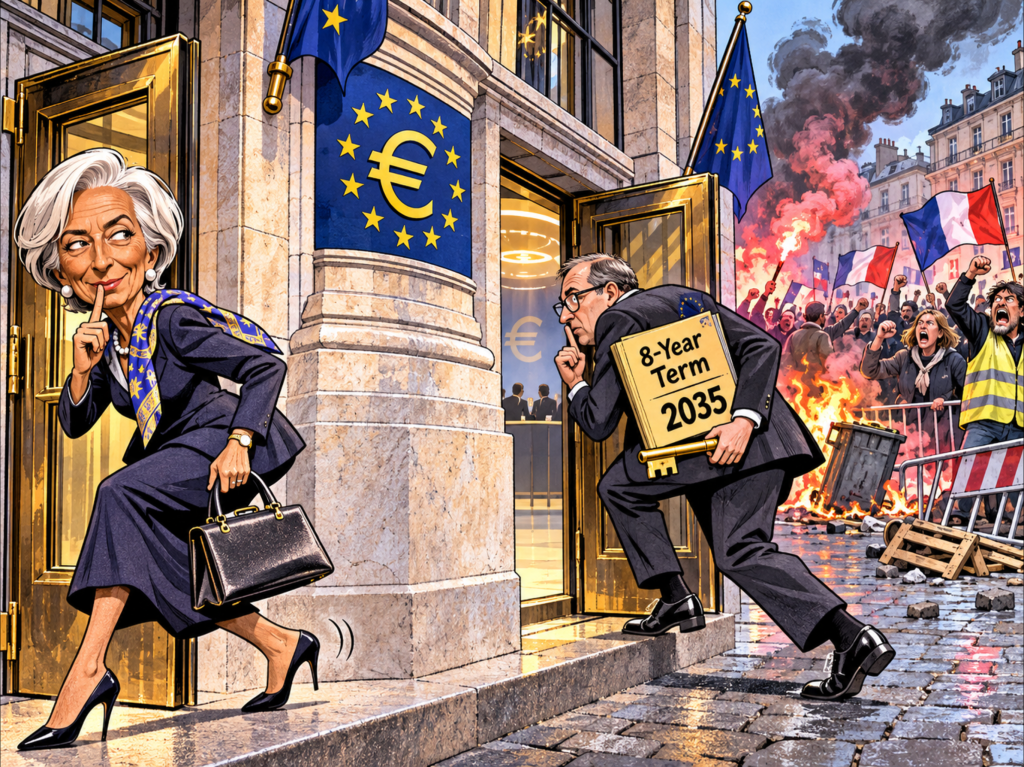
🇫🇷🇪🇺PARIS & BRUSSELS — A Gazette from the Future, February 2027.
Imagine the scene. France is preparing for a political earthquake. The presidential election is approaching, the establishment is polishing its farewell speeches, and Brussels is checking whether the emergency exits have been securely bolted.
Marine Le Pen’s nationalist movement is campaigning to challenge the European political and economic order. Meanwhile, Emmanuel Macron is approaching the end of his presidency.
But suppose the departing political generation has one last surprise.
Not a new law. Not a referendum. Not even a particularly expensive summit involving twelve motorcades and seventeen varieties of mineral water.
An appointment. Eight years. One enormous question about who really controls Europe’s monetary future. 💶🔒
Welcome to the hypothetical Great Eight-Year Lockout, where democracy gets the ballot box and technocracy gets the combination to the safe.
🏦The Frankfurt Padlock: Democracy Votes, the Central Bank Stays
The plot begins with a development that is very real.
Christine Lagarde announced on 29 October 2026 that she would leave the European Central Bank presidency on 7 February 2027, months before her original term was due to expire.
The official explanation concerned her desire for greater freedom to speak and engage on subjects beyond monetary policy.
Perfectly legitimate, naturally.
But the political timing invites a rather delicious question: What happens when Europe’s next monetary guardian is appointed just before France chooses its next political leader?
In our fictional February 2027, Europe’s leaders have completed the appointment.
Somewhere in Frankfurt, a new ECB President settles into a chair with an eight-year, non-renewable term.
Somewhere in Paris, campaign managers are promising to change everything.
And somewhere in Brussels, a bureaucrat quietly smiles at a calendar.
The arrangement looks like this:
- 🗳️ 18 April 2027: First round of France’s presidential election.
- 🇫🇷 2 May 2027: Second round.
- 🏦 February 2027–February 2035: A hypothetical new ECB presidency, lasting well beyond the next French presidential term.
Eight years!
That’s longer than most government economic strategies survive contact with an actual economy.
And unlike a politician, the ECB President doesn’t have to spend every five years smiling awkwardly beside a market stall, pretending to enjoy conversations about the price of onions.
🎭The Sovereignty Souvenir Shop: Take Home a Flag, Leave the Interest Rates Behind
Here is the part that makes the whole arrangement politically fascinating.
French voters can replace their president. They can change their government. They can demand different spending priorities, tax policies, industrial strategies and relationships with European institutions.
But they cannot, through a French presidential election alone, replace the ECB’s monetary-policy framework.
That power was already pooled at eurozone level long before 2027.
And the ECB President does not personally control every interest-rate decision. Those decisions belong to the ECB Governing Council, comprising its Executive Board and euro-area national central bank governors.
Still, the presidency carries considerable institutional influence.
And that is where the democratic argument gets interesting.
Supporters of central-bank independence argue that politicians shouldn’t be allowed to manipulate interest rates whenever an election approaches.
Critics ask whether institutions exercising such enormous economic influence can become too insulated from changing public priorities.
Both questions matter.
Because to a voter struggling with mortgage costs, government budgets and stubborn inflation, the distinction between democratically elected economic ambition and independently determined monetary policy can feel rather academic.
It’s like buying a brand-new car, choosing the colour, polishing the bonnet and discovering that the engine is managed by a committee in Frankfurt.
Congratulations on your democratic purchase. The steering wheel is included. Certain operating restrictions apply. 🚗💨
👑Macron Leaves the Palace — But Could His Political Influence Outlive Him?
Picture the fictional handover in May 2027.
The presidential carpets have been cleaned.
The photographers are assembled.
The outgoing administration has packed its belongings, leaving behind several thousand policy documents and possibly a ceremonial espresso machine.
A new president enters the Élysée promising a different economic direction.
Yet the ECB’s leadership remains in place.
Not necessarily because of some clandestine plot. Its independence, appointment procedures and long terms are features of the EU treaties.
And France alone does not decide who becomes ECB President: the appointment is made collectively by European leaders through a formal process.
But the optics of an appointment immediately before a major national election would still be remarkable.
An outgoing political generation could help select a central-bank leader who serves across several subsequent electoral cycles.
Critics might call that institutional continuity with suspiciously convenient timing.
Defenders might call it necessary protection against political interference.
The European Union would call it a procedure.
Naturally, the procedure would require meetings, recommendations, consultations, translations, legal opinions and enough paperwork to construct a small cathedral. 📑🏰
💶The Great Democratic Dilemma: Who Guards the Guardians?
Here lies the real issue beneath the satire.
Central-bank independence can protect monetary policy against short-term political pressure. But democratic accountability also matters when decisions affect borrowing costs, investment, employment and public finances.
The question isn’t whether France’s next president should be able to telephone Frankfurt and order cheaper mortgages before lunchtime.
That would present problems of its own.
The question is whether European institutions have struck the right balance between monetary independence and democratic oversight.
If a central-bank president serves eight years while governments come and go, how should voters hold the wider system accountable?
And if a major appointment occurs just before a politically consequential election, should the timing attract greater scrutiny?
These aren’t questions that can be answered simply by shouting sovereignty or stability louder than the other side.
Although, judging by European political debate, that remains a remarkably popular method.
🎰The Ultimate Punchline: The Politicians Change, the Institutional Clock Keeps Ticking
In our imagined February 2027, the appointment is complete.
France prepares to vote.
Campaign posters promise new beginnings.
Television studios fill with confident commentators, each explaining why everyone else has misunderstood the future.
And in Frankfurt, a new ECB President opens an eight-year diary.
The situation is both understandable and profoundly awkward.
Elections change governments. Independent institutions are designed to survive them.
Whether that arrangement provides essential economic stability or creates an uncomfortable democratic distance is a debate worth having openly.
Because when Europe’s citizens vote for change, they deserve to understand precisely which policies their elected governments can change — and which belong to institutions operating on a different clock.
The house may not be rigged.
But it certainly has a complicated rulebook.
And the people holding the rulebook rarely seem to face election. 🃏🇪🇺


Leave a Reply