France, the country that gave the world fine wine, haute cuisine and the revolutionary art of setting fire to things when politicians get too comfortable, has developed a rather expensive new national pastime: borrowing money it cannot stop borrowing.
With public debt approaching €3.6 trillion, equivalent to 119% of GDP at the end of June 2026, France is beginning to resemble a billionaire dining on champagne while discreetly asking the waiter whether the restaurant accepts payment in instalments. Insee +1
And the really delicious irony? This isn’t just France’s problem.
France is one of the eurozone’s biggest economies. If its financial foundations seriously crack, the consequences could reach banks, pension funds, governments and taxpayers from Paris to Rome, Berlin and beyond.
Welcome to Europe’s most expensive game of financial chicken. And nobody seems particularly keen to touch the brakes. 🚗💥
🥐 Liberté, Égalité, Bankruptcy? The French Financial Revolution Nobody Ordered
Let’s admire the numbers, shall we?
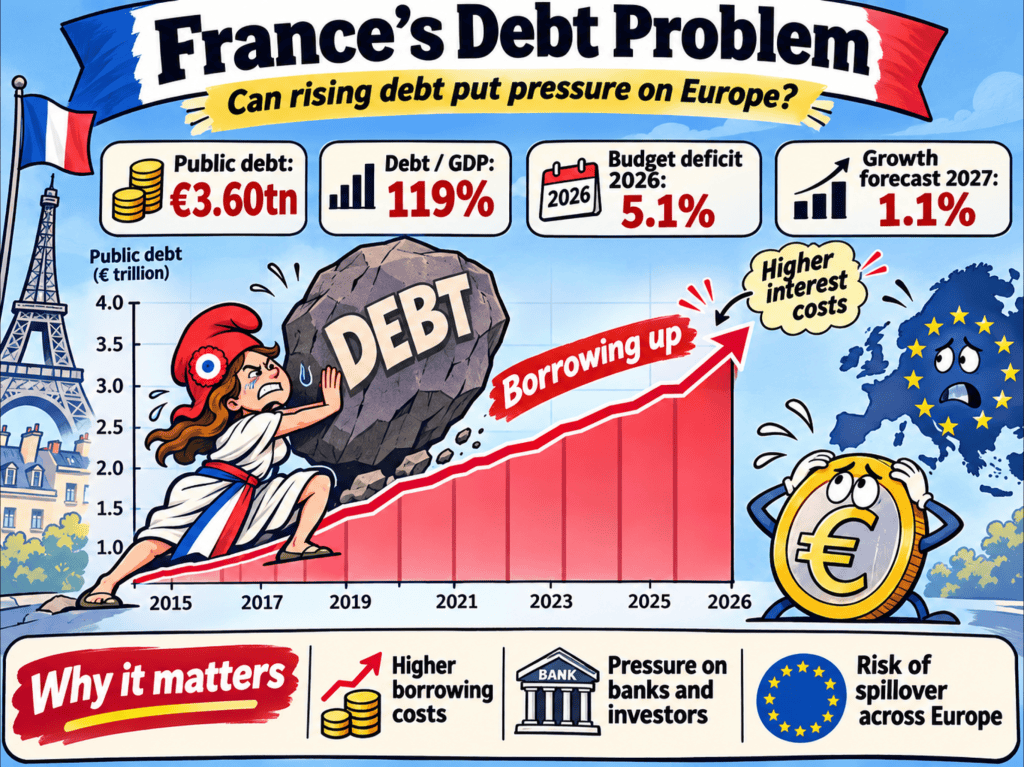
Public debt, June 2026
€3.60tn
Debt-to-GDP ratio
119%
2026 deficit forecast
5.1%
2027 growth forecast
1.1%
Sources: INSEE, September 2026; European Commission, May 2026. Deficit and growth figures are forecasts. Insee +1
France added approximately €135 billion to its public debt in just the first six months of 2026.
That’s an extraordinary amount of money to accumulate while insisting that everything is under control.
Imagine your neighbour buying a new Ferrari every week, paying the mortgage with borrowed money, then announcing a responsible household budget because he’s cancelled his Netflix subscription.
That’s roughly the confidence-inspiring atmosphere surrounding French public finances.
The European Commission forecasts debt exceeding 120% of GDP in 2027. Fitch expects approximately 124% by 2028. European Commission +1
And what is France’s political establishment doing?
Debating spending cuts nobody wants, tax increases nobody likes and pension reforms that could have half the country building barricades out of café furniture before lunchtime.
France has somehow turned fiscal responsibility into a national contact sport. 🥊
💶 The European Domino Disaster: When Paris Sneezes, Brussels Reaches for a Defibrillator
Remember Greece?
During the eurozone debt crisis, European leaders spent years arguing about financial rescues, austerity and who should pick up the bill.
Now imagine similar market panic involving France.
Greece was a difficult financial fire.
France could be the fire engine, the fire station and half the surrounding neighbourhood bursting into flames simultaneously. 🚒🔥
French government bonds are held by banks, insurers, pension funds and investors worldwide.
If confidence collapses, investors demand higher interest rates. Higher borrowing costs make government finances worse. Falling bond prices can weaken investors’ balance sheets.
Before long, markets may start looking suspiciously at Italy, Belgium and other heavily indebted eurozone countries.
Suddenly, a problem that began in Paris could be sending financial shockwaves across the continent.
Picture the emergency European summit:
Germany arrives carrying a calculator.
Italy arrives carrying its own debt figures.
Belgium asks whether everyone could please stop panicking.
France arrives carrying a €3.6 trillion invoice and announces that European solidarity has never been more important.
Meanwhile, the European Central Bank is standing in the corner wondering who keeps inviting sovereign debt crises to dinner.
And here’s the catch: the ECB has instruments to address certain forms of bond-market disruption, but that doesn’t give governments an unconditional rescue entitlement.
The central bank is supposed to defend monetary stability, not operate as Europe’s unlimited political overdraft facility.
🏛️ Paris Has a Political Problem Even a Trillion Euros Cannot Fix
Money may be the symptom, but political paralysis could be the disease.
Every serious deficit-reduction proposal appears to come with its own complimentary street demonstration.
Cut public spending? Outrage.
Raise taxes? Outrage.
Touch pensions? Prepare the riot police, put the café chairs away and alert the national railway network.
Do absolutely nothing?
Congratulations! You’ve invented the most politically convenient method of allowing debt to keep climbing.
On 30 October 2026, Fitch revised France’s credit outlook from stable to negative, citing deteriorating debt dynamics and political fragmentation. Its A+ rating was affirmed. Agence France Trésor +1
And France’s growing interest bill is no laughing matter.
Because every additional euro committed to servicing debt is a euro that cannot simultaneously finance hospitals, infrastructure, education or other priorities.
This is the great tragedy of government debt: yesterday’s political decisions eventually become tomorrow’s taxpayers’ invoices.
On 4 November, Bank of France Governor Emmanuel Moulin warned that France needed to address its own fiscal problems rather than expect the European Central Bank to solve them. Reuters
Translated into everyday language:
You’ve maxed out the credit card, the bank manager is getting nervous, and your wealthy relatives are no longer answering the telephone.
🚨 Could France Actually Break Europe? Or Is This Another Expensive European Drama?
Before anyone starts storing gold bars beneath the mattress and converting their savings into tins of baked beans, an important distinction needs making.
France is not bankrupt. The euro is not collapsing. And a debt crisis is not inevitable.
Governments routinely refinance debt, and France retains considerable economic strengths, a sophisticated financial system and access to deep capital markets.
But rising debt, weak growth and political deadlock create genuine vulnerabilities.
There are three broad possibilities.
France could finally achieve credible fiscal reform, stabilise borrowing costs and gradually restore confidence.
Alternatively, the country could endure years of financial strain, with expensive borrowing, sluggish growth and increasingly bitter battles over government budgets.
Or, in a much more severe scenario, investors could lose confidence sufficiently to destabilise French bond markets and transmit financial pressure throughout the eurozone.
That third possibility isn’t the most certain outcome. It’s the one European leaders have the strongest reason to prevent.
And it exposes the absurdity at the heart of Europe’s financial architecture.
Europe shares a currency, but not a single government responsible for every country’s debts.
It’s rather like eighteen-plus relatives sharing one gigantic credit card while maintaining separate bank accounts, separate spending habits and completely different definitions of financial responsibility.
Everybody loves the arrangement until somebody’s bill arrives.
Then suddenly it’s an international constitutional crisis. 🍷
🔥 Challenges: Is France Too Big to Fail — or Too Big to Rescue? 🔥
Here’s the uncomfortable question Europe’s political establishment would probably prefer you didn’t ask:
What happens when one of the countries supposedly holding Europe together becomes one of the biggest risks to its financial stability?
Is France heading towards a genuine debt crisis, or are politicians and financial commentators exaggerating the danger?
Should European taxpayers be expected to support a major member state if its borrowing becomes unsustainable?
Should France accept painful spending reforms, or should Brussels reconsider the economic rules that constrain national governments?
And perhaps the most explosive question of all:
If France ever needs rescuing, who exactly gets handed the bill — French taxpayers, German taxpayers, or everyone unfortunate enough to possess a euro? 💶
This is where you come in.
We want your verdict, your sarcasm, your economic insight and your most gloriously unforgiving political observations.
👇 Head to the Chameleon News blog and leave your answer in the comments. Don’t just argue on Facebook — put your opinion where the debate is happening.
❤️ LIKE this article if you think Europe’s financial leaders need a reality check.
🔁 SHARE it with anyone who believes political promises should come with a price tag.
💬 COMMENT on the blog: Is France a financial disaster waiting to happen, or can Europe survive another spectacular political mess?
🏆 The best, sharpest and most thought-provoking comments will be featured in the next issue of Chameleon News magazine.
And remember: France may have invented some of the world’s finest champagne, but when it comes to government debt, the bubbles could become very expensive indeed. 🥂💥


Leave a Reply