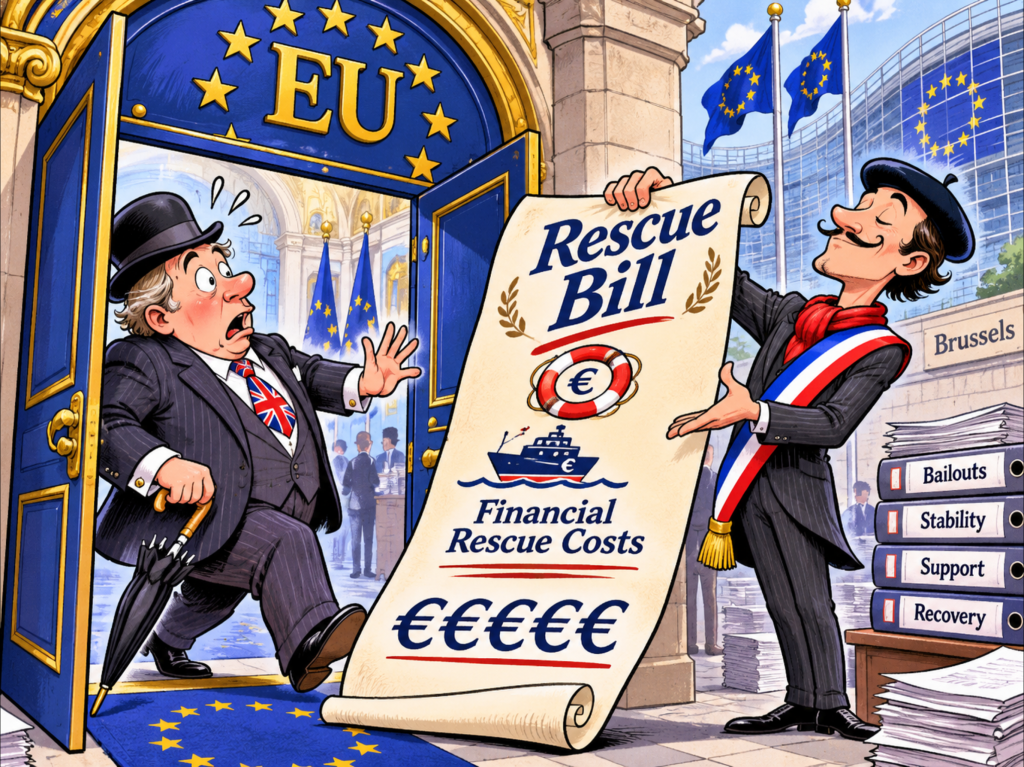
Britain has spent years arguing about Brexit, borders and Brussels. Now Prime Minister Andy Burnham is opening the door to a future return to the European Union. But there’s one rather expensive question hiding behind the promises of easier trade, smoother travel and European togetherness: if France’s finances hit the emergency button, could British taxpayers end up helping to pick up the bill? 💸
France’s national debt reached approximately €3.6 trillion, or 119% of GDP, by the end of June 2026. That’s an enormous mountain of borrowing, even before anyone starts waving a European solidarity flag over it. Insee
Burnham has ruled out rejoining the EU during this Parliament and indicated that he cannot envisage Britain adopting the euro. But he’s left the longer-term membership question open. ITV News +1
And here’s the important distinction: Britain would not automatically inherit France’s national debt by rejoining the EU. However, membership could expose UK taxpayers to certain EU-backed financial assistance arrangements.
The question isn’t whether Britain would suddenly own France’s debt. It’s whether British taxpayers could be asked to help underwrite a future rescue.
🎩💶 Bienvenue à Bruxelles: Where the Wine Is French, the Rules Are European and the Bill Might Be British!
Picture the scene.
France walks into the European financial restaurant wearing a designer suit, carrying a €3.6 trillion debt statement and announcing that the bill is getting rather uncomfortable.
Germany studies the figures. Brussels adjusts its spectacles. The European Commission produces a document containing 600 pages, 47 committees and the phrase collective financial solidarity.
Then Britain walks through the door.
“Ah, welcome back! Would you like a seat?”
“Lovely, thanks. What’s on the menu?”
“Trade cooperation, easier travel, economic opportunities and potentially some shared financial risks.”
“Shared what?”
“Nothing to worry about. Would you like to see the dessert trolley?” 🍰💸
And that, ladies and gentlemen, is why the financial details matter.
The EU has a rescue mechanism specifically for eurozone countries, called the European Stability Mechanism (ESM). Britain would not automatically join it if it re-entered the EU while retaining sterling.
But Brussels also has the European Financial Stabilisation Mechanism (EFSM), which can provide EU-budget-backed loans to member states facing severe financial difficulty. The European Commission confirms that this mechanism remains available, although the ESM would ordinarily handle eurozone assistance. European Stability Mechanism +1
In other words, keeping the pound is not necessarily the same as keeping Britain completely insulated from European financial rescues.
And before anyone starts screaming that France is already sending Britain an invoice, it isn’t. There is no automatic French bailout bill waiting in Downing Street.
The exposure would depend on the precise rules and terms of any future UK membership, the financial mechanisms involved and the decisions taken.
But surely that’s exactly what taxpayers deserve to understand before anyone starts campaigning to reverse Brexit?
🧾 The Great European Financial Menu
| Britain’s relationship with Europe | Potential financial exposure |
| Outside the EU | No automatic obligation to fund EU rescues |
| Single-market participation without EU membership | No automatic eurozone bailout obligation |
| EU membership, keeping sterling | Potential exposure through EU-budget-backed assistance |
| EU membership, adopting the euro | Participation in the ESM and its financial commitments |
Now imagine explaining those distinctions in a political campaign.
“Vote for closer European cooperation!”
“Wonderful. How much could it cost?”
“Well, that depends on treaty provisions, contingent liabilities, negotiated exemptions, budgetary commitments and future financial instruments.”
“So what’s the maximum exposure?”
“Have you seen how much easier your holiday in Spain could become?” 🏖️
This isn’t an argument that cooperation with Europe is bad. A French financial crisis could hurt British exporters, banks and investors whether Britain is inside or outside the EU. Sometimes shared financial support can prevent much larger economic damage.
But that possibility doesn’t eliminate the need for transparency.
A financial commitment doesn’t become free simply because somebody calls it European solidarity.
And a potential liability doesn’t disappear because it has been buried beneath enough diplomatic vocabulary to qualify as a doctoral thesis.
🔥 Challenges: Before Britain Books Its Return Ticket, Who’s Checking the Price? 🔥
Here’s the question that deserves more attention than another televised argument about Brexit slogans:
If Britain eventually rejoins the EU, should taxpayers be given a full account of the potential financial obligations before they’re asked to support it?
Andy Burnham should be challenged to explain what happens to Britain’s exposure to EU borrowing guarantees, rescue facilities and shared budget liabilities.
Would Britain seek legal protections against participating in future financial rescues? Could it refuse particular commitments? Would existing EU financial obligations affect the terms of joining? And what would the maximum reasonably foreseeable taxpayer exposure look like?
Those aren’t anti-European questions. They’re financial accountability questions.
Nobody sensible signs a mortgage without reading the repayment terms. Nobody buys a second-hand car without checking whether the engine works.
Yet some politicians appear comfortable discussing the biggest possible change in Britain’s international relationship while leaving the financial small print for another day.
Perhaps the real European tradition we should revive is asking for an itemised bill. 🧾🇬🇧
And let’s not forget: Britain has considerable debts and fiscal pressures of its own. This isn’t a contest to see which country can collect the largest overdraft.
It’s about ensuring voters understand both the economic benefits and financial risks before committing themselves to a new arrangement.
Because there’s a considerable difference between building stronger European partnerships and signing up to obligations the public never properly understood.
So here’s the challenge: should Burnham publish a detailed financial risk assessment of possible EU membership before asking the British public to consider rejoining? Or is the promise of closer European friendship enough?
👇 COMMENT directly on the Chameleon News blog — would you support rejoining the EU if British taxpayers could face financial exposure from future European rescue programmes?
👍 LIKE if you believe taxpayers deserve the full figures.
🔄 SHARE if you think politicians should explain the financial small print before selling the European dream.
💬 Whether you’re proudly pro-EU, fiercely pro-Brexit or simply tired of politicians treating public money like Monopoly cash, we want your opinion.
🏆 The best comments, sharpest observations and most outrageous one-liners will be featured in the next issue of Chameleon News Magazine! 🦎📰
Chameleon News — Where the News Changes Colour, but the Questions Don’t


Leave a Reply