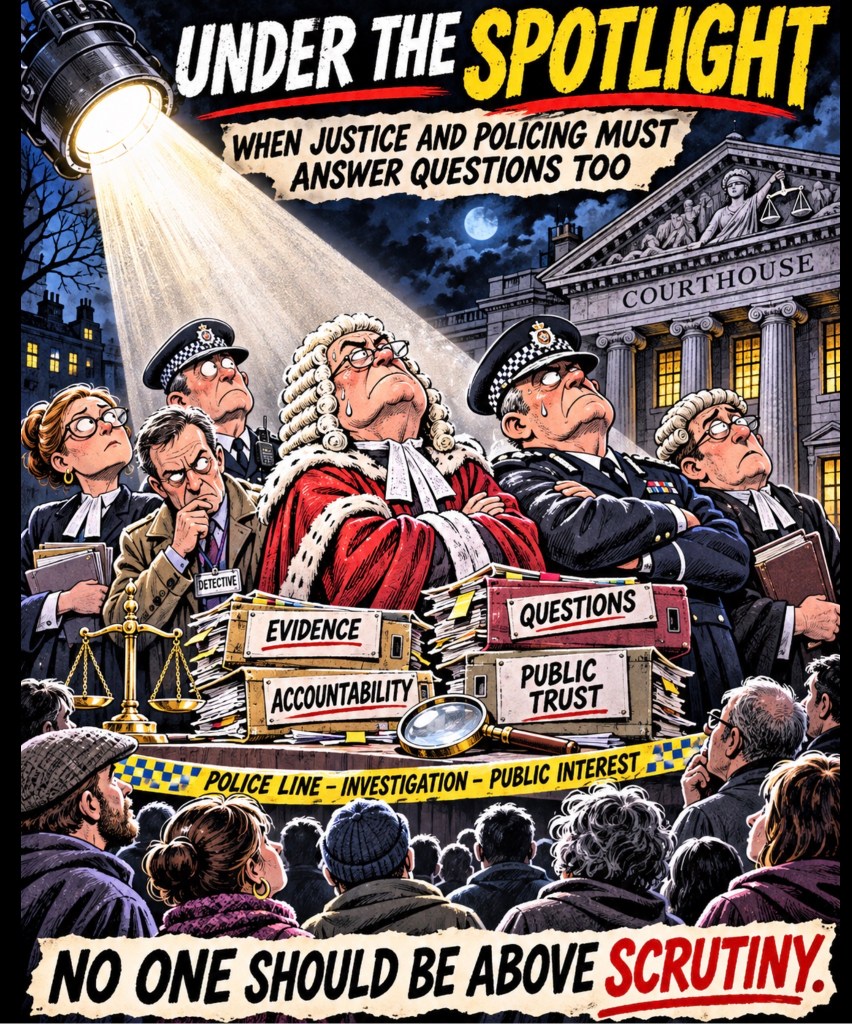
An examination of the evidence, the passage of time and one of the most important principles of British criminal justice.
Russell Brand has been sentenced to ten years and six months in prison after being convicted of one rape and three sexual assaults.
The offences were found to have taken place between 2004 and 2009.
The jury convicted him on four charges and acquitted him on three others.
But rather than simply accepting newspaper headlines, I wanted to examine a more fundamental question.
What was the actual evidence, and did it meet the criminal standard of proof beyond reasonable doubt?
Not what the newspapers thought.
Not what social media decided.
Not whether Russell Brand was a likeable or unlikeable individual.
The evidence.
Because if somebody is going to lose years of their freedom, surely we should be confident that the verdict rests on evidence sufficiently reliable to remove reasonable doubt.
1. First, what physical evidence existed?
According to the Metropolitan Police, the investigation faced significant difficulties because the alleged offences were so old.
There was:
- No available forensic evidence.
- No CCTV evidence of the offences.
- Limited surviving digital evidence.
- A considerable reliance on historical witness accounts.
Police interviewed more than 100 witnesses, took more than 400 statements and examined over 1,400 documents.
Those figures sound impressive.
But here’s the first question I asked.
How many of those documents actually established that a criminal offence had been committed?
A photograph can establish that somebody attended an event.
A floor plan can establish where a room was situated.
A witness can confirm that two people knew one another.
But none of those facts, on their own, establishes that rape or sexual assault occurred.
The distinction between evidence of opportunity and evidence of a criminal act is fundamental.
2. What about the text messages?
One of the most interesting elements concerned the 2009 rape allegation.
The complainant described a subsequent text conversation in which she challenged Brand about his treatment of her.
She recalled him apologising.
That sounds potentially significant.
So I asked a straightforward question.
Did the prosecution actually have the original messages?
According to the reporting of the trial, the woman no longer possessed the telephone on which the messages had been received.
The conversation was therefore described from recollection rather than presented as an authenticated original exchange.
Brand said he did not recall the conversation, although he accepted that an apology might have related to the woman’s dissatisfaction.
That creates a significant evidential distinction.
An original, authenticated message can establish precisely what was written.
A witness remembering a message many years later provides evidence of what they recall.
Both can be considered by a court, but they are not the same form of proof.
And even if an apology was sent, what exactly was being apologised for?
An unpleasant encounter?
Poor behaviour?
Or a criminal offence?
An apology is not automatically an admission of rape.
That is an important distinction when evaluating the strength of the prosecution’s case.
3. What about the other witnesses?
Several witnesses testified that the complainants had spoken to them about incidents years before the allegations became public.
Some described distress or changes in behaviour.
That evidence matters.
It may establish that complaints were made long before a media investigation and that the individuals were describing experiences that had affected them.
But it is important to understand precisely what such testimony proves.
If one person tells five friends that an assault occurred, those friends can independently confirm receiving the account.
They cannot necessarily independently confirm the assault itself.
Five witnesses describing one person’s earlier allegation are not the same as five eyewitnesses to the alleged offence.
Nevertheless, earlier disclosures can be admissible and can strengthen a case. A jury may consider their timing, detail and consistency alongside the complainant’s direct testimony.
The question is how much weight they deserve.
We must distinguish corroboration of a complaint from independent proof of the alleged act.
4. What happens to evidence after twenty years?
This is where I believe a wider debate about historical prosecutions is necessary.
Think about what happens during twenty years.
Mobile telephones are replaced.
Text messages disappear.
Medical records may be destroyed.
People move home.
Potential witnesses become impossible to locate.
Memories change.
And somebody accused of an offence may no longer possess the evidence that could support their defence.
How do you establish where you were on a particular evening twenty years ago?
How do you find somebody who might remember what happened?
How do you challenge an allegation when relevant correspondence, recordings or records no longer exist?
These difficulties affect both prosecution and defence.
They do not make historical prosecutions impossible, nor do they mean that memories are inevitably unreliable.
But they create substantial evidential challenges.
And one principle must remain unchanged.
The passage of time does not lower the prosecution’s burden of proof.
If the allegation is twenty years old, the standard is still beyond reasonable doubt.
5. What exactly does beyond reasonable doubt mean?
In an English criminal court, the jury must be sure that the defendant is guilty.
It is not enough to believe that an allegation is probably true.
It is not enough to dislike the defendant.
It is not enough to conclude that the complainant appeared sincere.
The jury must assess all the admissible evidence and be sure that the offence was committed by the defendant.
There is, however, an important legal point.
A person’s testimony under oath is evidence.
English law does not require DNA, CCTV, an independent eyewitness or a confession before somebody can be convicted.
A jury can convict on credible testimony alone if, having considered the evidence and the challenges made to it, it is sure of guilt.
The issue is therefore not whether physical evidence was absent.
It is whether the evidence that remained was sufficiently reliable to establish guilt beyond reasonable doubt.
6. Why did the jury convict on four charges but acquit on three?
This is another significant feature of the case.
The jury heard allegations involving six women.
It returned four guilty verdicts and three not-guilty verdicts.
That distinction matters.
It means the jurors did not convict Brand of every offence alleged against him.
However, we do not know precisely why they rejected the three charges.
They may have had doubts about particular details, the reliability of evidence or whether every legal element had been established.
Jury deliberations are confidential, so we should not invent their reasoning.
Equally, an acquittal on one allegation does not automatically undermine a conviction on another.
Each charge must stand or fall on its own evidence.
7. So I asked the most important question: would I have convicted him?
After examining the publicly reported evidence, my conclusion is this.
I cannot independently reach a finding of guilt beyond reasonable doubt on the material available to me.
The missing original messages, absence of forensic evidence, passage of time and reliance on historical recollections all require careful scrutiny.
But there is another side to that conclusion.
I have not examined the complete court transcripts.
I have not heard every witness under cross-examination.
I have not reviewed every exhibit presented to the jury.
And I have not heard the complete defence case or the judge’s directions.
Consequently, I cannot fairly conclude that the jury failed to meet the legal standard either.
That would require knowledge of evidence I have not examined.
The jurors heard the full case, and the four guilty verdicts were unanimous.
Their legal decision is therefore established, even though an independent observer examining public reports cannot reproduce the jury’s complete evidential assessment.
8. My final conclusion
Russell Brand’s case raises a difficult but important question about criminal justice.
How confidently can guilt be established when so much of the original evidence has disappeared?
The prosecution presented direct testimony, historical disclosures, witness observations and circumstantial evidence.
The jury considered that material and convicted him.
But we should not confuse a lengthy investigation with the existence of particular forms of proof.
Nor should we confuse evidence that a complaint was made with independent confirmation that every detail of the complaint was accurate.
Those distinctions are essential in any criminal trial.
There are two principles that must coexist.
People who report sexual offences deserve to have their allegations investigated seriously, regardless of how much time has passed.
And people accused of those offences remain entitled to the presumption of innocence and the full protection of the criminal burden of proof.
Neither principle should be weakened to accommodate the other.
My examination has not established that Russell Brand was wrongly convicted. But neither can I independently confirm, from the published material alone, that I would have reached the same verdict on all four counts.
That is not an accusation against the complainants, the jury or the court.
It is an acknowledgment that the publicly reported evidence is not the complete trial record.
And it leads to the question I believe deserves the greatest attention.
When a conviction rests heavily on testimony about events many years earlier, how do we demonstrate that the evidence has been tested thoroughly enough to exclude reasonable doubt?
The answer must be found in the quality of the evidence, the fairness of the trial, the testing of witnesses and the proper application of the law.
Not in celebrity.
Not in public pressure.
And certainly not in trial by media.
Because beyond reasonable doubt must remain beyond reasonable doubt — whether the accused is famous, unknown, popular or despised.
Justice must protect those who have suffered criminal offences. It must also protect every accused person from conviction unless guilt is proved to the required standard. Those are not competing luxuries. They are the foundations of a fair criminal justice system.
Sources checked
The Metropolitan Police confirmed the absence of forensic and CCTV evidence and described the scope of its investigation. Metropolitan Police The Crown Prosecution Service acknowledged the evidential difficulties caused by the passage of time and explained its reliance on testimony and supporting witnesses. The Crown Prosecution Service
The BBC’s reporting of the prosecution opening confirms that the 2009 phone containing the alleged texts was no longer owned by the complainant. BBC News The conviction and sentence were confirmed by the CPS on 9 November 2026. The Crown Prosecution Service


Leave a Reply