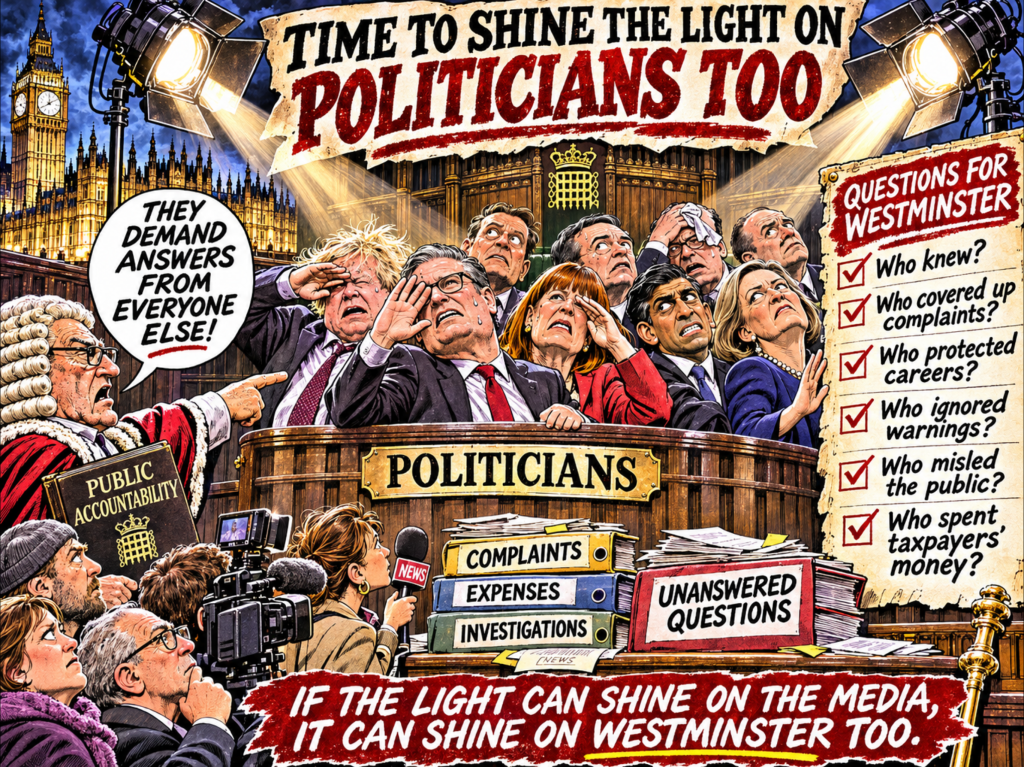
Politicians demand accountability from the police, broadcasters, businesses and the public. But what happens when allegations of sexual misconduct concern the politicians themselves?
Westminster is a remarkable place.
A politician can stand before the cameras, demand an independent investigation into somebody else’s behaviour, call for resignations and deliver a passionate speech about protecting the vulnerable.
But when allegations of misconduct emerge within their own political party, the questions become rather more uncomfortable.
Who knew?
Who received the complaints?
How long did the party take to investigate?
And did political influence affect what happened next?
Perhaps it’s time to examine some familiar names.
The politicians who have faced accusations, findings or convictions
Charlie Elphicke — Conservative
The former Conservative MP was convicted in 2020 of three counts of sexual assault and sentenced to two years in prison.
Imran Ahmad Khan — Conservative
The former MP for Wakefield was convicted of sexually assaulting a 15-year-old boy in 2008, before entering Parliament. He was sentenced to 18 months in prison in 2022.
Chris Pincher — Conservative
A parliamentary investigation found that the former deputy chief whip had groped two men at London’s Carlton Club in 2022.
The Standards Committee recommended an eight-week suspension. He subsequently resigned as an MP.
And here is the particularly interesting part.
Pincher had been responsible for enforcing party discipline.
Apparently, even the people entrusted with maintaining standards can become the subject of serious misconduct findings.
Peter Bone — Conservative
An independent parliamentary investigation upheld allegations of bullying and sexual misconduct involving a staff member.
The complainant had first raised concerns with the Conservative Party in 2017. Parliament’s investigation eventually resulted in a recommended six-week suspension in 2023.
Six years between the original party complaint and the parliamentary sanction.
That raises an obvious question about the effectiveness and speed of internal complaints procedures.
Rob Roberts — Conservative
An independent parliamentary panel upheld complaints concerning repeated unwanted sexual advances towards a member of staff.
He was suspended from the Commons for six weeks in 2021.
Mike Hill — Labour
The former Labour MP was found by an employment tribunal to have sexually harassed and assaulted a parliamentary employee.
He resigned from Parliament in 2021.
Patrick Grady — SNP
A parliamentary investigation upheld a sexual misconduct complaint involving an unwanted advance towards a junior member of SNP staff.
He received a two-day parliamentary suspension in 2022 and apologised.
The subsequent controversy also raised questions about how the SNP treated and supported the complainant.
Geraint Davies — Labour
The former Labour MP faced allegations of inappropriate sexual behaviour towards junior colleagues and was administratively suspended from the party in 2023.
These were reported allegations, not criminal convictions.
Dan Norris — Former Labour, subsequently independent
The MP has been investigated by police following allegations involving serious sexual offences.
By July 2026, police had submitted a file to the Crown Prosecution Service for a charging decision.
He has denied the allegations. An investigation or arrest does not establish guilt.
Lord Stone of Blackheath — Labour peer
In April 2026, the House of Lords Conduct Committee reported that he had repeatedly breached parliamentary conduct rules concerning bullying, harassment or sexual misconduct.
The committee recommended permanently excluding him from the parliamentary estate.
Now comes the question for party leadership.
These cases involve different political parties, different circumstances and different outcomes.
Some ended in prison sentences.
Some resulted in findings by independent parliamentary investigators.
Others remain allegations without findings of guilt.
But the public is entitled to ask how effectively Britain’s political parties handle complaints involving influential members.
Consider Peter Bone’s case.
A complaint was first raised with the Conservative Party in 2017. Years later, an independent parliamentary process resulted in findings against him.
Why did the party’s internal process take so long without reaching a conclusion?
Consider Chris Pincher.
A senior figure responsible for party discipline was himself found to have committed sexual misconduct.
What scrutiny was undertaken before he received that responsibility?
And consider the SNP’s handling of Patrick Grady.
The misconduct finding was established, but questions also emerged concerning the complainant’s experience of the process.
Is an apology sufficient if the organisation’s complaints procedures have failed to protect people’s confidence in reporting wrongdoing?
Perhaps Westminster needs to answer the questions it asks everyone else.
Political leaders demand that the police investigate failures.
They demand that the BBC and ITV explain what their management knew.
They insist that organisations protect employees, maintain proper safeguarding procedures and respond promptly to allegations.
Those are reasonable expectations.
So why shouldn’t political parties face precisely the same scrutiny?
Not simply the individual politician.
But the people who received the complaints.
The officials responsible for investigating them.
The party leaders who were informed.
And those who decided whether accused politicians should continue holding positions of authority while investigations proceeded.
An accusation is not a conviction. But an accusation serious enough to warrant investigation should never be ignored simply because the person concerned is politically important.
And what about the people who came forward?
Behind every substantiated case is somebody who had to challenge an individual with political influence, public recognition and, potentially, considerable power over their career.
We should be asking whether parliamentary employees can report misconduct without fearing that their careers will suffer.
Whether complaints are investigated independently.
Whether party loyalty influences disciplinary decisions.
And whether individuals in positions of authority are properly held accountable for their handling of credible warnings.
Parliament now has an Independent Complaints and Grievance Scheme and an Independent Expert Panel.
But the existence of a complaints system is not the same thing as demonstrating that every complaint is handled promptly and effectively.
The bigger question
Britain’s politicians have spent years telling employers, broadcasters and public institutions that nobody should be above scrutiny.
Perhaps it’s time to apply that principle consistently.
Publish what can lawfully be disclosed about how complaints were handled.
Investigate unnecessary delays.
Examine whether senior officials intervened in disciplinary processes.
Protect complainants and the rights of those accused.
And where evidence of criminal wrongdoing exists, refer it to the appropriate authorities, regardless of political position.
Because accountability should not stop with the politician whose behaviour makes the headlines.
It should also examine those responsible for responding to complaints when concerns were first raised.
Westminster doesn’t need another carefully worded promise that lessons have been learned.
It needs complaints procedures that inspire public confidence and independent scrutiny that is not influenced by political convenience.
The politicians have spent years demanding answers from everyone else.
Now the public deserves answers about how Parliament and political parties police their own conduct.


Leave a Reply