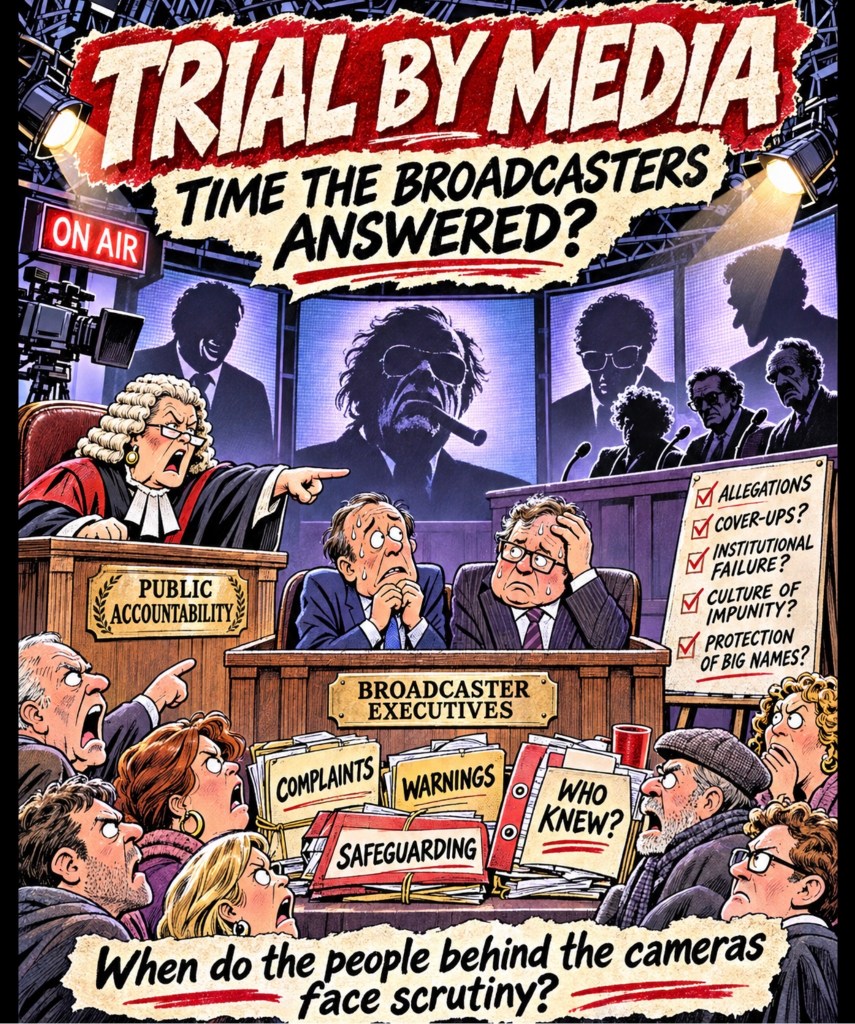
Britain’s television broadcasters are remarkably good at investigating other people’s scandals.
The BBC and ITV question politicians, demand resignations, expose institutional failures and ask why those in authority failed to act.
But what happens when the allegations concern their own presenters?
Jimmy Savile. Stuart Hall. Rolf Harris. Russell Brand. Huw Edwards. Tim Westwood. Gregg Wallace. Gino D’Acampo. David Walliams. Phillip Schofield. Noel Clarke.
Different cases, different allegations, different legal outcomes.
Some resulted in convictions. Others involved workplace investigations, admitted conduct or allegations that remain disputed.
But together they raise a question that deserves far greater public attention.
What did the people running Britain’s television industry know, when did they know it, and what did they do about it?
The BBC’s own independent investigation into Jimmy Savile and Stuart Hall identified serious failings in the organisation’s culture.
Years later, the BBC apologised after its investigation into Russell Brand found that people had felt unable to raise concerns.
In 2025, an investigation into Gregg Wallace substantiated 45 allegations of inappropriate behaviour.
ITV has also faced difficult questions over Phillip Schofield, while ITV News uncovered complaints concerning Gino D’Acampo that production companies had received years earlier.
And now, in November 2026, further allegations against David Walliams have brought the behaviour of prominent television personalities back into the headlines.
How many times must the television industry investigate itself before the public can be confident that its safeguarding arrangements actually work?
The issue isn’t whether an accusation automatically establishes guilt. It doesn’t.
The issue is whether credible complaints are properly investigated, whether junior employees can speak without fearing for their careers and whether famous presenters receive treatment that ordinary employees would never enjoy.
Why shouldn’t the executives who commissioned these programmes, received complaints and supervised these workplaces be required to account publicly for their decisions?
Why shouldn’t independent investigators examine complaints records, internal correspondence, settlement agreements and the decisions to continue employing presenters?
And where evidence establishes that an individual knowingly concealed criminal behaviour, obstructed an investigation or committed another offence, why shouldn’t that individual face the appropriate legal consequences?
Accountability shouldn’t end with the celebrity whose face appeared on television.
It should extend to the institutions responsible for the workplace, the safeguarding arrangements and the response to complaints.
The BBC and ITV expect accountability from politicians, businesses, hospitals and the police.
The public is entitled to expect equally rigorous scrutiny of the broadcasters themselves.
The next big television investigation should ask what happened behind the cameras — and who was responsible for responding when concerns were raised.


Leave a Reply