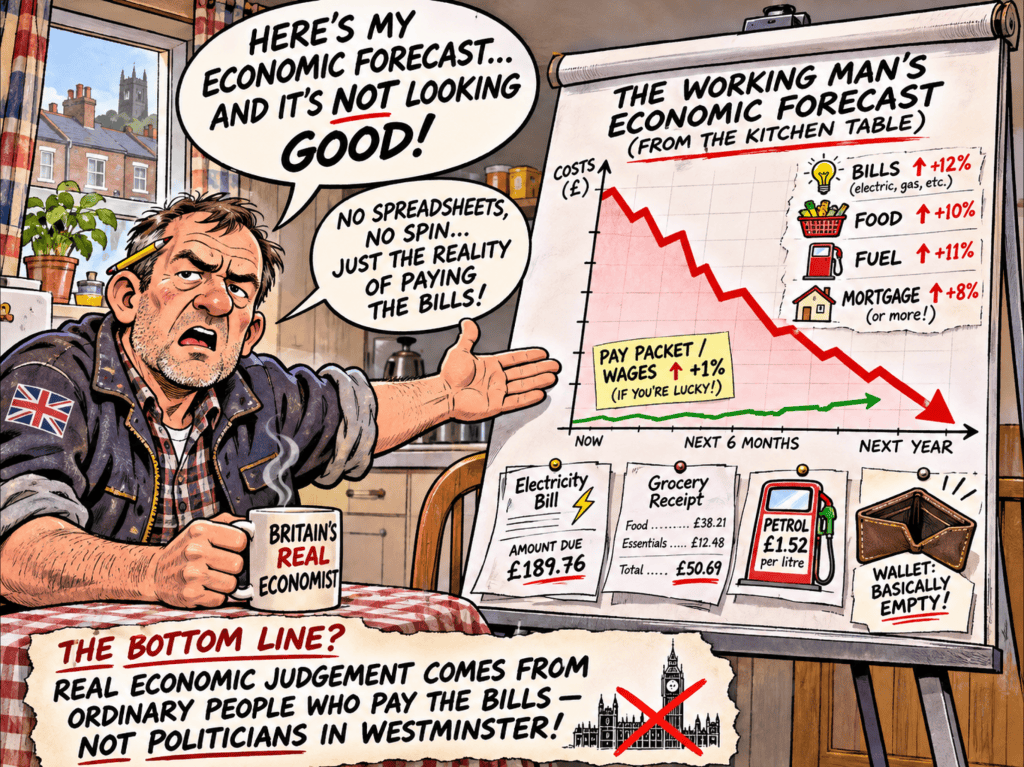
🇬🇧💷Westminster can celebrate GDP figures, wave economic forecasts around like winning lottery tickets and congratulate itself on every decimal point of growth. But there’s one rather inconvenient detail the political establishment must remember:
The real judges of Britain’s economic success aren’t sitting around the Cabinet table. They’re sitting around the kitchen table, wondering how much money they’ll have left at the end of the month.
Perhaps Britain’s economy will outperform expectations. Perhaps investment will improve productivity, inflation will ease and wages will stretch further. That would be welcome news for everyone, regardless of which political party occupies Downing Street.
But there’s a world of difference between an economy growing on a spreadsheet and ordinary people actually feeling better off.
And ultimately, it will be the British public who deliver the real verdict on economic growth — not ministers, economists or Westminster’s professional headline polishers. ⚖️
⛽ You Can’t Fill a Petrol Tank With a GDP Headline — And You Can’t Heat a House With Political Optimism!
🔥Picture the scene.
A government minister appears on television, positively glowing with excitement because the latest economic figures have moved upwards.
“Wonderful news!” they announce. “The economy is growing!”
Meanwhile, somewhere in Britain, a motorist is standing at a petrol pump watching the numbers climb faster than their wages.
A parent is examining the supermarket receipt, wondering how three bags of groceries managed to cost so much.
A pensioner is staring at an electricity bill that seems to have been calculated by someone heating Buckingham Palace with a blast furnace.
And a working family is performing its monthly financial gymnastics routine: mortgage, council tax, gas, electricity, food, insurance, fuel — and perhaps, if there’s anything left, the extravagant luxury of enjoying life. 💸
That’s where the real economy lives. Not on a Treasury graph, but in the wallets, bank accounts and everyday struggles of the British public.
Of course, economic growth matters. Without it, improving living standards and funding public services becomes harder.
But growth isn’t some magical economic fairy dust that automatically finds its way into everyone’s pocket.
A positive GDP figure doesn’t guarantee that wages will rise faster than prices.
It doesn’t automatically reduce mortgage payments.
It doesn’t promise cheaper electricity or a more affordable weekly shop.
And it certainly doesn’t mean that people filling their cars at the petrol station will suddenly feel like they’ve won the National Lottery.
Yet political debate often treats a quarterly economic statistic as though someone has discovered a giant treasure chest beneath the Treasury.
Cue the triumphant press releases, the television interviews and enough political backslapping to generate a minor earthquake in Westminster. 📈🥳
But here’s the uncomfortable truth: a country can experience economic growth while millions of its citizens continue to feel financially squeezed.
And that’s why the final judgment belongs to the public.
Not simply to the people drawing up forecasts.
Not to ministers celebrating their preferred statistics.
Not to opposition politicians who might be tempted to dismiss genuinely positive news because it happens under somebody else’s government.
It belongs to the workers earning the wages, the families paying the mortgages, the pensioners managing their budgets and the motorists filling their petrol tanks.
These are the people who will decide whether the economy is genuinely improving their lives.
They won’t need an economist to explain whether their shopping basket is becoming more affordable.
They won’t require a ministerial briefing to tell them whether their pay packet is going further.
And they certainly won’t need a Westminster press conference to establish whether there’s more money left in the bank before payday.
They’ll already know.
Because unlike a political speech, a direct debit cannot be paid with optimism. 💳
💷 Growth Must Mean Something Beyond the Headlines
Britain should welcome genuine economic progress. Higher productivity, stronger investment, better wages and sustainable growth are all things worth pursuing.
But governments of every political colour should be judged against a much more meaningful question:
Are ordinary people experiencing the benefits?
Does working hard provide a decent standard of living?
Can young families realistically afford a home?
Can pensioners heat their houses without worrying about the next bill?
Can small businesses cover their costs, invest and employ more people?
And can someone fill up the car, buy the groceries and pay the household bills without feeling that every month is another round of financial survival?
Those are the questions that matter.
Westminster can claim economic success. The opposition can challenge it. Economists can analyse it. Commentators can argue about it until the television studio lights go out.
But the British public will be the ones who decide whether economic growth deserves to be called a success.
Because prosperity isn’t just a percentage.
It’s peace of mind.
It’s financial security.
It’s the ability to plan for tomorrow without fearing the next envelope landing on the doormat.
And if politicians really want to know how Britain’s economy is performing, perhaps they should spend less time admiring their graphs and more time listening to the people paying the bills.
After all, if political optimism could generate electricity, Westminster would already be powering half of Europe — and we’d all be enjoying free heating. ⚡😂🇬🇧
🔥 Challenges: The Public Has the Final Say — So What’s YOUR Economic Verdict🔥
Forget the polished speeches and the carefully selected economic headlines for a moment.
Is Britain’s economy actually improving where it matters most — in your household?
When you fill your petrol tank, pay your electricity bill, renew your mortgage or walk out of the supermarket, do you genuinely feel better off?
Or does the government’s economic optimism disappear the moment your bank balance appears on your phone?


Leave a Reply