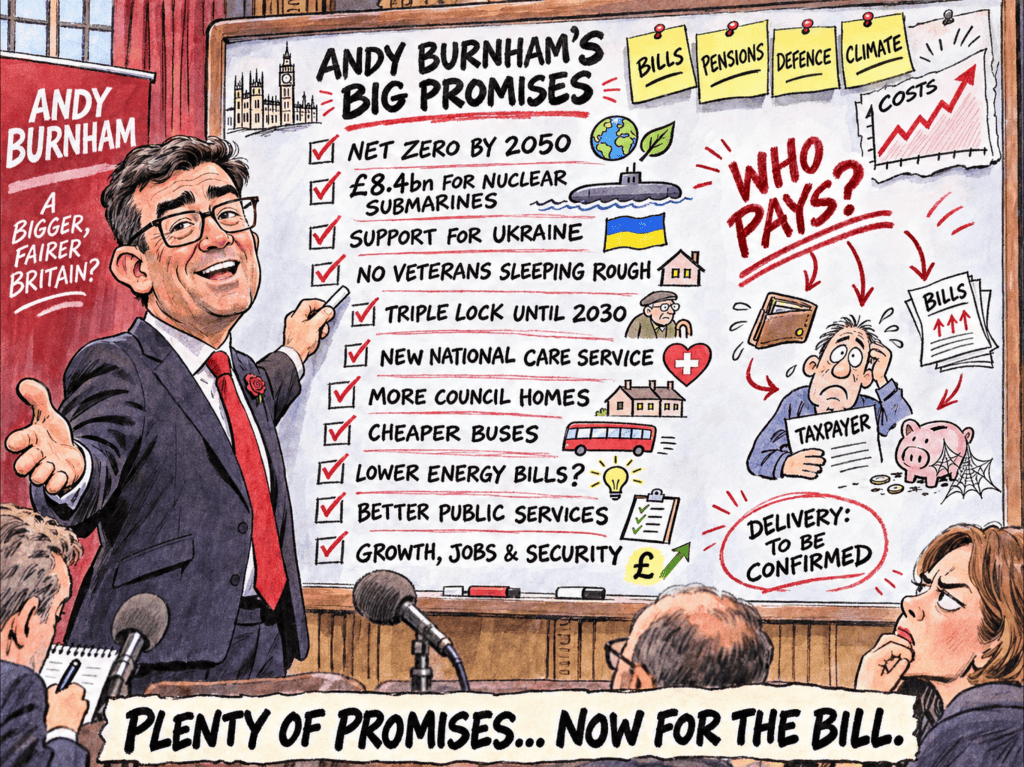
Prime Minister Andy Burnham has arrived at COP31 in Antalya, Turkey, carrying a familiar political message: net zero, major defence investment, veteran support, new council homes, improved public services, and a reshaped pension and social care settlement.
While Burnham holds full constitutional authority following his July 2026 Labour leadership victory, his extensive list of ambitions raises two critical questions for the British public: how will these programmes be funded, and when will households see tangible results?
🌍 COP31: Climate Ambitions Meet International Reality
At COP31, Burnham reaffirmed Britain’s 2050 net-zero target alongside progress on two offshore wind projects representing roughly £12 billion in investment. While supporters highlight the potential for job creation and energy security, the absence of an official US delegation under President Donald Trump and several other world leaders underscores uneven global momentum. For British families facing winter heating bills, environmental targets must ultimately translate into affordable electricity, competitive businesses, and measurable results—not just conference speeches. ⚡
🪖 Armed Forces & Veterans: Billions Pledged, Delivery Required
National security features heavily in Burnham’s programme, including £8.4 billion announced in July 2026 for the Dreadnought nuclear submarine programme, an ambition for 22,000 defence nuclear apprenticeships by 2035, continued support for Ukraine, and a commitment to spend 3.5% of GDP on core defence by 2035. Alongside this, the Government allocated £8.7 million in November 2026 across eight organisations to tackle veteran homelessness. However, multi-billion-pound defence pledges require strict procurement accountability, and homeless veterans need sustainable housing, mental health care, and addiction support—not just council action plans.
👵 Pensioners: The Triple Lock Stays — Until April 2030 💷
Burnham confirmed the existing State Pension Triple Lock will remain until April 2030, after which a modified formula will guarantee increases by inflation or 2.5% (whichever is higher), alongside a mechanism to maintain value relative to average earnings.
The Government projects this adjustment will reduce annual pension expenditure by £15 billion by the late 2030s and £50 billion by 2050, redirecting those funds toward a new National Care Service in England offering free personal care at the point of use. Yet crucial questions remain: accommodation and living costs in residential care will still be charged separately, implementation is deferred until the next Parliament, and retirees need clarity on whether reduced pension growth justifies care reforms they may never use.
🏠 Public Services & Finite Resources
Burnham’s domestic agenda also promises council housing, public control over essential services, mental health improvements, bus fare changes, and temporary electricity bill relief. While these address real cost-of-living pressures, many remain proposals awaiting legislation rather than funded achievements.
Just as a household cannot fund every home renovation and holiday at once without checking its bank balance, a government cannot rely solely on optimistic growth forecasts. Borrowing carries costs, taxation impacts families and businesses, and spending requires clear priorities.
⚖️ The Final Verdict Belongs to the Public 🇬🇧
When COP31 ends and the speeches fade, ordinary people will still be paying their mortgages, filling their petrol tanks, and opening their energy bills. You cannot heat a home with a net-zero press release or pay bills with political optimism. ⚡⛽💷
Good government isn’t measured by the volume of promises made from a podium, but by the security, prosperity, and public services actually delivered to the people who live here. 🇬🇧
Chameleon News — Independent questions. Informed debate. The public’s voice.


Leave a Reply