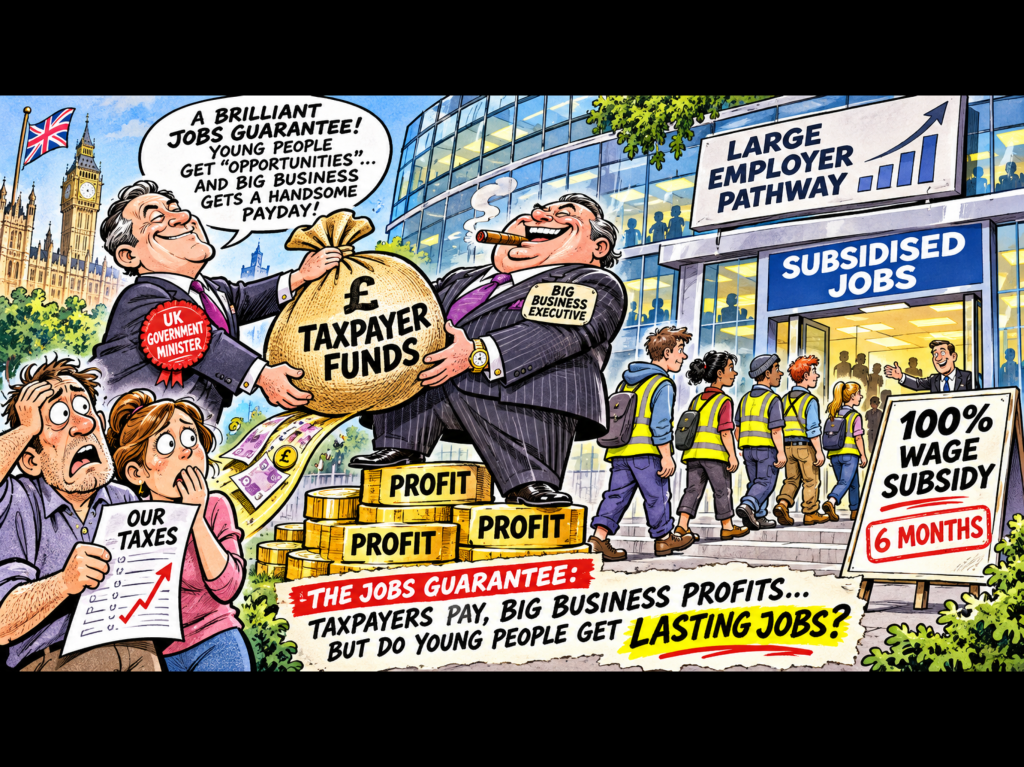
🤡🏦Welcome to Britain, where the Government has apparently invented a revolutionary economic policy: taxpayers fund the wages while businesses benefit from the labour!
Under the new Jobs Guarantee, eligible employers can receive 100% of qualifying employment costs for up to 25 hours a week, at the applicable minimum wage, for six months.
The target? More than 90,000 young people by March 2029.
And here’s the beauty of it: this isn’t restricted to struggling small businesses. Large corporations are actively encouraged to participate, with their very own Large Employer Pathway.
Apparently, big business needs a helping hand with something as financially demanding as paying its own employees. 💰
🎩Corporate Welfare: Socialism for the Payroll, Capitalism for the Profits!
Imagine running a profitable national company and being offered 100 eligible young employees whose qualifying wages are covered by taxpayers for six months.
The company benefits from their work, gains potential recruits and reduces its employment costs.
Meanwhile, the public picks up the eligible bill.
When did free enterprise become free employees?
The Government also offers separate incentives, including a £3,000 Youth Jobs Grant and a £2,000 apprenticeship hiring incentive, each with its own eligibility conditions.
At this rate, the Treasury resembles a corporate loyalty-card scheme. Hire someone, collect an incentive, and don’t forget to check the small print! 🎟️
Of course, the Government argues that subsidised jobs give unemployed young people valuable experience. That’s a worthwhile ambition.
But shouldn’t profitable businesses be expected to contribute meaningfully towards the employment costs of people working for them?
🚪Six Months of Free Wages — What Happens in Month Seven?
Here’s where the Government’s magnificent masterplan encounters reality.
After six months, do employers retain these young people permanently?
Or could some simply recruit another subsidised group while the previous workers return to unemployment?
There are safeguards, and no evidence establishes that employers are systematically abusing the scheme. But long-term outcomes have yet to be demonstrated.
Without measurable retention figures, how will taxpayers know whether they’re financing genuine opportunities or subsidising jobs businesses might have created anyway?
A temporary placement makes a lovely government headline. A permanent job actually changes someone’s life.
🗑️Biffa and the Corporate Recruitment Express
On 13 November 2026, the Government announced that waste-management giant Biffa intended to offer up to 2,000 opportunities through the wider Youth Guarantee.
That doesn’t mean 2,000 fully subsidised jobs. But it illustrates the active involvement of major national employers.
If those opportunities deliver training and lasting employment, fantastic.
But if publicly funded placements merely rotate workers through temporary positions, taxpayers could end up financing a very expensive revolving door. ♻️
🧠Alan Milburn and Ministers: Where’s the Accountability When Taxpayers Foot the Bill?
Alan Milburn and the Government have plenty to say about tackling youth unemployment. Admirable. But good intentions aren’t evidence of good outcomes, and spending taxpayers’ money isn’t the same as delivering value for it.
So here’s a challenge: prove these are genuinely new jobs, prove young people receive meaningful training, and publish how many remain in unsubsidised employment after six and twelve months.
And don’t bury the results in a glossy Whitehall report celebrating how many placements were announced. Publish employer-by-employer outcomes, where legally possible, and show whether the jobs would have existed without public funding.
Why should a profitable corporation enjoy the commercial benefit of someone’s labour while taxpayers cover 100% of the eligible employment costs — without a clear, measurable return?
Milburn’s review may identify the problems facing young people. But ministers must demonstrate that their proposed solutions work.
No measurable additional jobs? No credible training? No lasting employment outcomes? Then why should the public keep writing the cheques?
Because if the Government measures success by how much money it hands out rather than how many lasting careers it creates, this isn’t an employment revolution.
It’s corporate welfare wearing a youth-opportunity badge. 🎭💷
🔥Challenges: Jobs Guarantee or Corporate Giveaway?🔥
How stupid would a government have to be to spend millions subsidising employment without demanding clear evidence of lasting jobs?
And how much longer should taxpayers accept corporate subsidies without transparent accountability?
💷 Should profitable companies contribute towards every placement?
🚪 Should employers report how many workers they retain after six and twelve months?
🏦 Should public subsidies depend on genuine additional jobs and measurable results?
Helping young people into work is a worthy investment. Helping profitable corporations avoid costs they could afford themselves is another matter entirely.


Leave a Reply