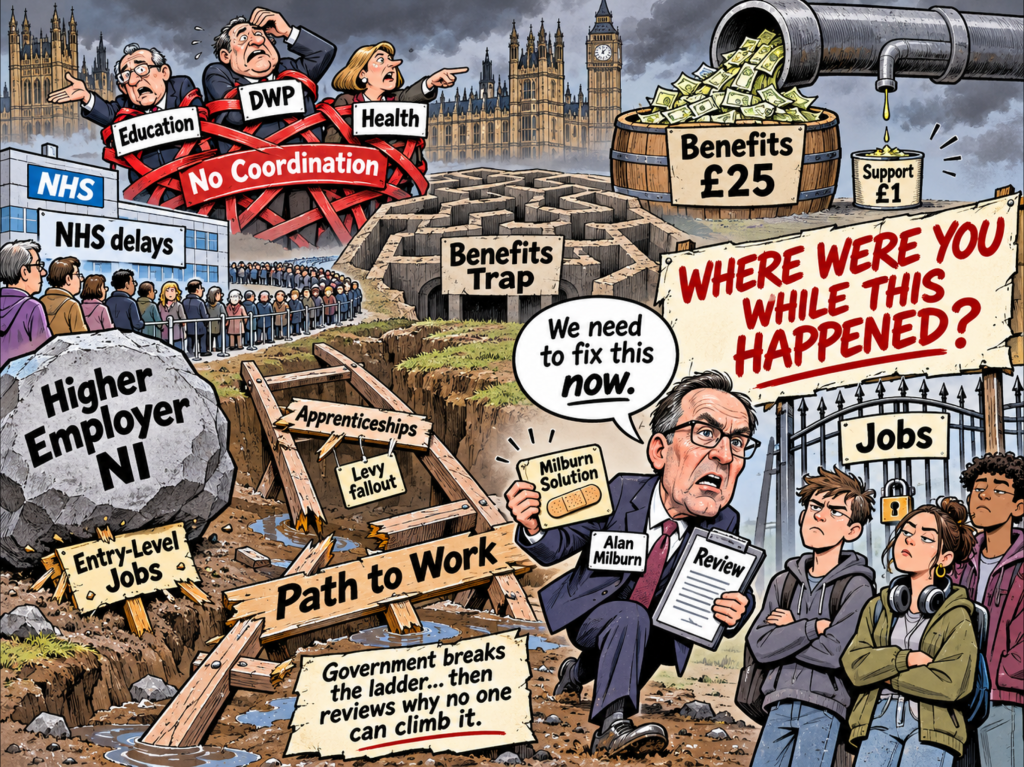
🪜💷🔥Young people didn’t invent Britain’s benefits system. They didn’t increase employers’ National Insurance, redesign apprenticeships, create NHS waiting lists or write the rules that can make moving from benefits into employment financially risky.
Politicians did. Yet somehow, young people could end up paying the price for fixing it.
Alan Milburn’s review of youth employment, with its proposals for a major overhaul of benefits and employment support, has exposed an extraordinary contradiction at the heart of British politics.
Successive governments have helped create obstacles to work. Now another government wants to reform the financial support received by those struggling to overcome them.
Welcome to Westminster, where the people who helped damage the staircase are holding an inquiry into why everyone is still downstairs. 🏛️🤡
🔥Seven Ways Westminster Helped Create the Crisis It Now Wants Young People to Solve
1. Make employing people more expensive. Then wonder why employers aren’t hiring. 💼
Labour’s April 2025 increase in employers’ National Insurance raised employment costs for many businesses.
Now the Milburn proposals include reducing employer National Insurance costs for younger workers.
Brilliant! First make employment more expensive, then consider using the tax system to make hiring young people cheaper again.
It’s like increasing the price of umbrellas during a thunderstorm, then launching a government-funded initiative to encourage people to stay dry.
Of course, employment decisions involve many economic factors. But perhaps ministers should examine the consequences of their own tax policies before presenting another incentive scheme as a revolutionary discovery.
2. Damage apprenticeships. Then complain young people lack opportunities. 🛠️
The Conservative Government introduced the Apprenticeship Levy in 2017.
According to Milburn’s interim report, apprenticeship starts among 16-to-24-year-olds in England subsequently fell by 35%, while Level 2 starts among young people declined by 68%.
Those figures do not prove the levy caused every lost opportunity. But they expose a serious failure in the system’s outcomes.
Britain took a well-established route into skilled work and oversaw a dramatic reduction in young people’s access to it.
Now politicians are discussing how to rebuild pathways into employment.
Apparently, the ladder needed dismantling before Westminster could discover the importance of ladders.
3. Design a benefits trap. Then accuse people of staying inside it. 🪤
This may be the most outrageous contradiction of all.
Milburn raises legitimate concerns about how financial incentives within the benefits system can discourage employment.
But who designed those rules?
Not a disabled 21-year-old deciding whether accepting an uncertain, low-paid job might put essential financial support at risk.
Successive governments designed the system, established the eligibility criteria and determined how benefits interact with earnings.
If those rules punish attempts to enter employment, the answer should be to fix them.
Instead, young people face the possibility of reduced entitlements under proposed reforms.
Imagine building a maze, charging people rent for being trapped inside it, then accusing them of lacking the ambition to find the exit.
4. Leave people waiting for healthcare. Then ask why they cannot work. 🏥
Milburn identifies poor physical and mental health as significant contributors to young people’s economic inactivity.
Unfortunately, a ministerial speech does not magically produce a psychiatrist, an operation or a specialist appointment.
Healthcare delays can worsen an individual’s ability to work, although the relationship between NHS waiting lists and benefit claims is complex.
Still, the underlying contradiction deserves attention.
A young person who needs treatment cannot necessarily become fit for employment because the Treasury would prefer a smaller benefits bill.
You cannot replace healthcare with motivational slogans.
And you cannot expect a benefits reform to perform the work of a functioning health service.
5. Create departments that don’t cooperate. Then commission a report about cooperation. 📋
In July 2026, the House of Commons Work and Pensions Committee identified a lack of coherence between government departments responsible for helping young people into employment, education and training.
What a revelation!
One department deals with qualifications, another with benefits and another with healthcare.
Meanwhile, the young person who needs all three services must somehow navigate the administrative obstacle course.
Westminster has apparently invented a relay race in which every runner is employed by a different department, nobody wants to pass the baton and the teenager is blamed for not reaching the finish line.
6. Spend £25 managing the problem for every £1 spent helping young people into work. 💸
Milburn estimated that in 2024–25, the Department for Work and Pensions spent approximately £25 on benefits for young people for every £1 spent on employment support.
That comparison needs context. Benefits provide essential living support, and the figures do not measure the effectiveness of each programme.
Nevertheless, the imbalance raises a vital question.
Why has Britain been so willing to fund the consequences of exclusion while failing to build sufficiently effective routes into sustainable employment?
Instead of treating prevention as a priority, Westminster appears to have perfected an expensive system for managing the aftermath.
7. Announce an expensive rescue mission for problems government helped create. 🚨Milburn’s recommendations include stronger employment support, expanded apprenticeships, employer incentives and reforms to benefits.
Some proposals could offer genuine improvements, especially if access to work, training and healthcare comes before reductions in financial support.
But here is the absurdity.
Governments have overseen deteriorating pathways into employment, created complex welfare incentives and struggled to coordinate essential services.
Now taxpayers may have to finance another enormous exercise in putting those failures right.
It’s the political equivalent of setting fire to the garden shed, charging the neighbours for the fire brigade and then delivering a lecture about responsible homeownership.
And everyone involved wants a round of applause for discovering the hose. 👏
⚖️The Real Scandal: Accountability Has Become a One-Way Street
Let’s be fair about one thing.
Labour inherited many of Britain’s structural problems when it entered government in 2024. Conservative governments deserve scrutiny for their record, including apprenticeship policy, employment support and public services.
Labour, equally, must answer for its own decisions and how effectively it addresses those inherited problems.
Employers, technological change and wider economic conditions also influence opportunities for young people.
But that makes the case for serious government accountability stronger, not weaker.
The argument is not that every unemployed young person is incapable of working, or that benefits should never change.
It is that government cannot reasonably demand greater responsibility from young people while refusing to account for the systems that have repeatedly failed them.
Milburn has identified serious problems. His review also recognises the need for substantial improvements in employment opportunities, education, apprenticeships and health support.
Those reforms deserve consideration.
But proposals that leave some vulnerable young people with less financial support deserve equally serious scrutiny.
A job opportunity is not much use if the job doesn’t exist. An apprenticeship guarantee is meaningless if employers cannot provide places. And a promise of mental-health support is worth considerably less when someone cannot actually access treatment.
What happens when the architects of failure demand that its victims pay for the repairs?
Before reducing anybody’s financial support, ministers should demonstrate how many young people have been pushed towards economic inactivity by government policy, inadequate training opportunities, healthcare failures and a shortage of suitable jobs.
And they should demonstrate that those problems will be corrected before removing the support on which people depend.
Because if government policy has helped close the doors to employment, perhaps the first investigation should concern those who closed the doors — not simply the young people standing outside.
Britain’s young people deserve opportunities, not another political invoice for failures they did not create.
👇 COMMENT DIRECTLY ON THE CHAMELEON NEWS BLOG, LIKE THIS ARTICLE AND SHARE IT.
💬 Tell us whether Westminster should be held accountable before young people’s benefits are changed. We welcome your experiences, evidence and opinions.
🏆 The best comments will be featured in the next issue of Chameleon News magazine.


Leave a Reply