Welcome to Britain, where the government can tell you how many people are claiming benefits, but calculating the long-term financial consequences of immigration and settlement policy is an altogether more complicated affair.
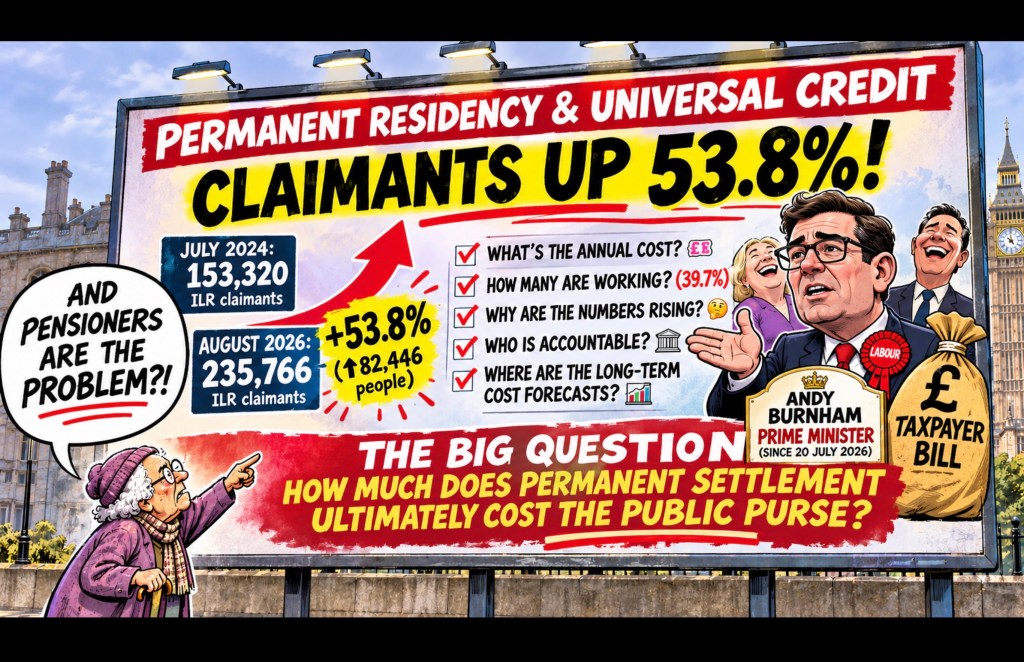
Figures highlighted by the Centre for Migration Control on 17 November 2026 reveal that Universal Credit recipients recorded as having Indefinite Leave to Remain (ILR) increased from 153,320 in July 2024 to 235,766 in August 2026.
That’s 82,446 additional claimants — a whopping 53.8% increase in just over two years. Guido Fawkes +1
And before Westminster reaches for its industrial-sized political excuse generator, there’s one rather important question:
How much is all this costing, and where’s the financial forecast? 🧮
🎪 Westminster’s Magic Money Calculator: Plenty of Numbers, Not Enough Answers
Britain’s immigration and welfare systems increasingly resemble two government departments sharing a building but apparently communicating through messages tied to carrier pigeons.
The Home Office deals with immigration and settlement rights. The Department for Work and Pensions administers benefits. The Treasury worries about the bill.
And the taxpayer? Well, the taxpayer gets to watch the whole performance while wondering whether anyone has added up the receipts. 💸
According to the DWP, people recorded in the ILR category represented 2.8% of Universal Credit recipients in August 2026. That’s a relatively small proportion of the overall caseload, but a sizeable increase in the number recorded in that category. GOV.UK
Here’s where the plot thickens.
In July 2026, 39.7% of Universal Credit claimants in the ILR category were employed. So this isn’t simply a story about people not working. Universal Credit also supports people whose wages don’t meet their assessed living costs. GOV.UK
And the figures don’t automatically tell us whether Britain’s finances are better or worse off. That would require knowing how much tax these households contribute, how much support they receive and what other public costs and economic contributions are involved.
In other words, we have a headline figure, but not the complete financial picture.
It’s rather like buying a house, celebrating the purchase, and only afterwards wondering whether anybody checked the mortgage repayments. 🏠
🧾 The Settlement System: A Receipt Without a Total?
To be fair, having ILR doesn’t automatically mean receiving benefits. People must still qualify. And the DWP’s ILR figures can include people who have subsequently become British citizens but whose administrative records haven’t been updated.
There’s another complication: claimants moving from older benefits onto Universal Credit can increase the UC figures without representing entirely new demands on the welfare system. GOV.UK
Which makes the need for transparent accounting even more obvious.
The increase happened during Labour’s time in government, but settlement decisions made under previous Conservative administrations can have consequences years later.
So neither party gets to escape scrutiny merely by pointing across the Commons chamber and shouting, “It was them!” 🏛️
Meanwhile, Labour has been pursuing tougher conditions for permanent settlement through its earned-settlement reforms. GOV.UK
There’s a legitimate policy question buried beneath all the political theatre: How should governments measure the long-term economic and fiscal effects of granting permanent settlement?
Because taxpayers deserve something more useful than a political blame game with an invoice attached.
🔥 Challenges: Three Questions Westminster Shouldn’t Be Allowed to Dodge
Here’s the challenge for ministers, opposition politicians and anyone claiming to understand Britain’s immigration finances:
- Where’s the full bill? What is the total annual Universal Credit expenditure attributable to households in the recorded ILR category, and how does that compare with their tax contributions?
- What’s driving the increase? How much reflects new settlement, changing household circumstances, transfers from legacy benefits or outdated immigration-status records?
- Who’s planning for tomorrow? Are settlement decisions supported by published forecasts covering future welfare spending, tax revenue and public-service demand?
And here’s the uncomfortable twist: a 53.8% increase makes an excellent headline, but it doesn’t establish a 53.8% increase in costs — let alone the net cost to the taxpayer.
The real scandal would be making major long-term policy decisions without properly measuring their consequences.
The public doesn’t need another competition to see which politician can shout “immigration” the loudest. It needs meaningful figures, coherent forecasts and accountability across governments.
💬 YOUR TURN: WHAT WOULD YOU ASK THE GOVERNMENT?
Should people granted permanent settlement have the same access to means-tested support as other eligible residents?
Should ministers publish an annual account of settlement-related tax contributions and welfare spending?
Or is the real problem Britain’s wider dependence on Universal Credit to support people whose wages simply don’t stretch far enough?
👇 Drop your verdict in the comments on our blog — not just on Facebook!
🔥 COMMENT, LIKE AND SHARE! Bring your sharpest arguments, your cleverest sarcasm and, ideally, a calculator that works better than Westminster’s.
🏆 The best comments will be featured in the next issue of Chameleon News Magazine!
Sources: DWP official statistics · Guido Fawkes, 17 November 2026
🌐 **https://chameleon-news.com**


Leave a Reply