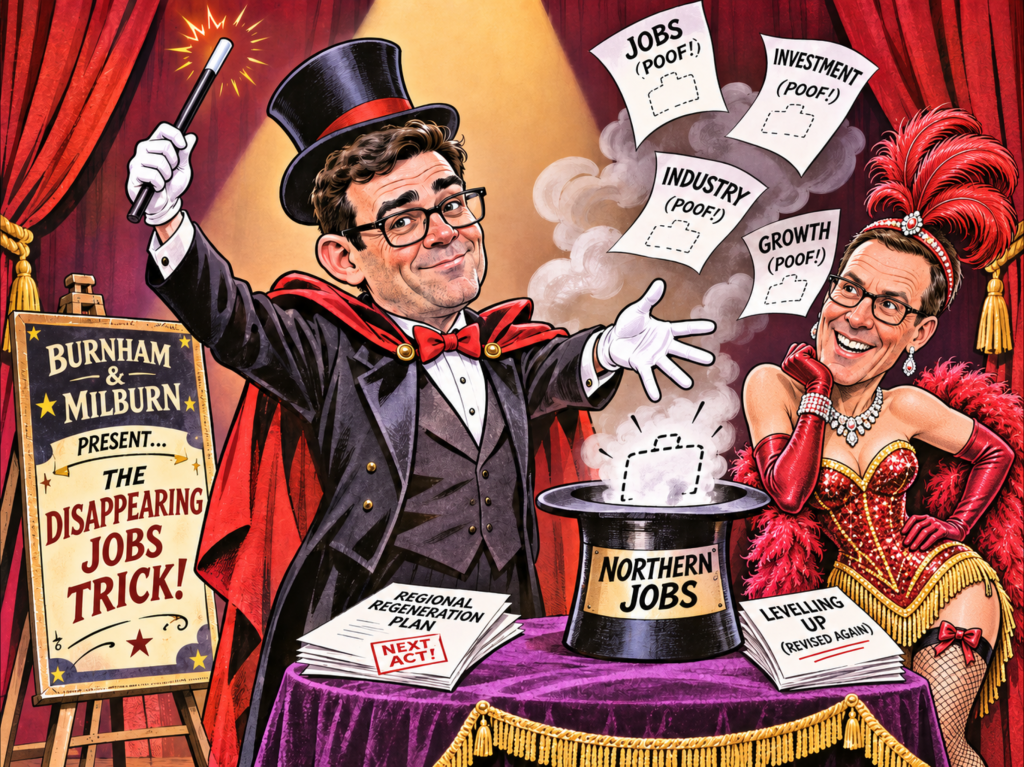
💷🐇Welcome to Westminster’s latest economic magic show, where hiring a young worker becomes more expensive, taxpayers are invited to help foot the bill, and politicians promise to tackle the unemployment problem.
According to the Centre for Policy Studies, the annual minimum employment cost of a full-time 18–20-year-old rose from £15,652 in 2024 to £19,747 in 2026 — an increase of more than £4,000.
Meanwhile, the Government is examining how to get more young people into work, including financial incentives for employers and changes to the benefits system.
Ladies and gentlemen, prepare to witness the incredible disappearing entry-level job! 🎩✨
🪄 ABRACADABRA! FIRST CREATE THE COST, THEN SUBSIDISE THE SOLUTION!
💰1Imagine running a small café, shop or restaurant.
You’re considering hiring an inexperienced 19-year-old. They’re enthusiastic, willing to learn and desperate for their first opportunity.
But employing them costs considerably more than it did two years ago.
You hesitate.
And somewhere in Westminster, a government adviser peers into a spreadsheet and announces:
“We’ve identified a worrying reluctance among employers to recruit young people!”
Well, congratulations, Sherlock. 🔍
The Government has discovered that businesses consider the cost of employing people before employing them.
Next comes the grand unveiling: taxpayer-funded incentives encouraging businesses to hire the very youngsters whose employment costs have been rising.
It’s rather like putting up the price of umbrellas during a rainstorm, then announcing a government-funded umbrella affordability scheme. ☔💷
The taxpayer potentially pays twice: once through the higher costs businesses face, where these are passed on, and again through the subsidies intended to encourage recruitment.
And the young person?
They’re still standing outside the employment agency wondering why every entry-level vacancy demands two years’ experience, three references and the wisdom of a retired bank manager.
🎪 THE WESTMINSTER CIRCUS HAS A NEW ACT
Of course, there are serious arguments for increasing minimum wages.
Young workers deserve decent pay. Nobody should be expected to survive on pocket money simply because their birthday cake has fewer candles.
And youth unemployment didn’t magically appear when Labour entered Downing Street. Poor skills provision, health problems, economic uncertainty and longstanding barriers to employment all contribute to the problem.
Indeed, the independent Low Pay Commission says there is little evidence that recent youth minimum-wage increases have themselves driven falling employment, although it recognises risks from further increases.
But the Institute for Fiscal Studies has also warned that the combined increases in minimum wages and employer taxes can reduce opportunities for young workers.
So here’s the question Westminster needs to answer:
If employers are reluctant to recruit because hiring costs have increased, how sustainable is a system that uses public money to persuade them otherwise?
Alan Milburn’s November 2026 review proposes stronger employment incentives alongside wider reforms to support young people into work. Those proposals deserve scrutiny, particularly over whether subsidised jobs become lasting employment.
Because the objective shouldn’t be to create a spectacular collection of subsidised six-month jobs that disappear when the funding does.
That isn’t necessarily an employment revolution.
It could become a taxpayer-funded game of musical chairs, with young people left standing when the music stops. 🎶🪑
And perhaps before demanding that unemployed youngsters demonstrate more responsibility, ministers should demonstrate that their own policies fit together.
After all, you cannot keep adding weight to the recruitment ladder and then express astonishment when fewer young people manage to climb onto it. 🪜
💬 What do you think? Is this a sustainable employment strategy or another expensive government revolving door?
👇 COMMENT on the blog, LIKE this article and SHARE it to get the debate going! 🔥
🏆 The best comments, sharpest observations and most thought-provoking contributions will be featured in the next issue of Chameleon News Magazine!


Leave a Reply