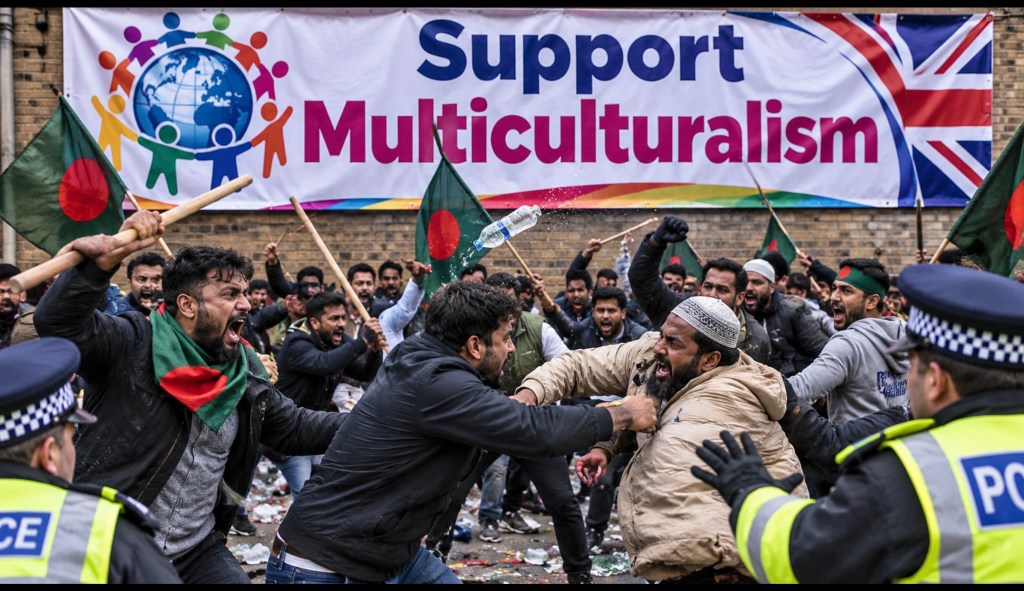
Welcome to Romford, East London. A place where residents might reasonably expect traffic jams, expensive parking and the occasional argument outside a pub. What they probably didn’t expect was a political dispute from Bangladesh apparently turning their neighbourhood into an international wrestling arena.
On Monday, 16 November 2026, supporters of rival Bangladeshi political factions clashed following a reception for opposition politician Nahid Islam. Reports described sticks, flying objects, injuries and police officers attempting to restore order.
At least six people were reportedly injured, although accounts differ on the precise number.
And the extraordinary twist? The political argument belonged to Bangladesh. The street fighting happened in Britain. And British emergency services were left managing the consequences. 🚔💥
Apparently, international politics now comes with a complimentary home-delivery service. Unfortunately, nobody ordered the violence.
🥊 Exporting Political Arguments: No Passport Required, Just Bring Your Own Stick!
There was a time when supporting a political party overseas meant attending meetings, waving flags, giving speeches or arguing passionately over dinner.
Now, judging by the scenes reported in Romford, some participants appear to have mistaken a political reception for auditions for Bangladesh’s Got Bruisers.
Forget diplomatic exchanges. Why debate when you can allegedly exchange flying bottles?
Forget international relations. Apparently, international altercations will do.
And forget the United Nations. Someone seems to have confused peaceful assembly with a particularly aggressive game of dodgeball. 🏐
But beneath the absurdity sits a serious question.
Why should British residents have to navigate street violence arising from political rivalries thousands of miles away?
Britain is home to people with connections to virtually every country on Earth. That cultural diversity includes different histories, political opinions, traditions and loyalties.
And that’s perfectly legitimate.
Supporting a political party in Bangladesh? Absolutely your right.
Protesting against that party? Equally legitimate.
Arguing passionately about Bangladesh’s political future? Go ahead.
Turning a residential street into an unofficial branch of an overseas political battleground? Absolutely not.
Political disagreement doesn’t become acceptable violence simply because the disagreement originated abroad.
🚨 British Police: Now Apparently Responsible for International Political Disputes
Imagine the emergency call.
“Police, what’s your emergency?”
“There’s fighting in Romford.”
“What’s the dispute?”
“Bangladeshi politics.”
“Sorry, did you say Romford or Dhaka?”
“Romford.”
“Of course it is.” 🙄
Jokes aside, officers responding to disorder have a serious job. They must protect the public, safeguard injured people, preserve evidence and investigate possible offences.
The Metropolitan Police have opened an investigation into the incident.
And let’s be absolutely clear: the overwhelming majority of British-Bangladeshi residents should not be judged by the actions of individuals involved in this confrontation.
Community leaders have condemned the disorder and offered to assist the police.
That distinction matters enormously.
A community is not responsible for every person who shares its heritage, just as football supporters aren’t collectively responsible for every hooligan wearing their team’s colours.
The issue isn’t ethnicity. It isn’t cultural identity. And it isn’t whether someone was born in Britain or Bangladesh.
The issue is whether people respect the law of the country whose streets they are standing on.
Anyone found responsible for assault, intimidation or violent disorder should face the appropriate consequences under British law, regardless of political allegiance or nationality.
No diplomatic discount. No ideological exemption. No special treatment.
Britain can accommodate a thousand cultures, a thousand political opinions and a thousand fiercely contested arguments.
What it cannot reasonably accommodate is a thousand miniature street battles every time somebody disagrees about politics back home.
Because multiculturalism should mean different communities living together peacefully, not importing every political confrontation along with the family recipes.
The question isn’t whether people should be allowed to care about their homeland. Of course they should. The question is why anyone believes caring about their homeland gives them permission to endanger their neighbours.
And that question deserves answers, not another flying bottle.
💬 YOUR VERDICT: SHOULD FOREIGN POLITICAL FEUDS EVER BECOME BRITAIN’S STREET PROBLEM?
What do you think? Should Britain introduce stronger safeguards around events where overseas political tensions risk escalating, or are existing public-order laws sufficient when properly enforced?
👇 COMMENT directly on our blog, LIKE this article and SHARE it with anyone who believes political arguments belong in debates, not street fights! 🔥🇬🇧
🏆 The sharpest, funniest and most thought-provoking comments will be featured in the next issue of Chameleon News Magazine! 🦎📰


Leave a Reply