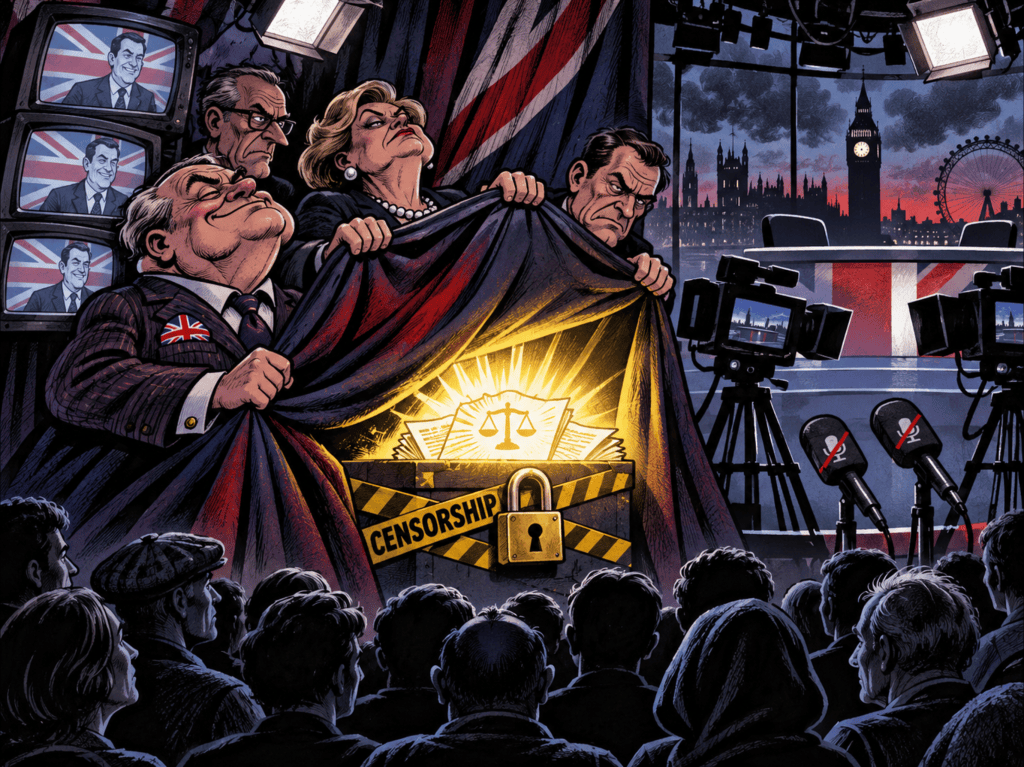
Switch on the television. Turn up the radio. Flick between the national news bulletins.
Ukraine. Russia. Gaza. Palestine. International conflict, diplomatic arguments, military developments and another round of politicians explaining what the world should be doing next.
These are serious stories that deserve coverage.
But here’s another question worth asking: what about the anti-immigration demonstrations happening here in Britain?
From Plymouth to other towns and cities, people have taken to the streets to protest immigration policies, border controls and the government’s handling of the issue. Yet some viewers and listeners are left wondering why demonstrations they see circulating on social media don’t always appear prominently on national television or radio.
The contrast is striking. A demonstration can attract attention online, generate heated debate and provoke local controversy without necessarily making the BBC’s national evening bulletin.
Is the problem selective reporting, different editorial priorities, or the enormous gap between what goes viral online and what broadcasters consider national news?
Whatever the answer, it’s a question national broadcasters should be prepared to address.
📺 The Great British Remote Control: World News at Full Volume, Local Voices on Low! 🔇
Imagine the scene.
You’re sitting on your sofa with a cup of tea, watching the evening news.
There’s a report from Ukraine. A correspondent discussing Russia. Another live update from Gaza. Then an international summit, a diplomatic row and a politician standing in front of seventeen flags explaining why the next six months are absolutely crucial.
By the time the programme finishes, you’re practically qualified to join the United Nations. 🌍
But if you wanted to know about anti-immigration demonstrations in Plymouth, Dover, Portsmouth or elsewhere in Britain, you might be wondering where to look.
Apparently, the remote control needs a new button marked “What’s Happening in Our Own Country?” 🇬🇧
Now, to be fair, national broadcasters haven’t completely ignored these events. Sky News has covered demonstrations in Portsmouth, ITV has reported on protests across Hampshire and Kent, and the BBC has reported on demonstrations in places including Gosport and Glasgow.
That makes the real question more interesting.
How much national airtime do these protests receive, how prominently are they presented, and how does that compare with other major stories?
Because reporting something once and examining its wider significance are not necessarily the same thing.
Take Plymouth.
On 8 November 2026, The Janner reported that approximately 25–30 masked demonstrators had gathered outside the BBC studios in Plymouth. Their message explicitly accused the broadcaster of ignoring the British public.
You might reasonably expect a protest directed at a major broadcaster to prompt questions about public confidence in journalism, editorial impartiality and the relationship between traditional news and social media.
Instead, the incident appears to have remained largely a local story.
Was that because of its relatively small scale? Because national editors had bigger stories? Or because broadcasters apply different thresholds to different kinds of demonstrations?
These are questions worth putting directly to the newsrooms.
And what about radio? BBC Radio 4, Radio 5 Live, LBC and the national radio news bulletins all play important roles in shaping public debate. Without examining their actual programme logs, we cannot say how much airtime they devoted to particular protests.
But audiences are entitled to ask for that comparison.
The BBC is publicly funded. Impartiality and editorial accountability should be more than words printed in a corporate handbook nobody reads until somebody complains. 📚
The same standards of accuracy, proportion and scrutiny should apply whether people are demonstrating over immigration, climate change, foreign policy or anything else.
Peaceful protesters deserve fair and accurate reporting. People who oppose their views deserve fair representation too. And where demonstrations involve intimidation, violence or criminal allegations, those facts must also be reported.
That’s journalism, not cheerleading.
What we should avoid is confusing a perceived shortage of coverage with proof of a deliberate blackout. The evidence doesn’t establish that.
But neither does the existence of a handful of reports settle whether the overall balance of coverage is appropriate.
A story can be covered without being given the prominence its audience believes it deserves.
And in a country where trust in the media is constantly debated, that distinction deserves more than a shrug and another weather forecast. ☔
The question is simple: if national television and radio can devote hours to events thousands of miles away, how do they decide which concerns and demonstrations closer to home deserve the nation’s attention?
Britain’s news should reflect the world. But it should also give audiences a clear picture of what’s happening on their own doorstep. 🇬🇧📺
👇 COMMENT DIRECTLY ON OUR BLOG, LIKE THIS ARTICLE AND SHARE IT. 💬🔥
Are national TV and radio broadcasters giving Britain’s anti-immigration demonstrations enough attention? Tell us what you think in the comments.
🏆 The best comments and most thought-provoking contributions will be featured in the next issue of Chameleon News Magazine! 📰


Leave a Reply