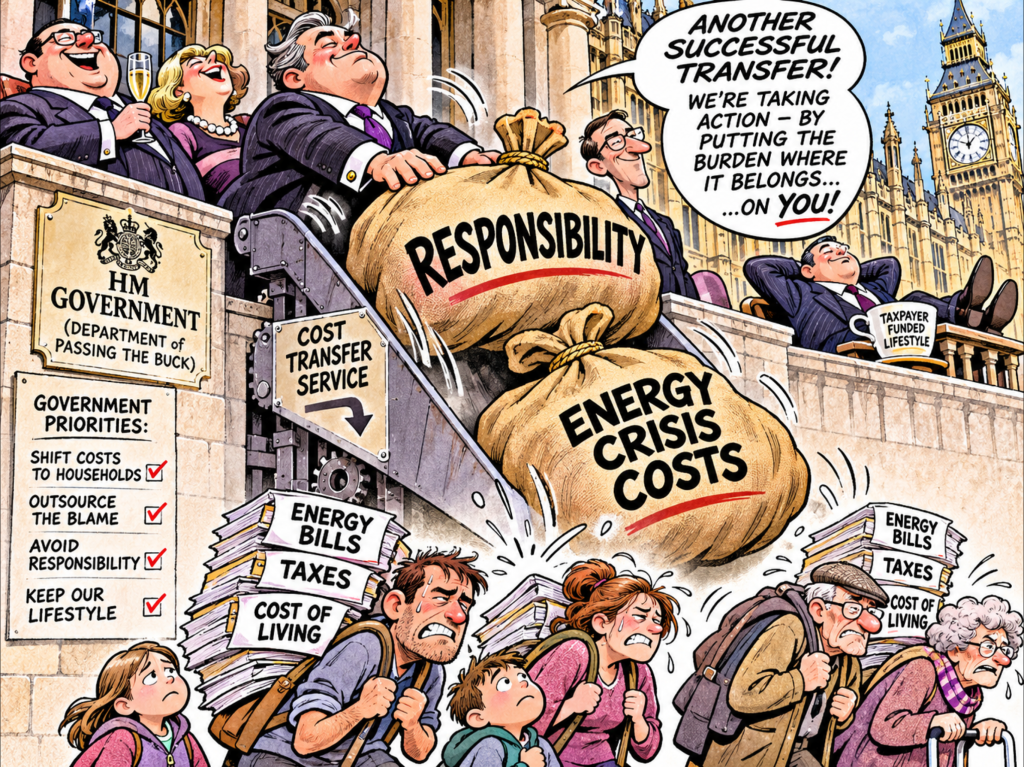
Imagine scrimping, saving, cancelling holidays and turning down the thermostat to keep your energy account in credit, only to discover that your own bill can include an allowance for the cost of other customers’ unpaid energy debts.
It raises an uncomfortable question about Britain’s energy system: who should ultimately foot the bill when households can no longer afford essential services?
💸 The National Bank of Your Back Pocket
Congratulations! You’ve managed your household budget, sacrificed a few luxuries and paid your energy bills on time. Your reward? An energy pricing system that allows suppliers to recover certain costs associated with other customers’ unpaid bills.
Ofgem’s pricing framework includes allowances for bad debt and debt administration. Its justification is that leaving suppliers unable to recover these costs could contribute to company failures and ultimately higher costs for consumers. Ofgem +1
But from the household budgeting perspective, it’s rather like going to a restaurant, ordering the cheapest meal on the menu and discovering that the prices also reflect the cost of customers who couldn’t pay.
Nobody should be left freezing in their own home because of genuine financial hardship. Equally, paying your bills doesn’t necessarily mean you’re financially comfortable.
The household just above the threshold for financial assistance might already be surviving on supermarket reductions, second-hand clothes and three layers of knitwear.
So where should financial responsibility sit? With energy suppliers, billpayers or government-funded social support?
Funding assistance through general taxation would spread the burden differently, although taxpayers would still ultimately meet the cost.
Perhaps the energy bill needs a new slogan:
“Keeping Britain warm — one increasingly complicated financial arrangement at a time.”
🔥 Challenges 🔥
When did paying your own bills become part of a wider debate about paying everybody else’s?
Should energy debt be funded through general taxation, absorbed by suppliers or shared among energy customers? And how should we protect households that are struggling but still managing to pay?
Where would you draw the line between social responsibility and financial fairness?
Don’t leave the debate buried beneath a Facebook algorithm. Head over to the blog and tell us exactly what you think. 💬


Leave a Reply