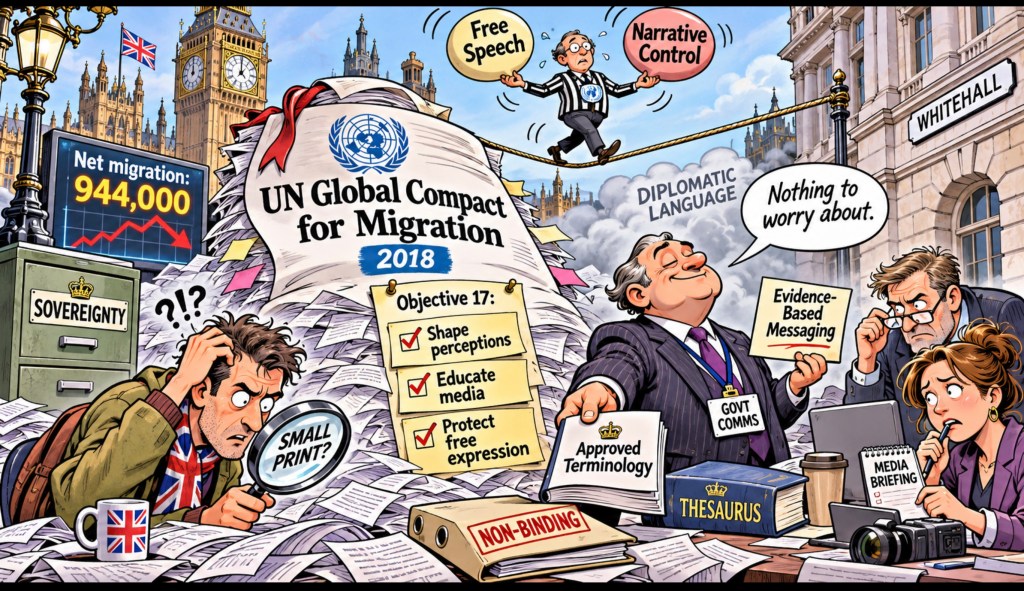
In December 2018, Britain quietly signed up to the United Nations Global Compact for Migration — a legally non-binding document that promises not to bind anyone to anything, right up until someone treats it like a sacred scroll.
Critics at the time worried about migration numbers, national sovereignty, and whether Whitehall might start treating newsrooms like interns needing “terminology coaching.” Naturally, those concerns were greeted with soothing assurances that nothing would change, followed shortly by changes nobody claimed to have caused.
Fast-forward to 2026, and Britain has experienced annual net migration reaching 944,000 in the year ending March 2023, before subsequently declining. Correlation isn’t causation, of course — otherwise we would have to blame the 2018 World Cup semi-final — yet watching numbers surge and wobble still makes people wonder what everyone actually agreed to.
📰 Freedom of Speech — Now With Terms, Conditions, and a Complimentary Thesaurus
International diplomacy possesses a rare, borderline-clinical gift for wrapping explosive political questions in prose dense enough to sedate a caffeinated badger.
Tucked inside Objective 17 are polite diplomatic nudges inviting governments to:
Bullet Mold public attitudes toward migration via “evidence-based” messaging (the evidence is always whichever spreadsheet agrees with the press office).
Bullet “Educate” journalists on migration issues and approved vocabulary (because reporters famously lack dictionaries and need civil servants to supply the right adjectives).
Bullet Cut off public money to outlets that systematically promote discrimination against migrants (a noble goal, provided nobody defines “systematic discrimination” as “asking where the tents are going”).
Right alongside those suggestions sits a solemn pledge to uphold free expression and media independence.
It is a delicate high-wire act. Rather like hiring the referee to coach both strikers, sponsor the half-time oranges, and decide which fouls are merely “robust interpretations of the offside rule.” ⚽
Who draws the line between sharp policy critique and prejudice? Who drafts the glossary? And, most urgently of all, who fact-checks the Ministry of Approved Phrasing?
Supporters say careful reporting curbs bias and cruelty. Critics worry that state-backed guidance nudges editors toward timidity before a story is even pitched.
Both sides deserve a hearing — ideally one where nobody is handed a laminated cue card first.
A treaty can be “legally non-binding” and still carry plenty of political gravity. Ministries love a helpful international nudge when they already want to say yes.
Perhaps the UN should have bundled a companion pocket guide titled How to Liberate Public Debate While Gently Steering Every Word. 📚
Asking questions about housing strain, NHS queues, rail capacity, tax contributions, border rules, and humanitarian duties is not an automatic attack on newcomers.
Questioning immigration policy is not the same as attacking immigrants.
And shielding people from prejudice should not turn into shielding ministers from awkward math.
Don’t let your hot takes rot at the bottom of a chaotic comment thread. March straight over to our blog and add yours to the pile.
👇 COMMENT. LIKE. SHARE. Poke holes in the logic, interrogate the policy, and make your voice heard before the algorithm buries it. 💬🔥
The sharpest comments could make it into the next issue of the magazine — assuming the editors haven’t been “re-educated” out of printing them. 🎯📝


Leave a Reply