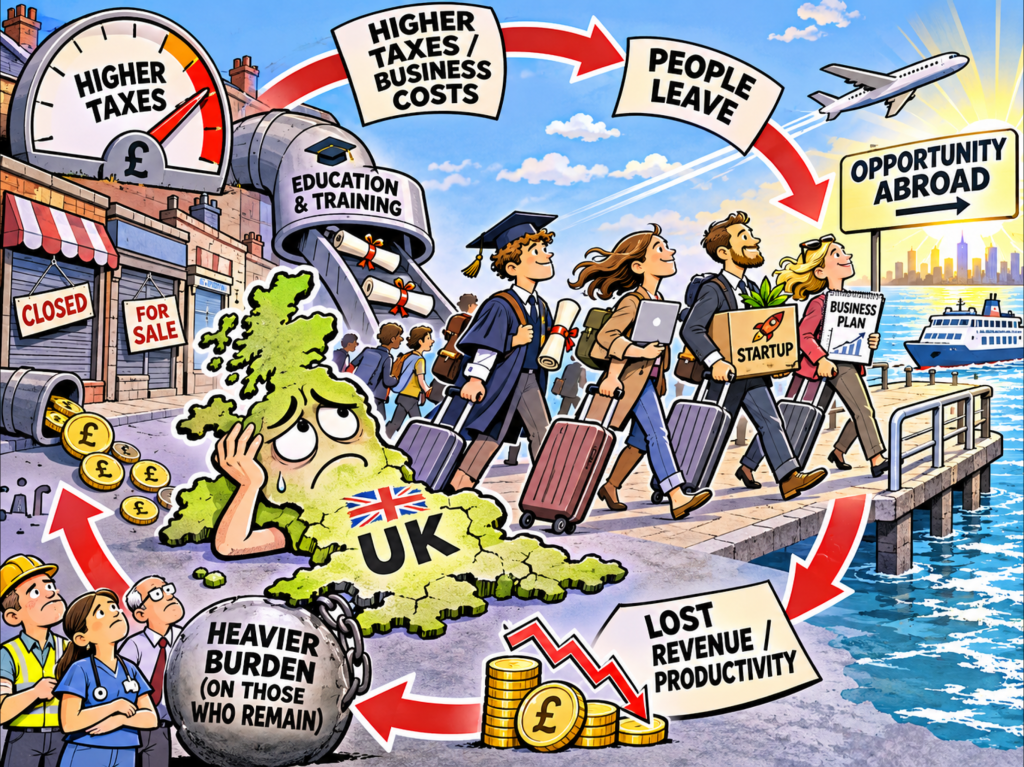
Britain may be facing a problem far more economically significant than population loss: the departure of its future workforce, entrepreneurs, taxpayers and wealth creators.
The concern is that Britain invests considerable resources in educating and training its citizens, only for other economies potentially to reap the financial rewards. If taxation, business costs and better opportunities overseas are contributing to these departures, the long-term implications deserve serious investigation.
🎓 Britain’s Potential New Export Industry: Its Own Talent
Forget exporting whisky, cars and engineering expertise. Britain may have another export worth examining: the very people capable of building its economic future.
Consider the figures:
- 245,000 British nationals left the UK in the year ending June 2026.
- 137,000 was the estimated net loss of British nationals.
- 91% of British emigrants were of working age in the year ending March 2025.
- Approximately two-thirds of British emigrants were aged between 16 and 34 during that earlier period.
- 2,758 was the net outflow of high-growth business owners between January 2024 and January 2026, according to research commissioned by Rathbones. Office for National Statistics +3
Imagine running a business, investing years in training your staff, and then watching your competitors benefit from their expertise. You would probably investigate your employee retention strategy.
Should a country approach its economic workforce any differently?
My concern is that Britain could find itself caught in an increasingly expensive economic merry-go-round:
Britain’s potential economic vicious cycle
An illustrative hypothesis, not an established causal relationship
It’s a bit like trying to fill a leaking bath by turning up the taps without investigating the hole in the bottom. 🛁
Of course, people emigrate for numerous reasons, including career prospects, family circumstances and lifestyle choices. The latest ONS figures also indicate that British emigration has remained broadly stable over the past five years.
Nor does every departing entrepreneur necessarily take their business, employees or entire tax contribution overseas.
But that is precisely why the economic consequences warrant closer examination.
How much public investment in education and training ultimately benefits competing economies? What is the net impact on tax revenues? How many future businesses might be established overseas rather than here?
You cannot properly assess the economic balance sheet without examining both sides of the ledger.
A successful country should be somewhere its own citizens aspire to build their futures, not somewhere they aspire to escape from.
🔥 Challenges 🔥
If Britain’s future workforce is packing its suitcases, what should Britain be doing to encourage it to stay?
Would you leave Britain if a better financial opportunity presented itself overseas? Is taxation the problem, or are wages, housing costs, career prospects and quality of life equally important?
What would persuade you to stay — or come back?
👇 Comment directly on our blog, like and share this article. We want your experiences, arguments and solutions — not just another migration statistic.
The best comments will be featured in the next issue of the magazine. 🎯📝
Editorial verification: All five headline statistics have been checked against ONS publications and Rathbones research. The 2026 migration estimates are provisional, the age figures relate to March 2025, and the proposed economic cycle remains a hypothesis requiring further evidence.


Leave a Reply