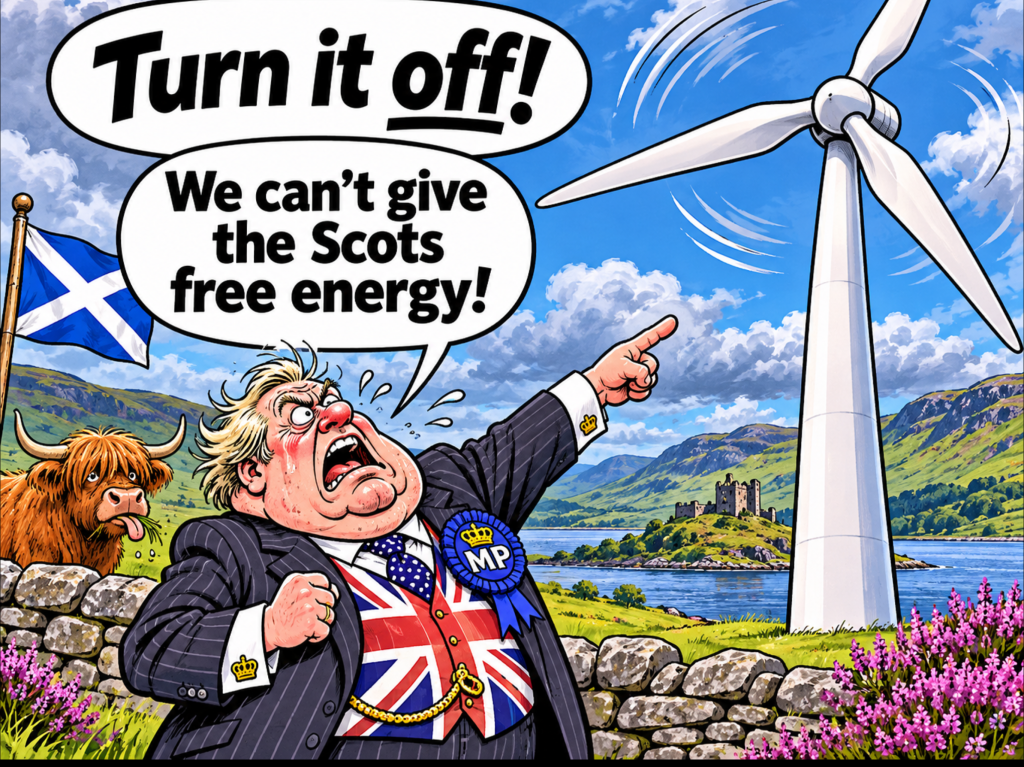
⚡💸Scotland generates an abundance of renewable wind energy, yet instead of rewarding Scottish households with cheaper electricity during periods of surplus, Britain can end up paying wind farms to switch off while expensive gas-fired power stations elsewhere increase production.
Meanwhile, France can potentially purchase British electricity at lower wholesale prices, with British consumers left picking up the associated grid-balancing costs.
If this is what an intelligent energy market looks like, heaven help us if they ever design a stupid one.
🌬️ Scotland’s Wind, France’s Bargain, Your Bloody Bill!
Imagine owning a bakery with hundreds of freshly baked loaves. Instead of offering them cheaply to hungry local customers, you pay your bakers to stop baking, fire up an expensive bakery hundreds of miles away and send your customers the bill.
Congratulations! You’re now qualified to help design Britain’s electricity market.
Under certain conditions, the extraordinary economic merry-go-round works like this:
- Scotland generates an abundance of cheap wind energy.
- Britain’s wholesale electricity price falls.
- France can purchase cheaper British electricity.
- Transmission bottlenecks restrict Scottish generation.
- Scottish wind farms are paid to stop generating.
- English gas-fired power stations are paid to increase production.
- British consumers shoulder the balancing costs.
It’s not an energy strategy. It’s a financial pantomime with turbines.
And before anyone starts blaming the French, they’re not the villains here. There is no established evidence of a specific preferential subsidy for France. They’re simply taking advantage of the market conditions Britain has created.
You can hardly blame someone for shopping in the reduced-price aisle when we’re the ones sticking yellow labels on everything. 🇫🇷
💡 Free Electricity? Don’t Be Ridiculous — That Might Actually Make Sense!
Greg Jackson, chief executive of Octopus Energy, has championed regional electricity pricing that would allow Scotland to benefit from its abundant renewable resources.
Yet on 10 July 2025, the UK Government announced its decision to retain national wholesale pricing, favouring alternative reforms and citing concerns about investment stability.
So why aren’t we doing more to encourage Scottish households to absorb surplus electricity?
Imagine receiving a notification:
🌬️ Scotland has surplus wind energy. Electricity consumption is free for the next three hours.
Charge your car. Heat your water. Fill your household battery. Put the washing machine on. Give local businesses an opportunity to reduce production costs.
Naturally, network charges and other costs would still need to be accounted for, but surely rewarding useful consumption deserves serious consideration alongside paying generators to stop producing?
We’ve managed to turn an abundance of a valuable resource into an expensive problem.
Only Britain could find a way to make the wind blow a hole in your wallet.
👇 COMMENT. LIKE. SHARE. Let’s generate some outrage that doesn’t need a transmission upgrade! ⚡
The best comments, arguments and spectacular bursts of common sense will be featured in the next issue of the magazine. 📝
Editorial note: The France example describes a potential market inefficiency, not a permanent trading arrangement or a confirmed government subsidy. Free electricity periods are presented as a policy proposal, not an existing entitlement.


Leave a Reply