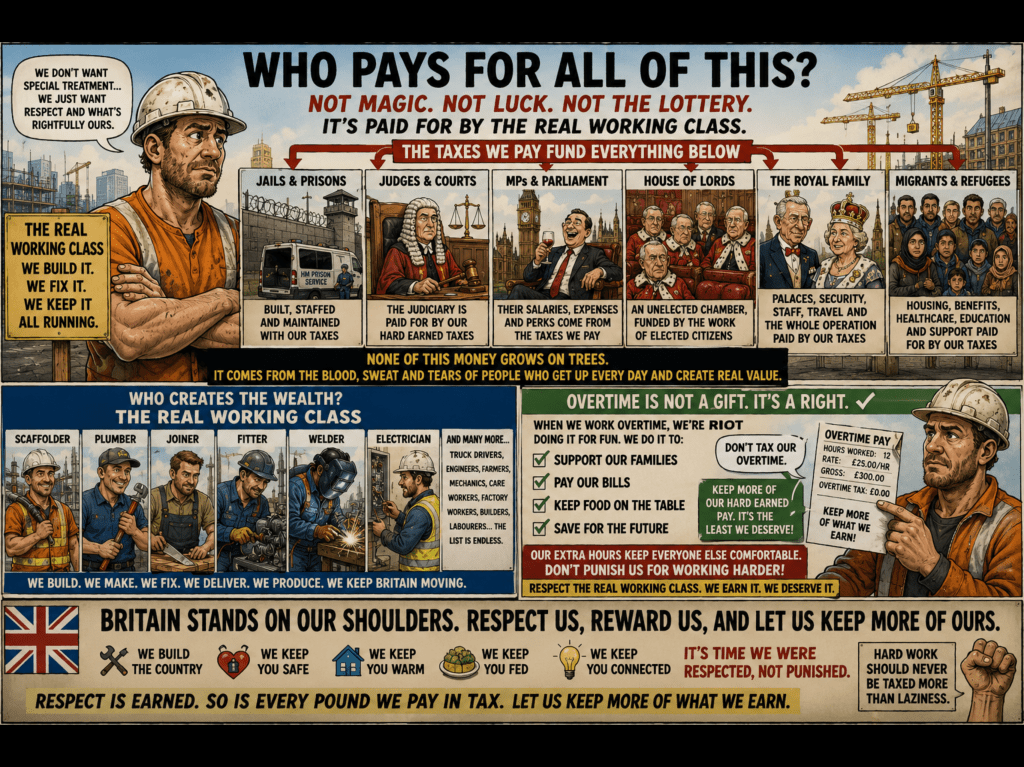
There’s something deeply backwards about a country that applauds hard work with one hand… while reaching into your payslip with the other. ⚒️📉
Because for millions of Britain’s tradesmen, builders, engineers, drivers, welders, fitters, plumbers, factory workers, and labourers — overtime isn’t some luxury hobby.
It’s sacrifice.
It’s exhaustion.
It’s missed evenings with the kids.
It’s another freezing morning on-site while most people are still asleep. ☕🌧️
And yet the harder these people work, the more the system seems determined to take from them.
🏗️ The Country Runs on Their Shoulders
This isn’t about creating division between workers.
It’s about remembering how the system actually functions.
Before governments can spend money on anything — whether it’s:
- Jails and prisons 🔒
- Judges and courts ⚖️
- MPs and Parliament 🏛️
- The House of Lords 👑
- The Royal Family 🇬🇧
- Civil servants 📋
- Public services 🚒🚓
- Migrant housing and support systems 🏨
…someone first has to go out into the real economy and generate the tax revenue that funds it all.
And that money doesn’t magically appear from Westminster press conferences. 💀
It comes from productive workers.
The people laying bricks.
Building roads.
Welding steel.
Fixing boilers.
Installing electrics.
Driving lorries.
Keeping factories running.
Maintaining infrastructure.
These are the people creating the real economic engine of Britain. 🛠️🔥
Without them, there is no tax base.
No salaries.
No institutions.
No government spending.
That’s not political ideology — it’s economic reality.
💸 So Why Punish Them for Working Harder?
Here’s the question millions are now asking:
If overtime means giving up more time, more energy, more physical wear and tear… why should the government automatically take an even bigger cut? 🤔
Especially when those extra hours are often worked to:
- Pay rising bills ⚡
- Support families 👨👩👧
- Cover mortgages 🏠
- Afford food 🥖
- Survive inflation 📈
Working overtime isn’t greed.
For many families, it’s survival.
And there’s growing anger that productive workers are constantly told they should “pay their fair share” while political elites spend public money like it’s Monopoly cash at a casino night. 🎰💷
⚒️ Overtime Is Earned the Hard Way
Nobody accidentally works overtime in heavy industry, construction, transport, manufacturing, or skilled trades.
Those hours are earned through:
- Physical strain
- Long commutes
- Dangerous environments
- Stress
- Fatigue
- Time away from family
That extra pay isn’t some “gift” from government.
It belongs to the worker who earned it in the first place.
And many now believe allowing people to keep more of their overtime pay isn’t generosity — it’s basic respect. 🏗️🇬🇧
Because the people carrying the country shouldn’t feel punished for carrying it harder than everyone else.
🧱 Britain Has Started Taking Its Builders for Granted
For decades, productive workers have watched entire layers of bureaucracy, administration, consultancy, and political management expand endlessly above them.
Meanwhile, the actual people keeping Britain functioning often feel culturally ignored, economically squeezed, and politically disposable.
Yet when there’s a crisis?
Who keeps the lights on?
Who delivers supplies?
Who fixes the infrastructure?
Who physically rebuilds the country?
The same working people who are now being told they should be grateful for keeping less of what they earn. ⚡
That’s why this debate cuts so deep.
Because it’s not just about tax.
It’s about dignity.
Respect.
Recognition.
And whether Britain still values the people doing the hardest jobs in society.
🔥Challenges🔥
Should productive workers be allowed to keep more of their overtime pay — especially when their taxes already fund the entire system around them? 💷⚒️
Has Britain forgotten who actually creates the wealth that keeps the country running?
And why does it often feel like the people doing the hardest physical work get the least respect from the political class? 🤔🔥
Drop your thoughts directly into the blog comments — especially if you work in trades, logistics, engineering, transport, manufacturing, construction, or skilled labour. We want the voices of the people actually carrying the country on their backs. 🗣️🏗️
👇 Comment, like, and share if you believe hard work should be rewarded — not punished.
The best reader comments and strongest opinions will be featured in the next magazine issue. 📰⚡


Leave a Reply