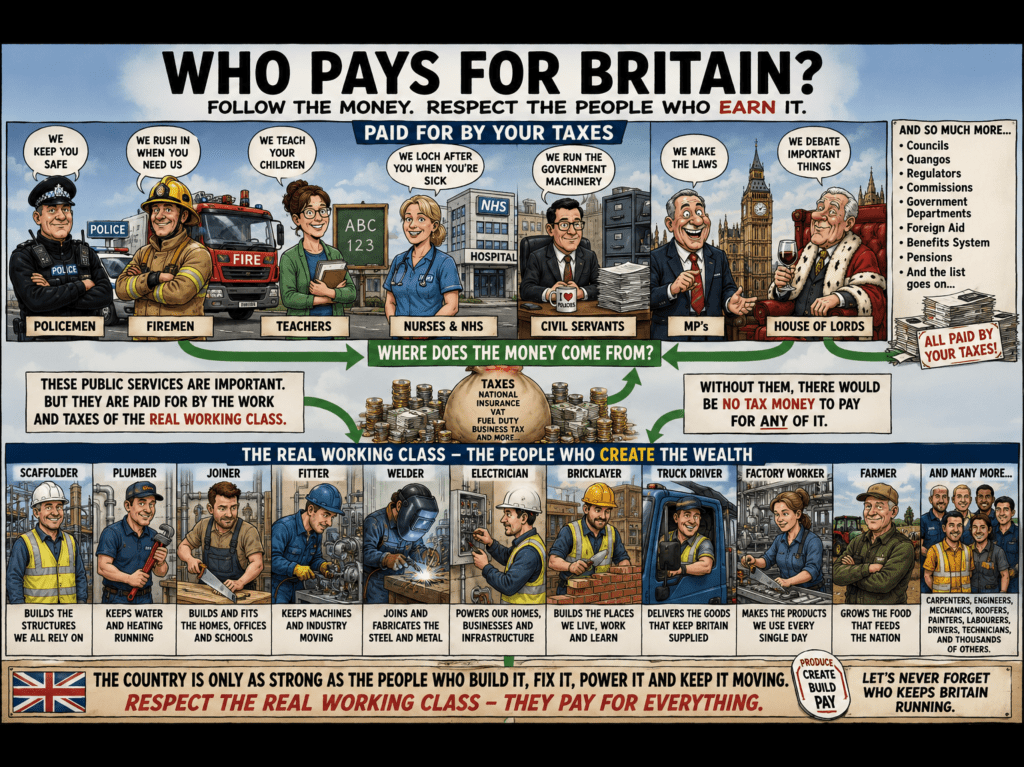
There’s a conversation Britain desperately needs to have — and no, it’s not about creating division between workers. It’s about remembering where the money actually comes from in the first place. 💷🏗️
Because somewhere along the line, the country forgot that before government can spend a single penny… somebody first has to go out into the real world and create that penny.
And usually, that somebody is standing in steel-toe boots at 6am. ⚒️☕
🧱 The Difference Between Producing Wealth and Spending It
This is not an attack on police officers, firefighters, nurses, teachers, or frontline public workers. Most people deeply respect what they do.
But there is a difference between sectors that generate wealth directly through production, construction, manufacturing, engineering, logistics, trades, and private enterprise… and sectors funded through taxation collected from that productive economy.
That distinction matters.
The scaffolder erecting buildings.
The welder fabricating steel.
The plumber fitting systems.
The joiner building homes.
The truck driver delivering goods.
The factory worker manufacturing products.
These are the people physically creating economic value that can then be taxed. 🏭💥
Without productive industry and skilled labour generating wealth, there is no tax pool to fund:
- Police salaries 🚓
- Fire services 🚒
- MPs and Parliament 🏛️
- Civil servants 📋
- Quangos and government departments 📑
- The House of Lords 👑
That’s not opinion. That’s how taxation and economic flow works.
💸 The Country Has Forgotten Who Carries the Weight
The frustration many working people feel is that the productive core of society is increasingly treated like an endless cash machine.
Every year the burden grows:
higher taxes, rising fuel costs, more regulations, more bureaucracy, more overheads.
Meanwhile, the people laying bricks in the rain or welding beams in freezing yards often feel looked down on by political classes who couldn’t wire a plug without forming a diversity committee first. 🔌📉
And again — this isn’t about blaming public-sector workers.
It’s about recognising economic reality.
A government salary ultimately depends on tax revenue.
Tax revenue depends on productive economic activity.
And productive economic activity comes from people building, making, transporting, repairing, inventing, and selling things people actually need.
That’s the engine room of the country. 🚂⚙️
🏛️ Too Many Politicians Talk Like Money Appears by Magic
Modern politics often speaks about public spending as though government itself “creates” wealth.
But governments redistribute wealth.
They manage it. Tax it. Borrow it. Spend it.
The actual creation of wealth happens in workshops, factories, building sites, warehouses, engineering firms, transport depots, farms, and small businesses across Britain. 🛠️🇬🇧
That’s why so many tradesmen and productive workers feel invisible.
Because the people carrying the economic structure increasingly believe they’re being treated as little more than funding mechanisms for an ever-expanding state.
🔥Challenges🔥
Has Britain forgotten who actually generates the wealth that keeps the entire system running? 🤔💷
Why do so many productive workers feel disrespected while bureaucracy and political classes continue growing larger every year?
And should the country place more value on the people physically building, repairing, manufacturing, transporting, and maintaining the nation itself? ⚒️🔥
Drop your thoughts directly into the blog comments — especially if you work in trades, construction, logistics, engineering, manufacturing, transport, or skilled labour. We want to hear from the people keeping Britain running while everyone else debates policy from heated offices. 🗣️🏗️
👇 Comment, like, and share if you believe Britain needs to reconnect with the people who actually create the nation’s wealth.
The strongest reader comments and best arguments will be featured in the next magazine issue. 📰⚡


Leave a comment