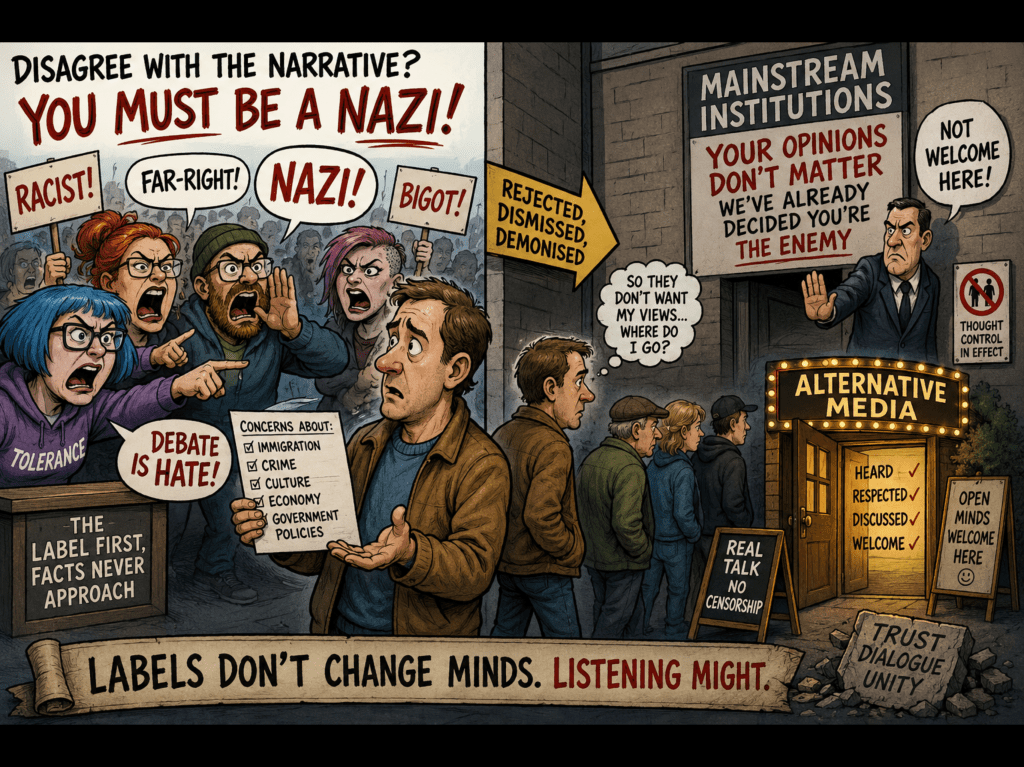
Political debate is supposed to be where ideas collide, arguments are tested, and citizens challenge those in power. Yet increasingly, it can feel like some discussions skip straight to the grand finale: accusations, outrage, and moral condemnation. ⚡
If someone raises concerns about immigration, crime, culture, taxes, public spending, or government decisions, there are times when the response isn’t an argument at all—it’s a label. “Racist.” “Far-right.” “Nazi.” End of discussion. 🚫🗣️
The problem? Most people don’t react to being insulted by suddenly agreeing with the person insulting them.
🚨 Congratulations! You’ve Just Manufactured More Distrust 🚨
Imagine walking into a conversation with a concern about your community, your job prospects, or the direction of the country. Instead of being challenged on the facts, you’re immediately informed that you’re apparently one goose-step away from invading Poland. 🤦♂️
For many ordinary voters, that experience doesn’t create enlightenment—it creates resentment.
The irony is almost painful. The people handing out these labels often believe they are defending democracy, tolerance, and open debate. Yet when every disagreement is treated as evidence of hidden extremism, the result can be the exact opposite. People stop listening. Trust evaporates. Institutions lose credibility. 📉
Words matter. Calling an actual extremist a Nazi is one thing. Calling half your neighbours Nazis because they disagree with government policy is something entirely different.
And when every political opponent is described as history’s greatest villain, eventually the vocabulary collapses under its own weight. If everyone is “far-right,” then nobody knows what “far-right” means anymore. 🎪
Meanwhile, those who feel dismissed begin searching elsewhere for voices willing to listen. Not because they’ve suddenly become extremists, but because they feel nobody in the mainstream is interested in hearing them.
It’s a political own goal of spectacular proportions. ⚽💥
🔥 Challenges 🔥
Here’s the uncomfortable question:
Are we winning arguments anymore, or are we simply assigning labels?
If millions of ordinary citizens feel ignored, mocked, or caricatured, does that reduce division—or deepen it?
Drop your thoughts in the blog comments. Tell us where legitimate criticism ends and unfair labelling begins. Can democracy survive if large groups of voters feel they are being talked about rather than talked to? 💬🤔
👇 Comment below, like, and share this article with friends who are tired of political shouting matches.
The sharpest comments, strongest arguments, and most thought-provoking responses will be featured in the next issue of the magazine. 📝🏆


 Chameleon Magazine
Leave a comment