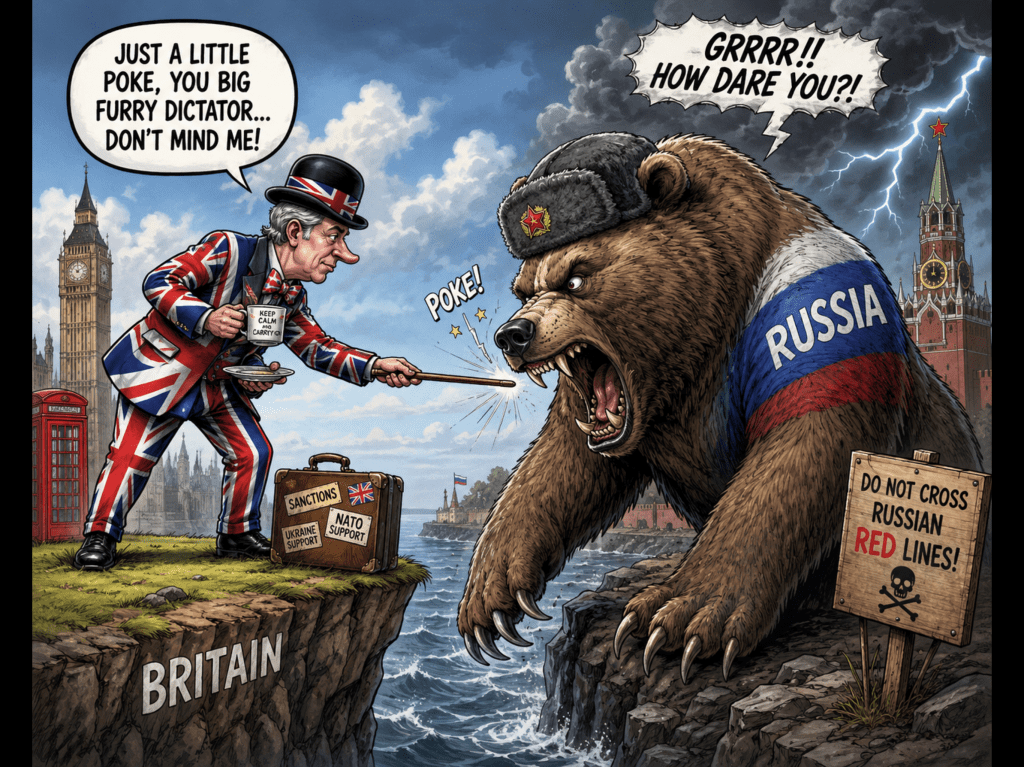
Britain’s defence debate is increasingly beginning to resemble a family argument conducted through a loudspeaker. One minister warns spending is too low, another raises concerns about readiness, while others appear on television insisting that all options remain under review. The result is a growing perception that the government is not speaking with one voice at all—but several competing ones simultaneously.
🎪 The Cabinet Choir That Forgot the Song Sheet
There was a time when governments at least attempted to look coordinated. Today, the challenge appears to be getting two ministers to finish the same sentence without contradicting one another halfway through it.
One day defence spending is an urgent priority. The next day it’s under consideration. Then comes another clarification, followed by another adjustment, followed by what Westminster politely calls a “change of position” and everyone else recognises as a U-turn wearing a fake moustache. 🤹♂️
The problem isn’t necessarily changing course. Sensible governments adapt when circumstances change. The problem is when policy starts looking like a shopping trolley with a broken wheel—lurching unpredictably from aisle to aisle while everyone nearby tries to avoid getting hit.
Businesses can’t plan. Departments can’t prepare. Voters can’t be certain what policy will exist next month. The immediate political fire might be extinguished, but each sudden course correction leaves behind another layer of uncertainty.
And nowhere is that uncertainty more uncomfortable than in defence.
Governments rarely advertise weaknesses in their own military capabilities. Yet public discussion is increasingly dominated by warnings about funding gaps, equipment shortages, recruitment struggles, and delayed programmes. Whether every concern is justified or not, the image being projected is hardly one of confidence. 🪖⚠️
From Moscow, the spectacle must look like Christmas arriving early. Russia’s propagandists barely need to invent narratives when Britain is publicly debating whether it has the resources, strategy, and political consensus to sustain its own commitments. Given the UK’s prominent support for Ukraine, mixed messages on defence can hardly be reassuring to allies—or discouraging to adversaries.
Meanwhile, British forces continue to find themselves engaged in a growing number of international commitments. Operations in the Channel, maritime security missions, support for allies abroad—the list continues to expand.
Supporters argue these actions protect British interests. Critics ask whether the government has adequately explained how all these commitments fit into a coherent strategy. If Britain is expected to do more overseas, voters naturally want reassurance that the resources exist to support those ambitions.
Instead, many are left watching a government that appears to be debating its own position in public while expecting everyone else to follow along.
The real danger may not be military weakness at all. Nations do not need to be weak to appear vulnerable. Sometimes confusion alone is enough. Mixed messages, shifting priorities, and public disagreements can create an image of uncertainty that rivals are only too happy to exploit. 🎯
In politics, perception often becomes reality long before reality has a chance to catch up.
🔥
Challenges
🔥
If ministers cannot agree on the message, how is the public supposed to understand the strategy? Is this healthy debate within government—or evidence of a leadership team constantly changing direction under pressure?
What do you think is more damaging: inadequate defence spending or the appearance of uncertainty surrounding it? 🤔💬
Drop your views in the blog comments and join the discussion.
👇 Like, comment, and share if you think government policy should come with indicators before the next political U-turn.
🏆 The best comments, strongest arguments, and sharpest observations will be featured in the next issue of the magazine.


 Chameleon Magazine
Leave a comment