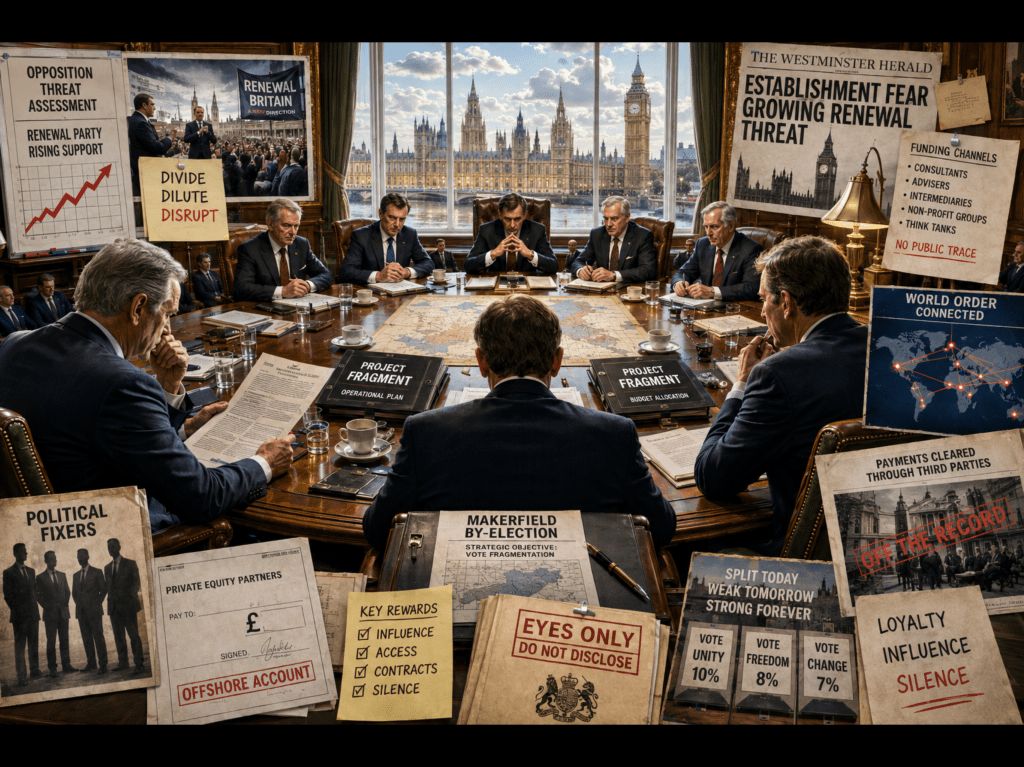
It is one of the oldest realities in politics. A government can survive declining popularity, difficult economic conditions, and even internal divisions if its opponents remain fragmented. The mathematics are simple. Two parties, conservatives and Labour competing for the same voters often weaken each other more effectively than any government campaign ever could. Votes that might otherwise combine into a single electoral challenge become scattered across competing banners, competing personalities, and competing visions. For any government facing a rising political threat like REFORM, drawing support from that threat to RESTORE would, at least in theory, be a welcome development.
There are rumours circulating around Westminster that the prospect of a future REFORM government has caused considerable concern amongst the political establishment. The whispers suggest that the fear is not confined to a single party but extends across the political spectrum. According to those who claim to have heard such discussions, the possibility of a political force emerging outside the traditional structures of power is viewed by some as a risk to a system that has remained largely unchanged for generations.
Naturally, none of this is ever discussed publicly. Politicians rarely comment on rumours, particularly those that imply common interests between parties that spend most of their time attacking one another. Yet people with knowledge, argue that this silence is precisely what makes the rumours so persistent. In their view, the absence of public discussion is not evidence against the theory but evidence that the subject is too sensitive to address openly.
As RESTORE works hard to unseat REFORM who is behind this new party a party that has the very same policies as REFORM. There are rumours that Rupert Lowe has been parachuted in to lead the destruction of REFORM. He first tried it from inside REFORM but was very quickly found out, so the next best thing was to create the new party.
The theory itself is remarkably simple. If a political movement cannot be defeated directly, then it may be weakened indirectly. Not through confrontation, but through fragmentation. Not by reducing support, but by dividing it. Throughout history, military strategists have understood the value of separating opposing forces before engaging them. According to those who subscribe to this line of thinking, politics is no different.
Whether these rumours are based on reality, coincidence, or imagination remains impossible to determine. Yet they continue to circulate through Westminster’s corridors, private gatherings, and political circles. Like all enduring rumours, they survive because they offer an explanation that some people find difficult to dismiss and others find impossible to believe.
The upcoming battle in Makerfield will tell whether their strategy has worked or not.
It has been rumoured that if it does work, more money will begin pouring into various factions and organisations. According to those who follow these theories, the funds will not move openly but will instead be filtered through a network of intermediaries, advisers, consultants, and political fixers. Some will be rewarded for their influence. Others will be rewarded for their loyalty. A select few, it is whispered, will be paid handsomely for their silence.
It is at times like these that the cogs of power begin to wind into action.
For many years, people have believed that there has always been a ruling body operating behind the scenes in secret boardrooms, funded by taxpayers yet somehow never appearing in the accounts. According to the theory, this influential body does not operate in a silo. Its reach extends far beyond national politics, with links stretching into the wider world order and a network of organisations, institutions, and interests that operate beyond public view.
If you are watching and hope to see this theory in action, then look closely at the final voting numbers that emerge from the upcoming by-election. Those who believe such things argue that the numbers will tell a story of their own, revealing whether the strategy succeeded and whether the machinery behind it is still working exactly as intended.


 Chameleon Magazine
Leave a comment