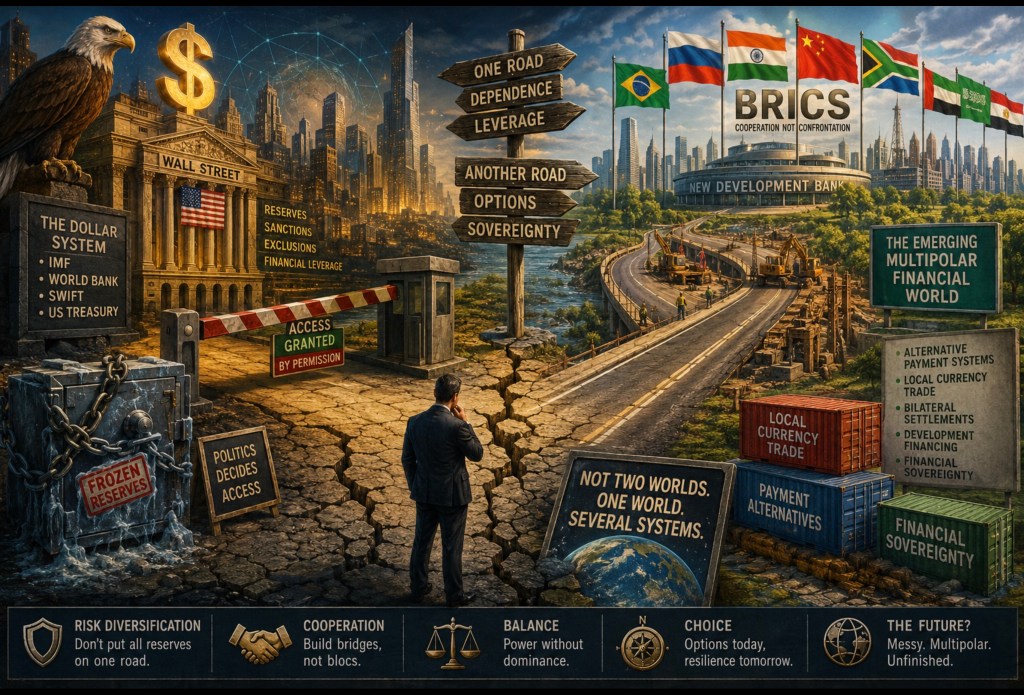
For decades, the US dollar was less a currency than the operating system of globalisation. Countries that agreed on almost nothing could still agree on one thing: dollars worked.
They bought oil with them, settled international trade with them and parked national reserves in dollar-denominated assets. The institutions surrounding that system—the IMF, World Bank and Western financial markets—became part of the plumbing of the post-war economic order.
But something is changing beneath our feet.
BRICS began as Brazil, Russia, India and China, with South Africa joining in 2010. Since then, it has expanded beyond the tidy little acronym dreamed up to describe emerging economies and developed into a political and economic coordination forum with annual summits, expanding partnerships and its own New Development Bank.
And behind all the summit photographs and diplomatic handshakes sits a rather awkward question:
What happens when countries decide they don’t want Washington holding the financial master key anymore? 🔑🌍
🌍 Welcome to the Financial Divorce Nobody Quite Wants to Call a Divorce
The fashionable word is “de-dollarisation.”
It sounds wonderfully dramatic—as though somebody is preparing to wheel the dollar out of the global economy on a hospital trolley.
That isn’t happening.
The dollar remains enormously important. BRICS has not replaced it. Nor has BRICS replaced the IMF, the World Bank or the wider Western financial system.
And BRICS itself is hardly one big geopolitical cuddle. China and India have serious strategic differences, while the wider membership contains countries with very different economic systems, alliances and national interests.
So this isn’t NATO with a different flag. Nor is it the European Union with more spices.
It is something considerably messier—and perhaps more important.
Countries are experimenting with trading in national currencies, alternative settlement arrangements, development financing outside traditional Western institutions and mechanisms that could reduce their vulnerability to decisions made in Washington, Brussels or other Western capitals.
Why?
Because the dollar didn’t exactly divide the world.
The weaponisation of access to the dollar-centred financial system helped convince parts of the world that they might need another one.
For decades, dollar dominance was enormously useful. It gave international commerce a common language. Two governments that wouldn’t trust each other with the office stapler could still conduct business in dollars.
Then geopolitics entered the bank vault. 🏦
Sanctions, restrictions on financial institutions, frozen reserves and exclusion from parts of international payment infrastructure demonstrated an uncomfortable reality:
Money sitting in the global financial system isn’t quite the same thing as money sitting under your mattress.
Access matters.
Jurisdiction matters.
Politics matters.
And other governments noticed.
Russia’s experience following its invasion of Ukraine dramatically accelerated the conversation. China hardly needed binoculars to see what was happening. Neither did governments elsewhere wondering what might happen if one day they found themselves on the wrong side of Washington.
The calculation doesn’t require anybody to adore Moscow or Beijing.
It requires only a finance minister capable of asking:
“Should we really have only one road?”
If one country exercises enormous influence over the motorway, countries with enough money, motivation and concrete mixers will eventually start discussing a bypass. 🚧
That is where BRICS becomes more interesting than another annual diplomatic photograph featuring twenty-seven people desperately trying to remember where the camera is.
The bigger story isn’t necessarily BRICS itself.
It’s the appetite BRICS represents.
An appetite for options.
For alternative lenders.
For different payment channels.
For bilateral trade conducted without automatically reaching for dollars.
For a financial world where losing access to one system doesn’t mean losing access to the world.
And there is a magnificent historical irony buried in all this.
The United States gained extraordinary geopolitical power because everybody wanted dollars and access to the system surrounding them.
But the more that access becomes associated with geopolitical leverage, the greater the incentive for potential targets to insure themselves against it.
In other words, one of the greatest dangers to the long-term exclusivity of dollar power could be using dollar power too successfully.
That’s not the same as announcing the death of the dollar.
Reports of its funeral have been circulating for decades, and the corpse continues stubbornly turning up for work. ⚰️💵
Nor should anybody imagine that BRICS is about to unveil some magical golden super-currency and send Wall Street screaming into the Hudson.
Building an alternative financial architecture is extraordinarily difficult.
You need liquidity, trusted institutions, enormous markets, legal certainty, convertibility, payment infrastructure and—perhaps most inconveniently of all—countries willing to trust one another.
And trust isn’t exactly available by the barrel at BRICS summits.
China and India alone demonstrate why predictions of a perfectly unified anti-Western financial bloc should be treated with caution.
But perhaps we’re looking for the wrong revolution.
Maybe the future isn’t:
Dollar system OUT. BRICS system IN.
Maybe it’s far untidier.
Dollar settlement here.
Yuan settlement there.
Rupees somewhere else.
Bilateral currency arrangements.
Regional payment networks.
Western institutions operating alongside alternative development banks.
Different financial rails for different geopolitical relationships.
Not two worlds.
One world running several financial operating systems simultaneously. 🌐
And that brings us back to the wider Dog Days.
Wars have returned to Europe and the Middle East. Nations are rearming. Alliances are shifting. Great-power competition has returned wearing a fresh suit and carrying hypersonic missiles.
Yet underneath the tanks, summits and sanctions lies another battlefield receiving far less attention:
the architecture of money itself.
The international financial order constructed in the aftermath of the Second World War isn’t disappearing tomorrow morning.
But cracks are appearing.
Countries that once simply accepted the Western-dominated financial architecture as the price of participating in the global economy increasingly appear interested in having a Plan B.
And then perhaps a Plan C.
That may ultimately prove more consequential than any imaginary BRICS currency.
Because empires don’t necessarily lose influence when somebody destroys their road.
Sometimes they lose it when everybody quietly starts building alternative routes around the toll booth. 🛣️💰🌍
🔥 Challenges: Is America Accidentally Building BRICS for Them?
Here’s the uncomfortable question: has Western financial power been used so aggressively that it is creating the incentive for rival systems to emerge?
Or is all the BRICS excitement mostly geopolitical theatre—grand speeches, impressive summit photographs and a collection of countries whose competing interests will prevent them from ever seriously challenging dollar dominance?
And if the world really is moving towards several competing financial systems, does that make countries safer from financial coercion—or simply make an already fractured planet even harder to hold together? 🤔
We want your verdict on the blog, not disappearing into the Facebook wilderness.
👇 Comment. Like. Share. Challenge the argument. Tell us whether BRICS is building the future—or merely building a very expensive bypass nobody will use.
The best comments, counterarguments and financial truth bombs will be included in the magazine. 🎯📰


Leave a comment