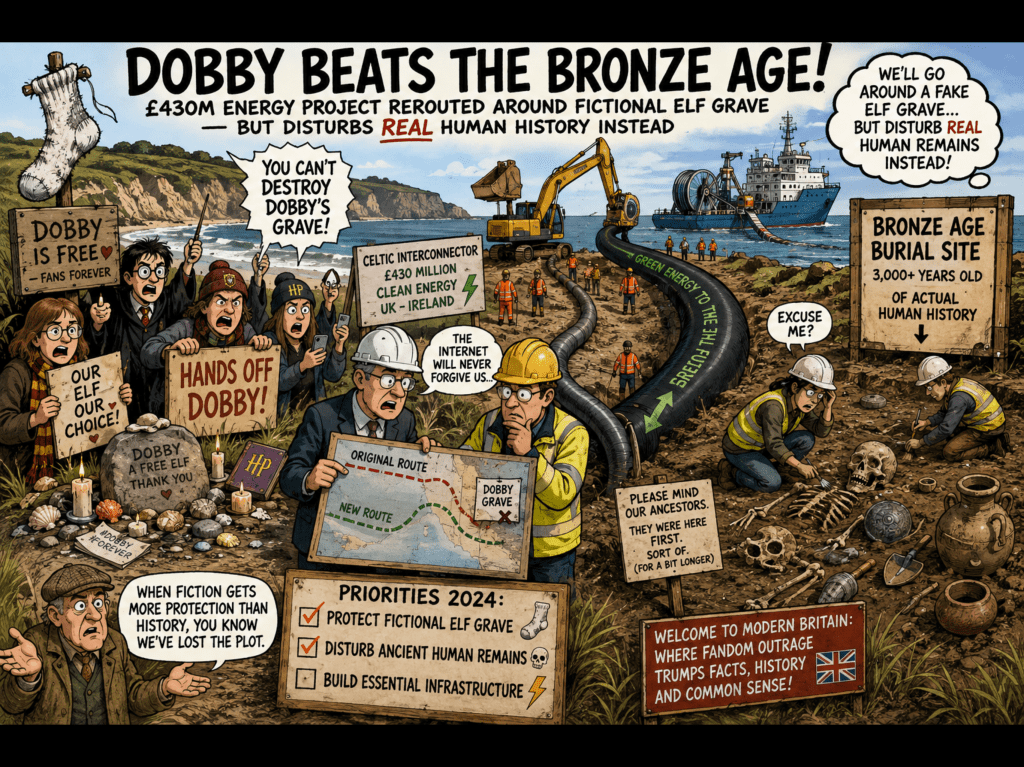
A £430 million electricity interconnector between Wales and Ireland reportedly found itself navigating an extraordinary clash between pop culture, archaeology and infrastructure planning. Concerns surrounded the route near Freshwater West, famous among Harry Potter fans as the location associated with Dobby’s grave. Meanwhile, archaeological work connected with the project uncovered Bronze Age remains elsewhere along the route. The result is irresistible modern Britain: a vital energy project, an unofficial memorial to a fictional house-elf, and very real ancient history all competing for attention.
🧙 Fictional Elves, Real Ancestors & the £430 Million Detour ⚡
Imagine explaining this planning meeting to somebody from the Bronze Age.
“Good news: humanity survives for another 3,000 years. We invent electricity, undersea cables and an international power grid.”
“Wonderful!”
“Bad news: we may become considerably more emotionally invested in the resting place of an imaginary elf.” 🧦
Welcome to infrastructure planning in the age of fandom, where absolutely everything risks becoming a cultural battlefield.
Dobby, for anyone fortunate enough to have escaped the Potter cinematic universe, is fictional. Beloved? Certainly. Heroic within the story? Absolutely. Real archaeological remains?
Not so much.
Yet an unofficial memorial associated with the character became important enough to generate substantial public concern over protecting the site.
Meanwhile, the earth beneath our feet contains something rather less fictional: thousands of years of actual human history. 🏺💀
That’s what makes this saga such perfect satire.
We have reached a peculiar cultural moment where disturbing somewhere associated with a movie character can potentially generate enormous online outrage, while genuine archaeological discoveries struggle to produce anything approaching the same emotional mobilisation.
Perhaps archaeology simply needs better marketing.
“BRONZE AGE BURIAL SITE — AS SEEN IN THE HIT FRANCHISE: ACTUAL HUMAN CIVILISATION.” 🎬
Give the ancient inhabitants merchandise, a hashtag and a limited-edition commemorative sock and perhaps they’ll finally stand a chance.
None of this means archaeological remains can simply be bulldozed, of course. Major infrastructure projects routinely involve surveys, archaeological investigation, environmental assessments and route changes. Nor does affection for the Dobby memorial automatically make Potter fans ridiculous.
The absurdity lies in the hierarchy of public attention.
We can mobilise thousands of people around something invented by a novelist, recreated by filmmakers and memorialised by fans — while objects representing people who genuinely lived, worked and died thousands of years ago can remain largely invisible outside archaeological circles.
And somewhere in the middle sits a £430 million energy project attempting to connect two countries while navigating planning rules, environmental sensitivities, archaeology and the unstoppable force of internet fandom. ⚡🌊
You couldn’t write it.
Actually, apparently you could.
J.K. Rowling just needed to add an electricity interconnector to the final chapter.
🔥 Challenges 🔥
So here’s the question: have we completely scrambled our cultural priorities?
Should major infrastructure ever be rerouted because the public has become attached to an unofficial memorial for a fictional character? Or is protecting places people genuinely care about simply part of responsible planning — regardless of why they matter?
And here’s the uncomfortable bit: why can fictional history inspire louder public passion than the real history buried underneath us? 🏺🧦
👇 Don’t just argue about it on Facebook. Come to the blog and leave your verdict. Comment, like and share — Potter fans, archaeology buffs and infrastructure planners are all invited into the firing line. 💬🔥
The best comments, counterarguments and spectacularly sarcastic takedowns will be included in the magazine. 🎯📰


Leave a comment