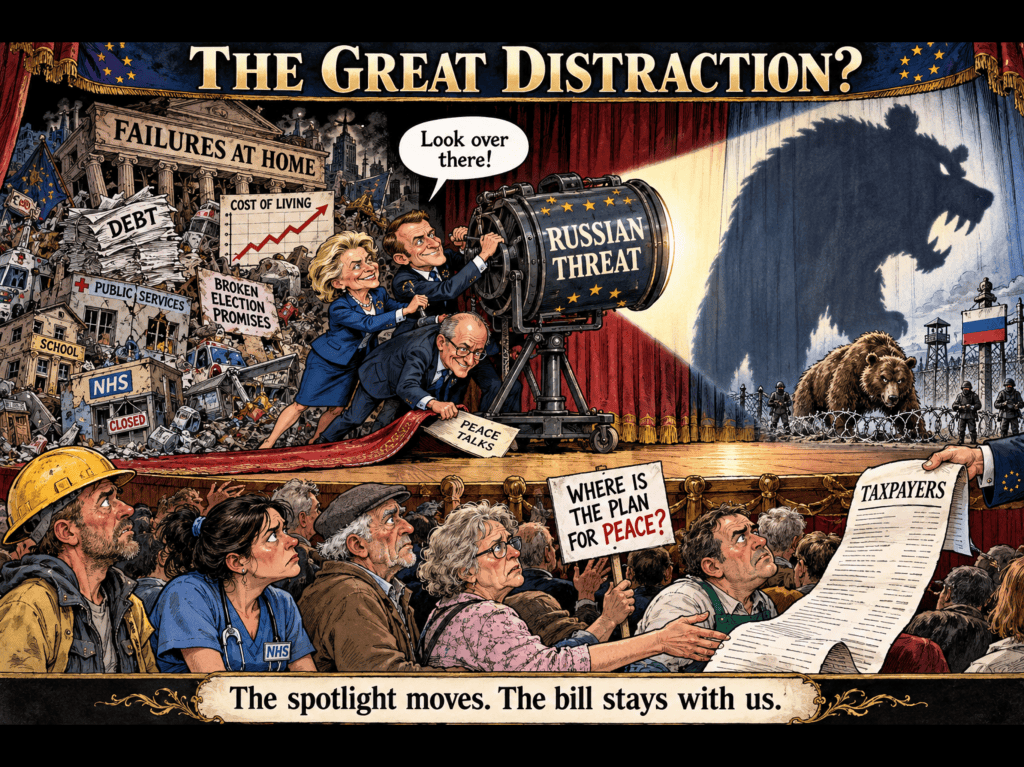
An external enemy is a remarkably convenient thing for a government struggling to explain itself. Questions about living standards, public services and political competence can suddenly be pushed aside by a much bigger announcement: national security.
Yesterday, you wanted to know why your government could not make things work. Today, you are asked to stand behind it.
That does not prove European leaders are deliberately engineering a war with Russia. Europe consists of different governments with different interests, and suspicion is not evidence. But citizens are entitled to ask whether their leaders are working hard enough to prevent a wider conflict—or becoming comfortable with the political distraction it provides.
Russia’s security concerns did not appear from nowhere. Declassified records show that Western leaders gave Soviet officials assurances about NATO’s eastward movement during negotiations over German reunification. Those assurances never became a binding prohibition on all future enlargement, but dismissing the entire history as fantasy is hardly a serious way to rebuild trust. (nsarchive.gwu.edu, nato.int)
Russia’s invasion of Ukraine also cannot be erased from the argument. Ukraine has borders and security concerns of its own. Understanding Moscow’s fears does not require accepting that its neighbours must surrender their independence. (nato.int)
The uncomfortable question is what happens next. Can Europe defend its citizens while pursuing a settlement, or does every confrontation become another reason to postpone diplomacy?
Estonia is moving forces closer to Russia and acquiring weapons capable of striking deep into Russian territory. Its officials describe this as preparation against possible aggression. But the danger is clear: one government’s defensive preparation can become another government’s justification for further escalation. Each side announces that it is making itself safer while the space for error grows smaller. (ft.com)
Meanwhile, the taxpayer is expected to fund the policy and trust the judgment. If costs rise, there is an enemy to blame. If domestic promises slip, there is an emergency to explain it. If voters ask awkward questions, there is always the temptation to question their loyalty instead of answering them.
None of that requires a secret meeting where politicians agree to start a war. The more plausible danger is that leaders discover confrontation is politically useful and lose their appetite for compromise. They can drift towards disaster while describing every step as necessary.
Peace talks are still taking place, according to current reporting. That matters. But the public deserves to know what achievable outcome its own leaders support, what compromises they would consider and how their military decisions serve that outcome. (reuters.com)
Defence is a responsibility. So is diplomacy. A government demanding sacrifice should be able to explain how the fighting ends, rather than merely describing how it might expand.
Is Europe picking a fight to distract us? That intention has not been established. But allowing a confrontation to become a permanent excuse for failures at home deserves scrutiny.
The people who will pay for another war—and whose children may fight it—have every right to demand more than flags, speeches and another warning.
Show us the plan for peace. And answer for the failures at home.


Leave a comment