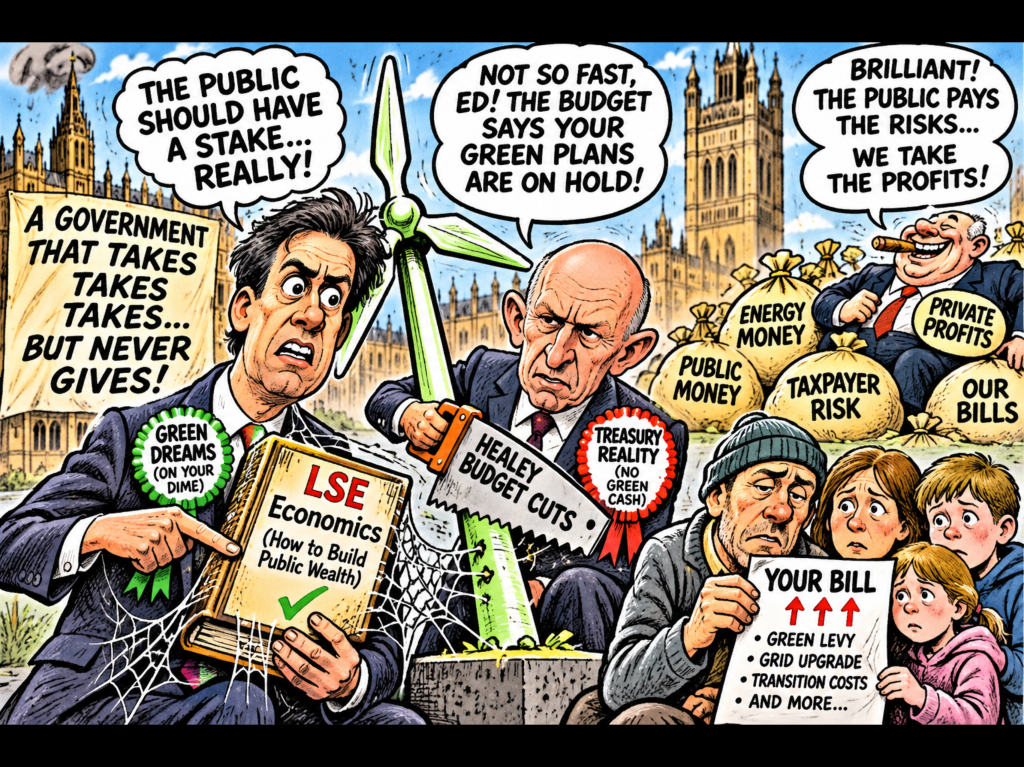
⚡💸Ed Miliband studied economics at the London School of Economics, so you’d think the man might be familiar with the radical concept of “getting something back when you pay for something.” Yet when taxpayers are asked to bankroll Britain’s energy infrastructure, the public too often gets the bill, the risk, the surcharge, the standing charge, the levy, the lecture — and then a polite invitation to applaud while someone else collects the dividends. 🎓📉
Miliband previously held the Energy Security and Net Zero brief from July 2024 to July 2026, while John Healey’s recent budget direction has been reported as shifting emphasis away from clean-power ambitions and cutting into green heating plans, leaving Miliband’s personal green crusade looking like it has been mugged in a Treasury corridor.
🧾 Ed’s Economics Degree Meets the National Collection Tin
Here’s a wild idea from the forbidden scrolls of common sense: if the public pays to build the energy system, the public should own a stake in it. Not just a fridge magnet saying “Thank you for your sacrifice,” not another glossy government PDF with wind turbines on the cover, but actual ownership, dividends, or a share of the profits. 💷🌬️
Because right now, it feels less like national renewal and more like a direct debit wearing a hi-vis jacket.
Taxpayers are endlessly told to “invest in the future,” which apparently means coughing up today so private operators, consultants, funds, and infrastructure giants can enjoy tomorrow. We shoulder the risk, underwrite the transition, pay the bills, absorb the policy wobble, and then stand outside the profit party like we forgot the password. 🏭🚪
And Ed, mate — this is where the LSE economics degree is supposed to kick in. If the people finance the grid, the wind farms, the cables, the upgrades, and the grand green machinery of tomorrow, then the people should not be treated like an ATM with voting rights.
Public money should buy public equity. Public risk should earn public reward. Public funding should mean public ownership, public dividends, or at the very least a public share in the profits. Anything less is not vision. It is a very expensive group project where the taxpayer does all the work and someone else gets the certificate. 🏆🤡
Then along comes John Healey, apparently parking a Treasury tank on Ed’s flowerbed of green ambitions. Reports suggest Healey’s budget choices have cut into green heating plans and shifted energy policy toward cost-cutting and defence pressures — which means Ed’s grand eco-symphony is now being performed on a kazoo in the basement. 🎺🔥
So now the taxpayer gets the worst of both worlds: asked to pay for the green transition, while watching the political class argue over whether the transition is too expensive, too slow, too ambitious, or just a convenient piggy bank whenever another department starts rattling the tin.
This is not how public investment should work. This is how you fleece a nation in instalments and call it “strategy.”
🔥 Challenges🔥
Here’s the question: why should taxpayers fund the infrastructure, carry the risk, and then be denied a proper stake in the rewards? If our money builds the system, why shouldn’t we get dividends, ownership, or a public profit share? 💬⚡
Drop your take in the blog comments — should energy infrastructure funded by the public belong partly to the public, or are we just expected to keep feeding the meter while others cash the cheques?
👇 Comment, like, and share if you think public money should come with public ownership — not another invoice dressed up as progress.
The best comments will be included in the magazine. 📝🔥


Leave a Reply