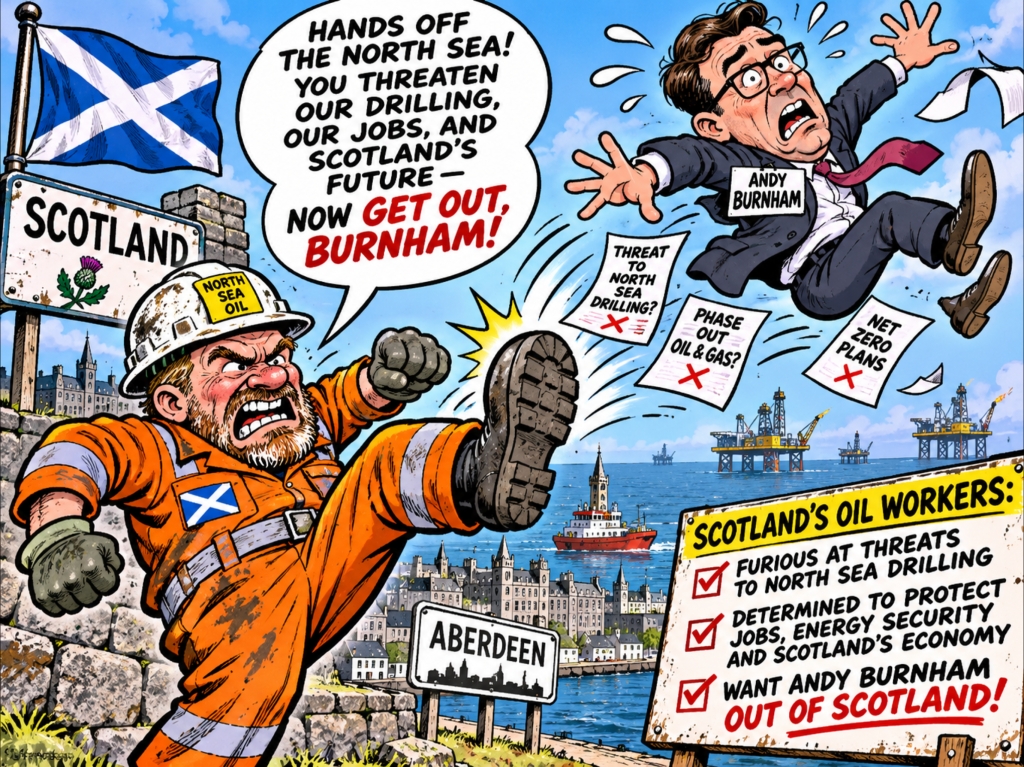
If the Labour government intends to close the door on new North Sea exploration, it faces a question that no amount of green rhetoric can answer: who will compensate Scotland for the economic opportunities that may be lost?
Prime Minister Andy Burnham’s government introduced its Energy Independence Bill on 4 November 2026, proposing to prevent new licences for exploring previously undeveloped North Sea oil and gas fields.
Existing licensed fields can continue operating, and some additional production near established infrastructure would remain possible. But the long-term investment implications for Aberdeen and Scotland’s offshore supply chain deserve serious scrutiny.
💷 Westminster Writes the Policy — But Does Aberdeen Get the Bill?
Imagine telling a business owner that future opportunities are being restricted for the greater good, then handing them a glossy brochure about exciting possibilities sometime in the next decade.
“Don’t worry about your engineers, your apprentices or your mortgage. The future is green!”
Wonderful. But the bank manager doesn’t accept environmental ambition as a mortgage payment. 🏦
Andy Burnham has spoken about revitalising British industry and taking a pragmatic approach to North Sea resources. Now his government faces a test of how those promises translate into investment, jobs and opportunities for Scotland.
The government promises a £2 billion Energy Wealth Fund and support for workers moving into new industries. But the unanswered question is whether those measures can adequately address any economic losses arising from the licensing restrictions.
And the potential losses cannot simply be assumed. North Sea production has been declining for decades, while future discoveries, operating costs, oil prices and tax revenues are uncertain.
That makes a credible, independently assessed economic impact study essential.
🔥 Challenges: Should Political Leaders Be Held Accountable for the North Sea’s Future?
The argument isn’t just about oil. It’s about whether political promises come with measurable financial responsibilities.
Before the government proceeds, Scotland deserves clear answers.
💷 What is the estimated value of investment, employment and tax revenue potentially affected by the restrictions?
🛢️ What proportion of that opportunity would realistically be recoverable, given the North Sea’s natural decline?
🏭 What specific employment and investment guarantees will protect Aberdeen and its offshore supply chain?
🌱 How will the government ensure replacement industries provide comparable wages, skills and long-term opportunities?
🥾 What political accountability should follow if those commitments are not delivered?
If Westminster controls the policy, Westminster must be prepared to explain its consequences.
The government argues that new licensing would not reverse declining North Sea production and that moving towards cleaner energy offers long-term benefits. Industry representatives warn that losing existing supply chains could undermine Scotland’s ability to develop those very industries.
Both arguments need to be tested against evidence, not slogans.


Leave a Reply