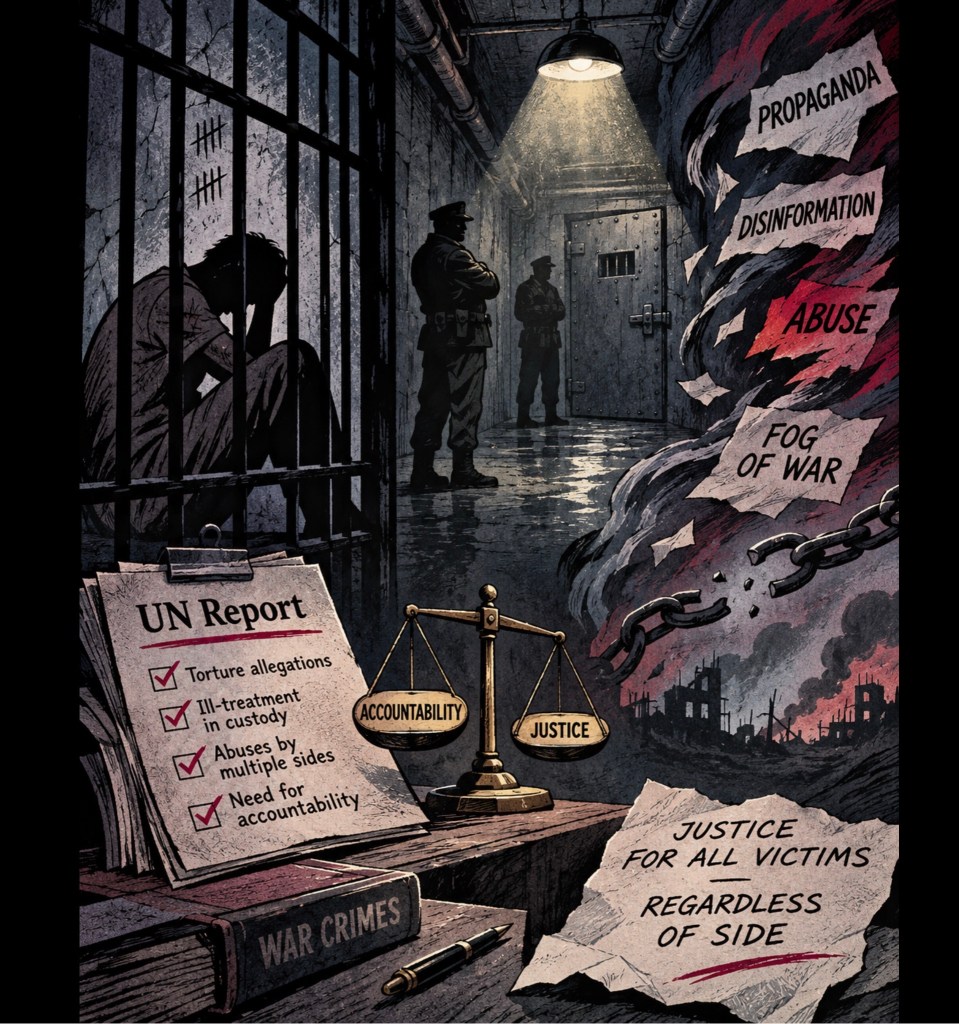
The United Nations has delivered findings that deserve more than a diplomatic cough and an awkward change of subject. In its report published on 29 June 2026, the UN confirmed that more than half of the Russian prisoners of war interviewed reported torture or ill-treatment while in Ukrainian custody, primarily during capture and transfer.
Previous investigations documented beatings, electric shocks, sexual violence and deaths in custody. One Russian prisoner died following torture at a Ukrainian transit facility, while investigators examined two further reported deaths.
Meanwhile, allegations of a secret torture prison near Kyiv erupted across social media in November 2026. The problem? The most sensational claims, including secret torture chambers, deaths and a detained child, remain unsupported by independently verified evidence. Some circulating videos have been identified as fabricated or misleading.
Two stories. Two different levels of evidence. And one rather inconvenient principle: the Geneva Conventions don’t come with a friends-and-enemies discount card.
🎭 The Geneva Convention Isn’t a Loyalty Card — You Can’t Collect Points for Torturing the Other Side
Welcome to modern warfare, where apparently even human rights need a public relations department.
For some commentators, allegations against an enemy are treated as gospel before the ink has dried. Allegations against an ally? Suddenly, everyone becomes a forensic scientist demanding DNA samples, satellite imagery and a signed confession witnessed by three archangels. 🔬
But here’s the uncomfortable reality.
The UN has documented torture and ill-treatment by Ukrainian personnel. It has also documented widespread and systematic torture of Ukrainian prisoners in Russian captivity, along with executions and sexual violence.
These findings are not interchangeable, nor do they establish identical patterns or scales of abuse. They do, however, establish that accountability cannot depend on the nationality of the victim.
And then there’s the November incident near Kyiv.
On 2 November, protesters gathered outside a building used by Ukraine’s National Guard following allegations that people were being unlawfully detained and tortured. Authorities acknowledged that soldiers were being held at the site and that four injured servicemen received medical attention. They disputed claims of hostages and deaths.
That deserves scrutiny. But scrutiny isn’t the same thing as declaring every viral accusation proven.


Leave a Reply